The build vs. buy debate for AI voice usually settles into a familiar frame: cost on one side, control on the other. That frame hides the decision that actually determines whether the system works.
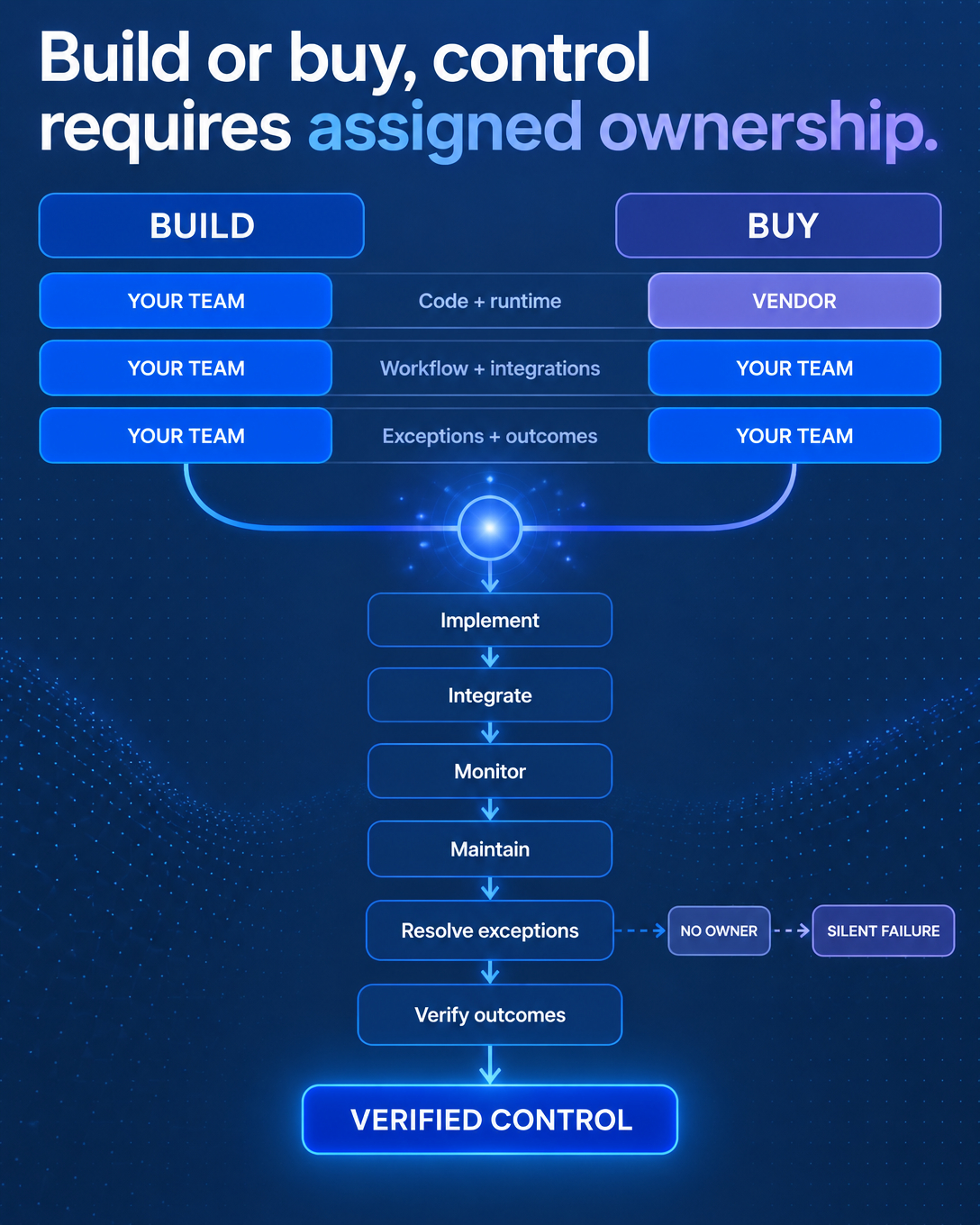
The decision is ownership. Someone has to own implementation, integrations, monitoring, maintenance, and exceptions. That ownership has a price measured in time, and it exists under both options.
A custom build gives you control over the code. A commercial application gives you control over the workflow. Neither gives you control if nobody is assigned to own exceptions.
Control Over Code Is Smaller Than It Looks
Teams that choose to build expect to spend their engineering effort on the voice experience. The budget tells a different story. Integration work with your CRM, databases, and existing workflows accounts for 40 to 60 percent of the engineering effort in AI voice projects.
Most of your build budget goes to plumbing. The plumbing produces no differentiation. It produces an obligation: every connected system you touch becomes a system you maintain.
The maintenance load is specific and recurring. A custom system costing $200,000 requires $30,000 to $40,000 annually for patches, dependency updates, and performance tuning. That figure assumes someone owns the work. When nobody does, the cost shows up later as outages and silent data drift.
Technical debt compounds the problem. Engineering surveys show developers spend 20 to 40 percent of their time on debt instead of new capability. In one McKinsey study, 87 percent of CTOs named technical debt their top impediment to innovation.
Buying Transfers the Code. The Workflow Stays With You
A commercial application removes the code ownership question. It leaves the workflow ownership question fully intact.
Your vendor runs the runtime. Your team still owns the calling job definition, the CRM mapping, the review of call outcomes, and every exception the system surfaces. A failed booking, a missing record, a call that ended without a verified next step. That work lands somewhere, and the contract rarely names the person.
Hidden costs make this concrete. In AI voice deployments, hidden costs equal or exceed platform subscription fees once you count integration, training, and ongoing maintenance. Implementation support typically sits outside pay-as-you-go plans.
This is commonly overlooked in procurement. The quote covers minutes and platform access. The operating cost covers people reviewing calls, correcting records, and handling exceptions. Both belong in the same budget.
Exceptions Are Where Ownership Gets Tested
Execution that cannot be traced is theater. The trace matters most when something fails, because a failed action without an owner becomes a false completion in your pipeline.
Unstructured exception handling leads to manual intervention, delayed decisions, and reduced visibility. Effective systems detect exceptions, assign ownership, and trigger notifications. That only works when responsibility is defined before the process is built.
Apply that standard to both options:
- Build: Who owns the integration when your CRM changes its API. Who owns monitoring at 2 a.m. Who owns the regression test after a model update.
- Buy: Who owns the exception queue. Who reconciles claimed bookings against the calendar record. Who accepts or rejects a qualified meeting.
Write the names down before you sign anything. An unowned exception path fails quietly, and quiet failures are the expensive kind.
Run the Decision as an Ownership Audit
Here is a cleaner process than the cost spreadsheet alone.
1. Define the calling job in one sentence. Who gets contacted, why the contact is permitted, what the agent accomplishes, and what a person does next.
2. List every ownership role. Implementation, integrations, monitoring, maintenance, exception handling, outcome acceptance. Six roles, each with a named person and an estimated weekly time cost.
3. Price the time under both options. For the build, include the 40 to 60 percent integration share and the annual maintenance figure. For the purchase, include review time, exception handling, and anything the quote excludes.
4. Reject any option with an unowned role. If a role has no name next to it, the option is incomplete regardless of its price.
A poor build vs. buy decision increases total costs by two to five times over three to five years when operational overhead is underestimated. The underestimate almost always lives in the ownership column.
Control Is a Staffed Function
You get control of an AI voice system by assigning people to own its outcomes and giving them the evidence to verify each one. The code can be yours or the vendor's. The workflow can be configured or custom. The ownership has to be explicit either way.
Choose the option whose ownership load your team can actually carry. Then hold it to the same acceptance evidence you would demand from a human caller.