
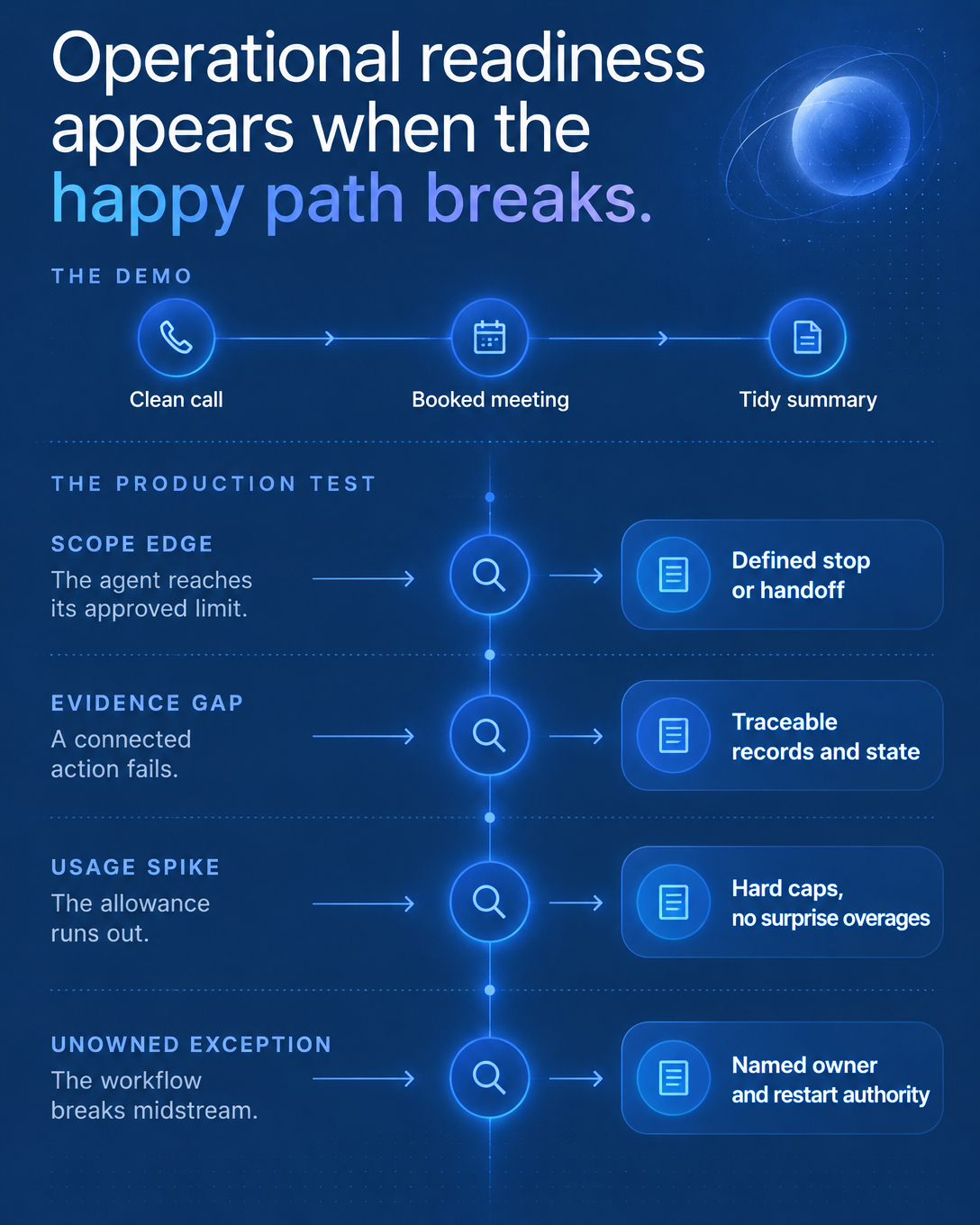
A product demo answers the questions you brought into the room. It shows a clean call, a booked meeting, and a tidy summary. The purchase decision depends on a different set of questions, the ones that only surface three months into production when a connected action fails and nobody knows who owns the cleanup.
You can ask those questions before you sign. This article gives you a structured list, organized around four areas: application fit, evidence availability, budget predictability, and exception ownership.
Start With Application Fit
Define the calling job in one sentence before any vendor conversation. Who gets contacted, why the contact is permitted, what the agent should accomplish, and what a person does next.
Then ask the vendor to price and demonstrate that configuration. A quote for an inbound receptionist tells you nothing about a sales qualification campaign. Capabilities share a foundation. The applications built on them carry different policies, handoffs, and outcomes, and your evaluation should treat them separately.
Questions to ask:
- Which specific workflow is enabled for this quote, and what sits outside it?
- What does the agent do when it reaches the edge of its approved scope?
- Can the same platform run a second application without inheriting the first one's rules?
Demand Evidence, Not Summaries
Execution you cannot trace is theater. After the demo, ask which call artifacts your team can actually review: recordings, transcripts, outcome records, and the state of every connected action.
Artifact availability depends on configuration. Confirm what your specific workspace retains before you design your review process. Retention gets complicated fast. A recording deleted after 90 days still leaves behind a transcript, a sentiment score, and a CRM summary, and each needs its own retention rules.
Procurement teams now treat this as standard. The G2 2025 Buyer Report found that 80% of enterprise AI purchases face stricter scrutiny from security, legal, and compliance teams than they did 18 months ago.
💡 Tip: Ask the vendor to show you a failed call in the evidence system, including what your reviewer sees and what stays hidden.
Make the Budget Predictable Before It Exists
The advertised per-minute rate rarely covers the full stack. An advertised $0.07 per minute often covers only the orchestration layer, with telephony, text-to-speech, and speech-to-text billed separately, and overage rates that spike 20 to 50 percent higher than the bundled rate.
The question that matters most is behavioral: what happens when the minute allowance runs out? Some systems stop. Others keep billing. You want hard constraints in writing: spend caps, reserved quotas, and no automatic overages. A system that fails closed protects your budget. A system that fails open protects the vendor's revenue.
Also confirm what counts as billable. Many platforms charge for ringing, hold time, and silence, and some continue the billing clock after a call transfers to a human. Failed calls, including voicemails and wrong numbers, can represent 20 to 40 percent of outbound attempts, each potentially carrying minimum charges.
Assign an Owner for Every Exception
This is the question demos are least prepared for. When a calendar connection fails mid-call, when a booking reports success without a record, when a contact asks to never be called again, someone has to own the resolution.
Exception handling determines whether a disruption gets resolved cleanly or cascades through your pipeline as silent data loss. At scale, routing every failure to an administrator stops working. The question for the vendor is specific:
- When a connected action fails, does the system report an unresolved state or a false completion?
- Who gets notified, through which channel, and with what evidence attached?
- Which failures stop the campaign automatically, and who can restart it?
⚠️ Warning: A system that reports a failed booking as complete will corrupt your pipeline reporting quietly. Test this scenario before purchase, with a deliberately broken connection.
Bring the List to the Demo
Write your answers into the contract conversation. Record each item as included, separately billed, not required, or unresolved, and give every unresolved item a named owner and a deadline.
The vendors worth buying from welcome this process. Their systems were built for inspection, and the questions give them a chance to prove it. The vendors who deflect have told you something useful too.
You are buying a layer where conversation becomes commitment. Hold it to the standard that commitments require: traceable evidence, predictable cost, and a named owner for everything that breaks.