
Your AI voice agent says "your meeting is confirmed for Tuesday at 10." The transcript reads clean. The caller sounded satisfied.
Then you open the calendar. There is no event.
That call did not succeed. It produced an unresolved result, and your review process should label it exactly that way.
What a Transcript Actually Tells You
A transcript is a record of words exchanged. It tells you what the agent said, what the person said, and how the conversation ended.
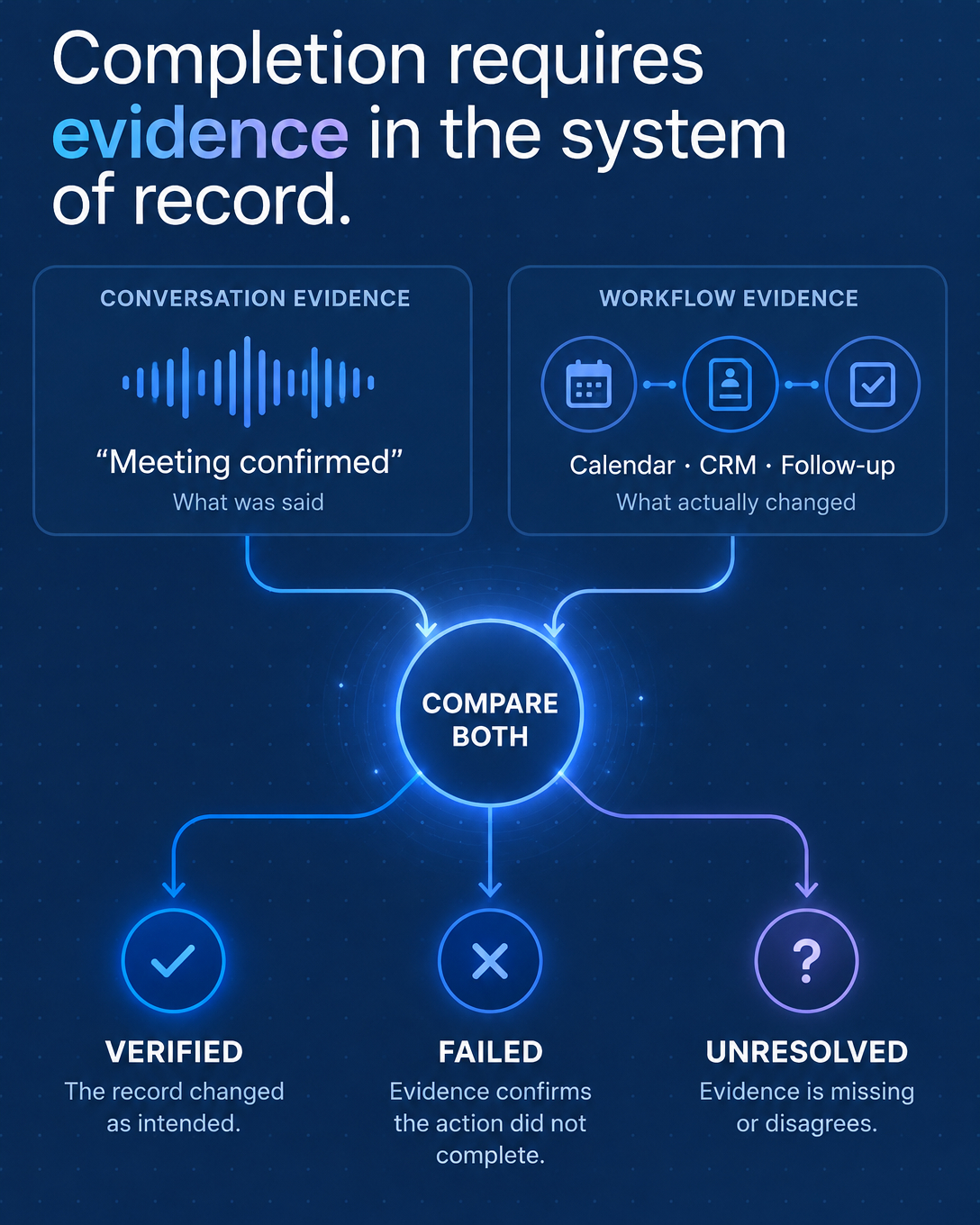
It tells you nothing about whether the connected systems changed state. An agent that says "booked" proves nothing on its own. The only way to validate completion is to read the calendar event, the CRM field, and the follow-up task, then confirm each one landed.
Execution that leaves no trace in a connected record is a claim, and claims need verification before they enter your pipeline reporting.
Why Agents Sound Finished When They Are Not
Voice agents are optimized to close conversations gracefully. That means an agent can sound finished even when the acceptance criteria were never tested, which forces you to reconstruct evidence manually from long transcripts.
The failure usually lives in the action layer. The booking API timed out. The CRM write used a malformed field. The calendar invite went to the wrong attendee. The conversation layer reported success anyway.
Testing research makes the same distinction. Verification means checking the right tool was called with the correct parameters, and multi-turn conversations break down most often around the third turn, well after the opening sounded fine.
This failure mode is quiet. Nothing errors visibly. The damage shows up days later as a no-show, a missing record, or a prospect who signed elsewhere while your team believed the follow-up was handled.
Best Practices: Review Audio and Workflow Evidence Together
Build your review process around paired evidence. Each claimed outcome gets two checks.
1. Define completion before the pilot
Write down what counts as done for each task type. A booked meeting means a calendar event exists with the right attendee, the right time, and the right campaign context. Name the person who accepts or rejects each result.
2. Score the conversation and the action separately
A call can be excellent audio and a failed action. A call can be awkward audio and a completed action. Each score drives a different fix, so keep them in separate columns.
3. Verify every claimed completion against the connected record
- Booking claimed: open the calendar and confirm the event, attendee, and time.
- CRM update claimed: read the field values and the timestamp.
- Follow-up claimed: confirm the task exists and has an owner.
4. Use three statuses, never two
Verified, failed, and unresolved. Transcript says confirmed and calendar shows nothing means unresolved. Resist the urge to round unresolved up to success or down to failure before someone investigates.
5. Route every unresolved case to a named owner
Give that person the recording, the transcript, the event history, and the connected record. Set a deadline for resolution so unresolved cases stop aging silently.
If available evidence is insufficient, the system should say so rather than implying the work was independently verified.
What to Do When the Evidence Disagrees
Disagreement between transcript and record is diagnostic gold. Treat it as a repeatable test case.
Reproduce the call with an authorized tester. Change one setting at a time. Check whether the failure sits in the integration, the entitlement, the configuration, or the conversation design. Then rerun the scenario and confirm the fix against your baseline.
Log the disagreement rate itself as a metric. A rising rate between claimed completions and verified completions tells you the action layer is degrading before your pipeline numbers do.
The Standard You Should Hold
Stakes here are commercial, and they compound. Research on funnel breakdowns shows 82% of lost deals trace to poor follow-up rather than pricing, which means process failure costs more than competitive loss.
So hold your voice agent to the same standard you hold a new hire. You would never accept "I told the prospect the meeting was set" as proof. You would check the calendar.
Apply that rule to every claimed outcome. Read the transcript, listen to the audio, then open the connected record. When all three agree, count the result. When they disagree, mark it unresolved and investigate.
That discipline turns an AI voice pilot from a demo you hope about into infrastructure you can report on.