
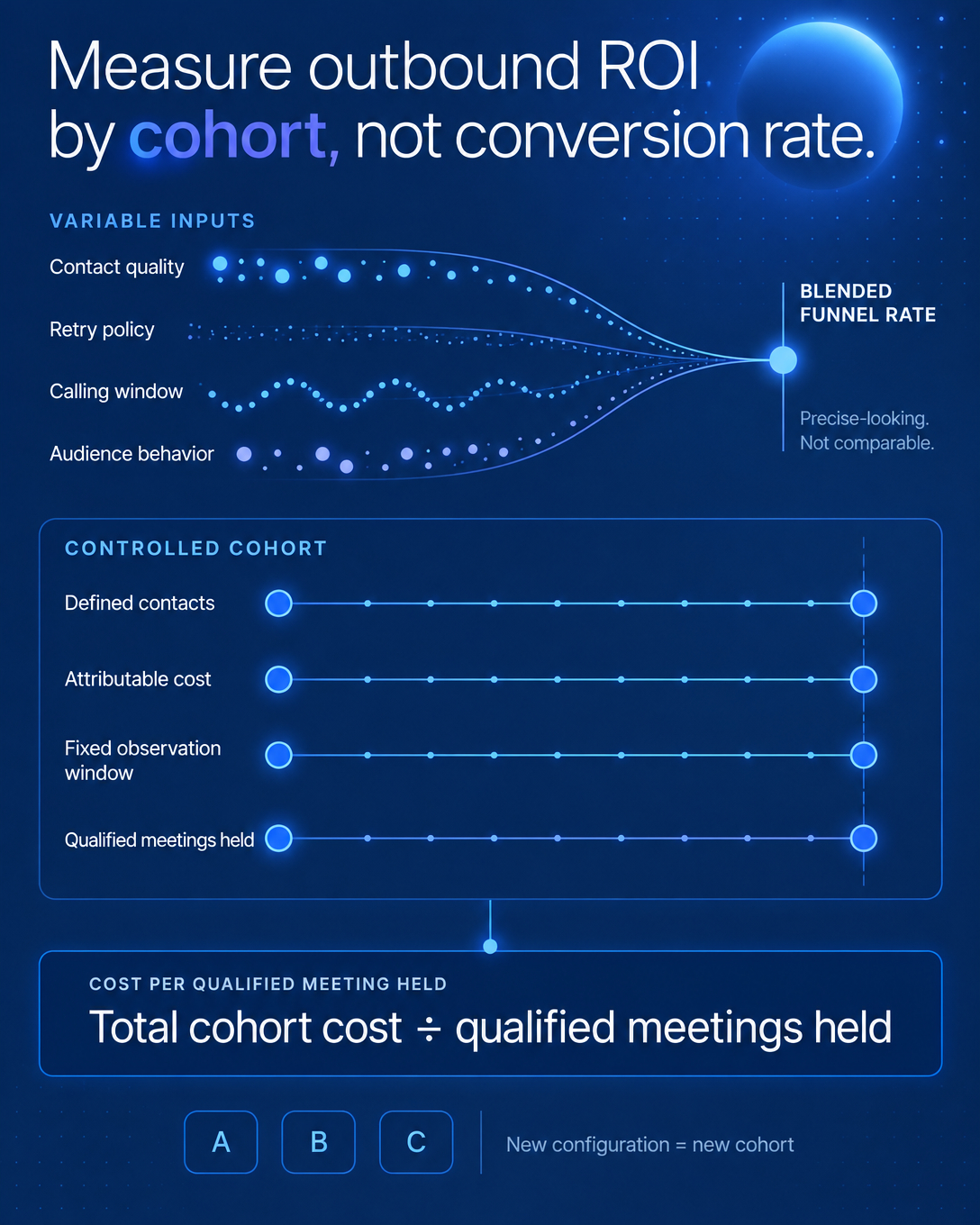
The most common mistake in measuring AI outbound calling ROI is treating it like a funnel metric. Conversion rates assume stable inputs. Outbound calling gives you none. Contact quality shifts by list. Retry policy shifts by campaign. Calling windows and conversation duration shift by audience.
Feed unstable inputs into a funnel model and you get numbers that look precise and mean nothing.
The right unit of measurement is a cohort: a defined group of contacts, a recorded cost, a fixed observation period, and a count of qualified meetings that actually held. Everything else is reporting theater.
Why Funnel Logic Breaks in Outbound
There is no single outbound conversion rate, and anyone handing you one number is oversimplifying. The spread across teams is severe. Research on outbound conversion rates shows average cold email replies at 3.43%, with the top 10% clearing 10.7%. Run 1,000 contacts at conservative rates and you get 3 to 4 meetings. Run the same list at the top of healthy bands and the math returns about 16. No single stage ever looked dramatic. The output still quadrupled.
A benchmark borrowed from someone else's funnel tells you nothing about your campaign.
Data quality compounds the problem. A rep who contacts 50 accounts but reaches only 20 real people has a different funnel health story than the activity log suggests. As ZoomInfo's work on data-driven funnels puts it, the data problem masquerades as a messaging problem until someone audits the underlying records.
Your AI caller inherits every one of those flaws. Wrong numbers and stale contacts burn minutes you pay for, and the funnel chart hides it.
The Cohort Framework, Built From the Ground Up
A cohort locks four things in place before the first call goes out. Write them down and refuse to change them mid-flight.
1. A defined contact group
Distinct contacts, approved for this workflow, in this reporting window. Keep unique contacts separate from dialing attempts. A retry adds an attempt. It does not add a person to the cohort.
2. A recorded cost
Platform fees, billable minutes, telephony, purchased data, setup, and the human time spent reviewing calls and handling exceptions. If a cost is amortized, disclose the period and show the upfront amount too.
3. A fixed observation period
Set Day 0, the granularity, and the window before launch, and apply those definitions consistently across every dashboard. The cohort analysis discipline here is simple: document the boundary once, then measure against it.
4. A count of qualified meetings that held
A booked time, a completed conversation, and an accepted opportunity are three different events. Each needs its own status and evidence. Name the person who decides whether a meeting counts.
Then the equation is honest arithmetic: cost per qualified meeting held equals total attributable cohort cost divided by qualified meetings held.
Why Averages Across Cohorts Will Burn You
Blending cohorts recreates the funnel problem one level up. Brands have made expensive scaling decisions off an average customer value of $180 without noticing that recent cohorts were generating 30% less. Cohort analysis fixes this by tracking groups over identical time periods. The question shifts from "what is our average result" to "how does the result evolve across cohorts acquired in different periods." That difference separates strategic clarity from expensive confusion.
For AI outbound, this means every campaign configuration gets its own cohort. New list source, new retry policy, new script version: new cohort, new cost record, new window. You are building a comparison ledger, and the ledger is what makes expansion decisions defensible.
When the Denominator Is Zero
A cohort with zero qualified meetings held produces an undefined cost ratio. Report it that way. Show the outcome count as zero and leave the ratio blank.
Resist the urge to substitute an industry conversion rate to make the report look complete. A borrowed number answers a different question about a different cohort.
Before you diagnose the campaign, audit the measurement itself. Pause the diagnosis if tracking is incomplete, event definitions changed mid-window, or the reporting window is shorter than your normal sales cycle. A zero sometimes means the instrumentation failed, and that requires a different fix than the script does.
The Decision This Framework Earns You
Agree on quality blockers, a minimum acceptable commercial result, and a review checkpoint before launch. Then let the cohort evidence drive one of three moves.
Expand when the observed workflow and economics meet your thresholds. Repair when the evidence identifies a correctable issue. Stop when a critical blocker or missing evidence prevents an accepted result.
Execution that leaves no trace cannot be evaluated, scaled, or defended to finance. Build the cohort first. The ROI conversation gets short after that, because the evidence answers it for you.