
I run execution infrastructure for revenue teams, so I read every AI SDR benchmark that gets published. Most of the debate compares the wrong layer.
The public argument centers on cost per call and dials per day. The performance data tells a different story. It points at the structural gaps between systems, the places where a booked meeting turns into a no-show and a qualified lead turns into silence.
Here is what the numbers actually show when you trace them to completion.
Speed Is Where AI Wins Outright
Start with the one metric where the comparison is settled.
Leads contacted within 5 minutes qualify at 21x the rate of leads contacted after 30 minutes. Human SDR teams average a 47-hour lead response time. AI voice agents respond in under one minute.
That 47-hour window is the silent gap where intent dies.
Nobody logs it. Nobody owns it. The lead sits in a queue while the buyer's attention moves on. By the time a human dials, the moment that generated the inquiry has closed.
💡 The operational point: speed to lead is a coverage problem, and coverage problems are exactly what machines solve. An AI agent runs 24 hours a day, holds response time under a minute, and logs every attempt. On this dimension, the human loses on structure, and effort has nothing to do with it.
If the analysis stopped here, the case for AI-only teams would look closed. The analysis stops there far too often.
The Show Rate Data Exposes the Real Gap
Trace the funnel one stage further and the picture inverts.
AI-booked meetings show up at 40 to 60 percent. Human-booked meetings show up at 70 to 85 percent. Meeting-to-opportunity conversion follows the same pattern: 15 percent for AI-sourced meetings against 25 percent for human-sourced ones.
The technology books the slot correctly. The commitment behind the slot fails to transfer.
A human SDR sets an expectation during the call. The prospect makes a small social promise to a person. An AI agent captures a calendar event, and the context that made the prospect say yes evaporates between the call and the meeting.
⚠️ Watch this in your own pipeline: a low cost per booked meeting means nothing if half the meetings never happen. Cost per held meeting is the number that survives contact with reality, and it is the number most vendor decks omit.
This pattern is commonly overlooked because teams measure activity at the stage where it occurs, then stop watching. The failure occurs one handoff later, in a gap no dashboard covers.
Hybrid Teams Post Numbers Neither Side Reaches Alone
The strongest data in the entire research set belongs to teams that run both.
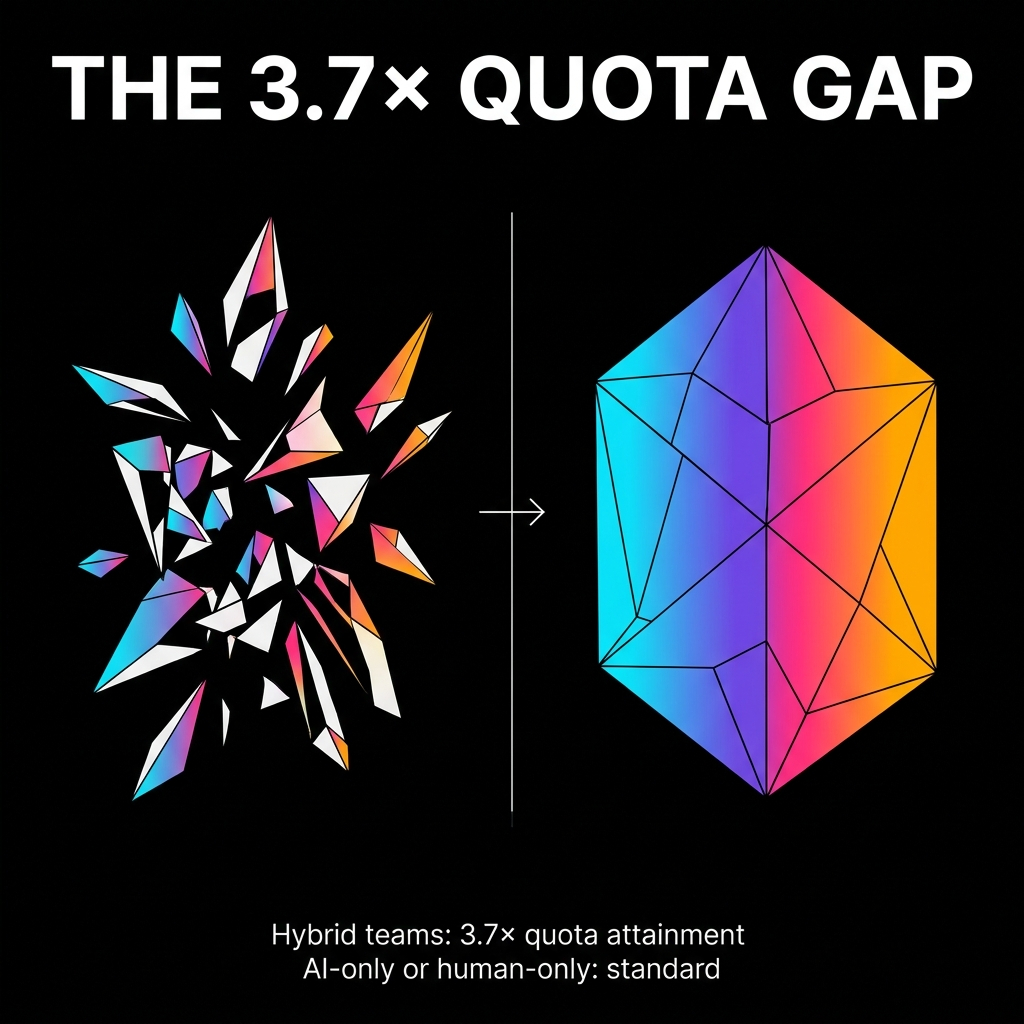
Hybrid teams hit quota at 3.7x the rate of AI-only or human-only approaches. Organizations using voice AI for volume and humans for depth report a 42 percent reduction in cost per qualified lead and a 36 percent lift in conversion to meeting when the AI is context-primed on the account.
The cost data confirms it. Hybrid AI and human pods cut cost per qualified opportunity from $487 to $224, a 54 percent reduction. At the same time, AE win rates on AI-sourced opportunities still run 9 to 12 points below human-sourced ones, and AI-only teams report 25 to 35 percent lower pipeline value per lead.
Read those numbers together and the architecture becomes visible:
AI owns coverage. Instant response, full logging, zero dropped inbound leads.
Humans own commitment. Expectation-setting, objection depth, the transfer of trust that gets a prospect to show up.
The handoff owns the outcome. The 3.7x quota multiple belongs to teams that engineered the transition point, with context captured, routed, and preserved.
The performance gap sits between teams that architect the handoff and teams that leave it to chance. The AI-versus-human framing hides that entirely.
Handoffs Are Already the Documented Failure Point
This finding matches what the broader revenue operations data has said for years.
Ninety-three percent of organizations report that deals struggle to move smoothly across sales, legal, finance, pricing, and IT. Thirty-eight percent report lost or delayed revenue caused by handoffs between systems. Forty-five percent lost a deal in the past six months to slow quote approval alone.
Poor sales-to-CS handoffs drive 15 to 25 percent higher first-year churn. Organizations with documented handoff processes see 15 to 20 percent higher conversion through the pipeline.
The sales execution gap as a whole costs roughly 40 percent of a strategy's potential value, and organizations that close it are three times as likely to report above-average growth.
So the AI SDR question lands inside a system that already leaks at every seam. Adding an AI agent to that system adds one more handoff: machine to human, call to calendar, transcript to CRM.
Each new handoff either closes a loop or bleeds value. Ungoverned, it bleeds.
What Governed Execution Requires at the Seam
I hold one operating principle above the rest: if it is not tracked to completion, it did not happen.
Apply that standard to the AI-to-human seam and the requirements become concrete. Every deployment I evaluate gets checked against four conditions:
Context persists across the handoff. The full conversation record, objections, and stated intent arrive with the meeting. The human walks in primed, and the 36 percent conversion lift from context-priming depends on this.
Every booking carries an owner. A calendar-connected action with a named human accountable for confirmation and follow-up. Unowned bookings become the 40 percent no-show rate.
Every commitment stays visible. Callbacks, reschedules, and next actions get logged and tracked to a terminal state: completed, converted, or explicitly closed. Silence stops counting as an outcome.
The record stays auditable. When a meeting no-shows, the system shows where the loop broke. Diagnosis replaces guessing.
Visibility precedes accountability. Accountability precedes the hybrid numbers. Teams that skip the governance layer and deploy AI for volume alone multiply their handoff count while their loss rate per handoff holds steady.
That is how a 21x speed advantage turns into a 38 percent drop in reply rates and a 6.4x volume increase that fails to convert.
The Role Is Shifting Toward Architecture
One more signal from the data deserves attention. Ninety-one percent of customer service leaders face executive pressure to deploy AI. Gartner projects that by 2028, AI agents will outnumber human sellers 10 to 1, while fewer than 40 percent of sellers will say those agents improved their productivity.
That projected gap between deployment and performance is structural, and it lands on whoever owns the seams.
The SDR role is already evolving in response. Industry analysis describes the emerging profile as a sales operations architect: a professional managing 5 to 10 AI agents, monitoring performance, adjusting messaging, and stepping in where human judgment is required. Fifty dials a day becomes supervision of a governed execution loop.
Your hiring profile, your comp plan, and your management cadence all inherit that shift.
My Verdict, Stated as an Operating Rule
The question "AI voice agent or human SDR" has a precise answer once you measure to completion.
AI wins the coverage layer. Sub-minute response, unlimited concurrency, complete logging. The 21x qualification multiplier is real and structural.
Humans win the commitment layer. The 25 to 30 point show-rate advantage and the 9 to 12 point win-rate advantage are equally real and equally structural.
The governance layer decides everything else. The 3.7x quota performance and the $224 cost per qualified opportunity belong exclusively to teams that made the handoff visible, owned, and tracked to a terminal state.
💡 The evaluation question for your own stack: when this agent books a meeting, name the exact system that guarantees a human confirms it, holds the context, and logs the outcome. If no such system exists, you bought volume and left the leak in place.
Execution dies in handoffs. The teams posting the best numbers eliminated the handoff as a failure point before they scaled the machine.
Govern first. Scale second. The data now backs the order of operations.