
TL;DR: AI voice agents are worth deploying in 2026 — but only when three conditions hold: a measurable call leak, a fully loaded cost model, and end-to-end outcome instrumentation. Conversation quality is not the risk. Broken handoffs are.
73% of small businesses miss critical calls, costing an estimated $126,000/year in lost revenue.
Real production cost runs $0.12–$0.25 per minute — not the $0.05 advertised rate.
The dominant failure mode is a broken handoff layer, not poor AI conversation quality.
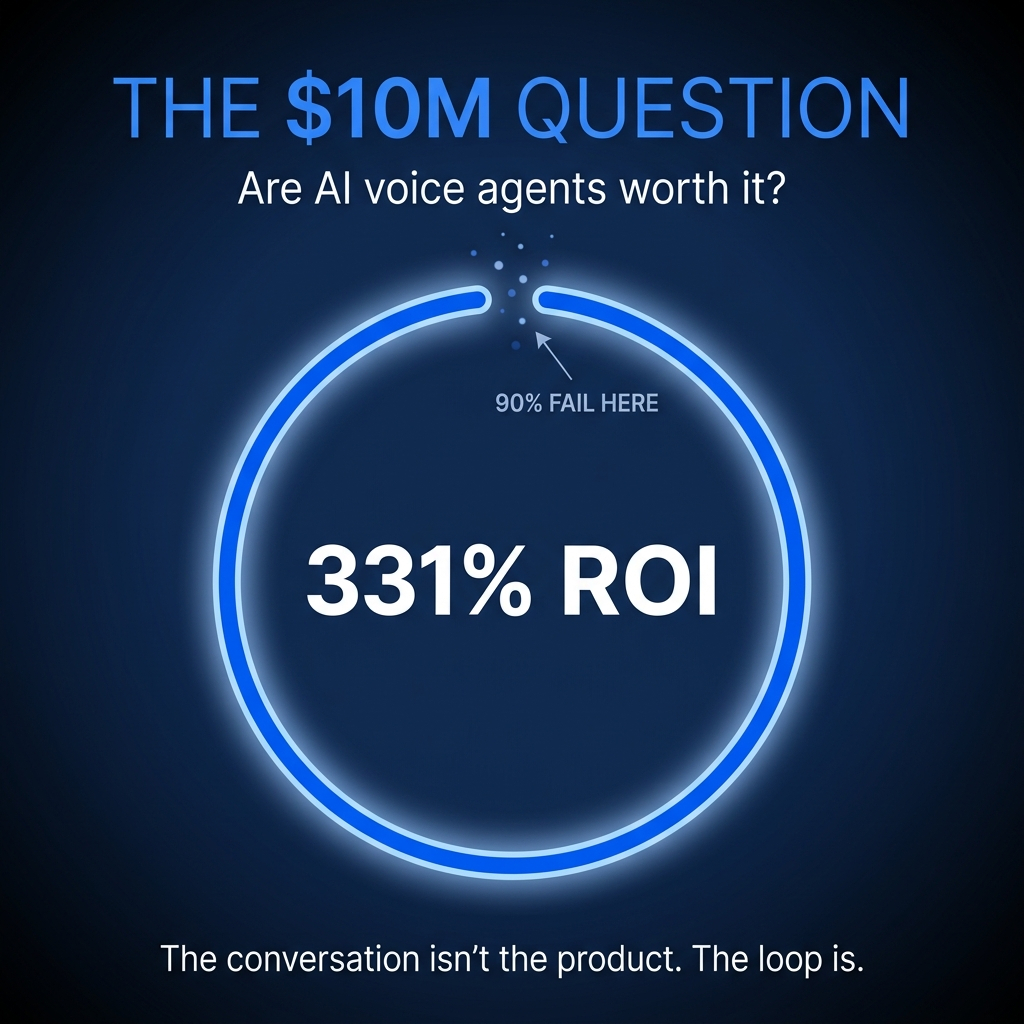
When the full loop closes, Forrester documents 331–391% three-year ROI with $10.3M in average savings.
Vague vendor answers to operational questions are disqualifying. Production-ready systems answer in one sentence.
I build infrastructure for the part of the call nobody watches: the moment after someone hangs up. That vantage point shapes how I answer the question I hear most often from revenue leaders in 2026.
They want to know if AI voice agents are worth the money.
My answer: yes, under specific conditions. The technology holds up. The economics hold up. Execution determines the outcome, and execution is where most deployments quietly fall apart.
The industry numbers back this up. Gartner predicts 40% of AI agent projects will be canceled by 2027, while 79% of organizations are deploying them right now. Only 10 to 15% of deployments ever reach production maturity. That gap between enthusiasm and outcome is the entire story of this article.
Why Start With the Missed-Call Leak?
Every honest ROI evaluation starts with a number you already own: the cost of your unanswered calls.
73% of small businesses miss critical customer calls. The estimated annual cost of that leak sits around $126,000 per business. Run the math yourself. Five missed calls a day, a 20% conversion rate, a $2,000 customer lifetime value. That number closes fast.
The competitive dynamics make the leak worse. 78% of deals go to the first business that responds. 85% of callers who hit voicemail never call back, and 62% contact a competitor immediately.
A missed call is dead revenue.
This is where your evaluation begins. Quantify the leak first. If the leak is real, the case for AI voice builds itself. If you already answer every call and volume is low, the math gets thin — and you should know that before you sign anything.
Bottom line: Your unanswered call rate is your baseline. Quantify it before evaluating any vendor.
What Does an AI Voice Agent Actually Cost in Production?
Vendors advertise per-minute rates starting at $0.05. Production deployments run at a different number, and the gap is material.
The real cost stacks five layers:
Speech-to-text: $0.004 to $0.024 per minute
LLM inference, text-to-speech, telephony, and platform orchestration layer on top of that.
Stacked together, production runs $0.12 to $0.25 per minute. Platforms advertising $0.07 per minute on a bring-your-own-key model require you to source the speech and language layers yourself, which adds $0.06 to $0.19 per minute before the platform takes its margin. The realistic production number lands 3 to 4 times above the headline rate.
Hidden Fees That Erode the Model
Beyond the per-minute rate, watch for:
Silence and hold-time billing
Concurrency overage charges of $8 to $15 per month per slot
HIPAA surcharges up to $1,000 per month
Failed call minimums and setup fees of $500 to $5,000
Token bloat from unoptimized prompts
These add 15 to 30% on top of whatever estimate you received.
Demand a fully loaded cost projection based on your actual call volume, in writing. Teams that commit at $0.05 and discover $0.22 in production lose confidence in the entire initiative. For context, a human support agent costs $35,000 to $50,000 per year, handles one call at a time, and sleeps at 2am. Even at the fully loaded rate, the per-call economics favor the machine.
Key Point: The advertised rate and the production rate are not the same number. Model the full stack — including hidden fees — before you commit.
Where Do AI Voice Agent Deployments Actually Fail?
Buyers assume conversation quality is the risk. The data points somewhere else.
The dominant failure mode in production is a broken handoff layer. The AI answers well, the call ends, and then nothing traceable happens. No CRM update. No follow-up trigger. No visibility into whether the lead converted, escalated, or went cold.
The team sees answered calls and assumes the system works. The pipeline stays flat.
This is execution theater. The call happened. The outcome never did.
The follow-up data makes the stakes concrete. Production data across millions of calls shows it takes an average of 4.7 contact attempts before a lead answers, with nearly three of those attempts on day one. An agent that answers once and coordinates nothing afterward leaves roughly 80% of the opportunity untouched.
Deployments that produce revenue treat the handoff as a core product feature. The agent knows when to escalate. It transfers full context. It sends the human a summary before pickup. It logs every attempted step, and failed handoffs get tracked and reviewed like any other production defect.
Execution that leaves no trace is theater. That principle governs everything I build, and it should govern everything you buy.
Key Point: The handoff layer — not conversational quality — is the primary failure point. If outcomes aren't logged and routed, the system is delivering theater, not results.
What ROI Is Documented When the Loop Closes?
When governance holds and the full loop runs from inbound call to logged outcome, the returns are well documented.
Forrester's composite analysis of production deployments found 331 to 391% three-year ROI with $10.3 million in average savings. Most small businesses reach positive ROI within 30 to 60 days. Home services and dental practices see the fastest payback because appointment volume is high and every missed booking has an immediate price tag.
The per-call comparison settles the cost side. Human-handled calls average $7.16 each. AI voice handles the same call at $0.12 to $0.40 all-in — a 90 to 95% reduction per automated interaction, with after-hours coverage and simultaneous handling included.
The revenue side compounds this:
AI outbound calls with structured qualification achieve 45 to 60% conversation rates
AI-powered lead engagement delivers 3 to 5x higher conversion versus web form qualification
Proactive voice outreach reduces churn by 25 to 40%
One more number matters here. 82% of senior leaders invested in AI for customer service over the past year, yet only 10% reached mature deployment where the system works at scale. Mature teams report 87% improved metrics. Investment and execution are separate achievements, and only one of them shows up in the pipeline.
Key Point: Documented ROI is substantial — but only for deployments that close the full loop. Investment without execution produces metrics, not revenue.
What Three Conditions Determine Whether It Pays Off?
ROI shows up reliably when three conditions hold. When one is missing, the numbers stop closing.
1. You have a measurable call leak. Track what percentage of inbound calls go unanswered. A quantified leak gives the deployment a baseline to beat and a payback clock you can verify.
2. You priced the full stack. Model the five-layer cost against your actual volume, add a 20% buffer for first-quarter overages, and get the all-in number in writing before you commit.
3. The system proves its own outcomes. Define success before deployment. A successful call means the lead was qualified, logged, and routed — with every step instrumented. Track handoff success rate, CRM update rate, and downstream conversion separately from call volume. A loop you can measure is a loop you can manage.
Key Point: All three conditions must hold. A strong call leak without outcome instrumentation still produces theater. Outcome tracking without a real baseline produces noise.
Which Questions Filter Out Prototypes From Production Systems?
In 2026, operational architecture separates production systems from demos. Before signing, demand specific answers to these:
The all-in cost per minute for your configuration, in writing
What the handoff looks like when the AI cannot resolve the call, and what context transfers
What outcome data the system logs after each call, and where it writes
How failed handoffs get tracked and surfaced for review
Concurrency limits, and what happens when you exceed them
Whether HIPAA compliance is included or billed as a surcharge
Vague answers are disqualifying. A vendor who has actually run this in production answers each of these in one sentence, because they built for the failure cases before they built the pitch.
Key Point: Operational questions reveal whether a vendor has built for production or for the demo. One-sentence answers signal readiness. Vagueness signals risk.
My Bottom Line
AI voice agents are worth deploying in 2026. The cost-per-call economics are proven. The missed-revenue problem is real and quantifiable. The production ROI data exists at both enterprise and small-business scale.
The work sits in the architecture. The companies getting returns built the full loop: governed handoffs, traceable outcomes, and a system that proves what happened after the call ended.
Conversation is the entry point. The closed loop is the product.
Buy the loop, instrument it end to end, and hold the vendor to the numbers. That is how conversation becomes commitment, and how commitment becomes truth in your pipeline.
Frequently Asked Questions
Are AI voice agents worth it for small businesses in 2026?
Yes, when a measurable call leak exists. Small businesses missing 5+ calls per day with a meaningful customer lifetime value typically see positive ROI within 30 to 60 days. If call volume is low and most calls are already answered, the math is thin.
What does an AI voice agent actually cost per minute in production?
Advertised rates start at $0.05 per minute, but fully loaded production costs run $0.12 to $0.25 per minute. Hidden fees — silence billing, concurrency overages, HIPAA surcharges, setup costs — can add another 15 to 30% on top of that.
What is the most common reason AI voice agent deployments fail?
A broken handoff layer. The AI answers the call but fails to log outcomes, trigger follow-ups, or route qualified leads with context. The team sees answered calls and assumes the system works, while the pipeline stays flat.
How do AI voice agents compare to human agents on cost?
Human-handled calls average $7.16 each. AI voice handles the same call at $0.12 to $0.40 all-in — a 90 to 95% cost reduction — with after-hours availability and simultaneous call handling included.
What ROI can enterprises expect from AI voice agents?
Forrester's composite analysis of production deployments found 331 to 391% three-year ROI, with an average of $10.3 million in savings. Only mature deployments with full-loop instrumentation reach these numbers.
What questions should I ask an AI voice vendor before signing?
Ask for the all-in cost per minute in writing, handoff procedures and context transfer details, outcome data logging location, how failed handoffs are tracked, concurrency limits, and whether HIPAA compliance is included or an add-on. Vague answers disqualify a vendor.
How does AI outbound calling perform compared to web form lead capture?
AI-powered lead engagement delivers 3 to 5x higher conversion versus web form qualification. Structured outbound qualification achieves 45 to 60% conversation rates.
What does "execution theater" mean in AI voice deployments?
Execution theater is when the AI answers calls but produces no traceable outcomes — no CRM updates, no follow-up triggers, no logged results. The call metric looks healthy. The pipeline is not.
Key Takeaways
AI voice agents are worth deploying in 2026 — the economics and ROI data are proven at both enterprise and small-business scale.
Start with a quantified call leak. Without a measurable baseline, the ROI case is speculation.
Real production costs run 3 to 4x the advertised rate. Model the full stack before committing.
The dominant failure mode is a broken handoff layer, not poor conversational quality.
When the full loop closes — qualified, logged, routed — Forrester documents 331 to 391% three-year ROI.
Three conditions must hold: measurable leak, fully loaded cost model, and end-to-end outcome instrumentation.
Operational questions separate production systems from demos. Demand one-sentence answers before you sign.