
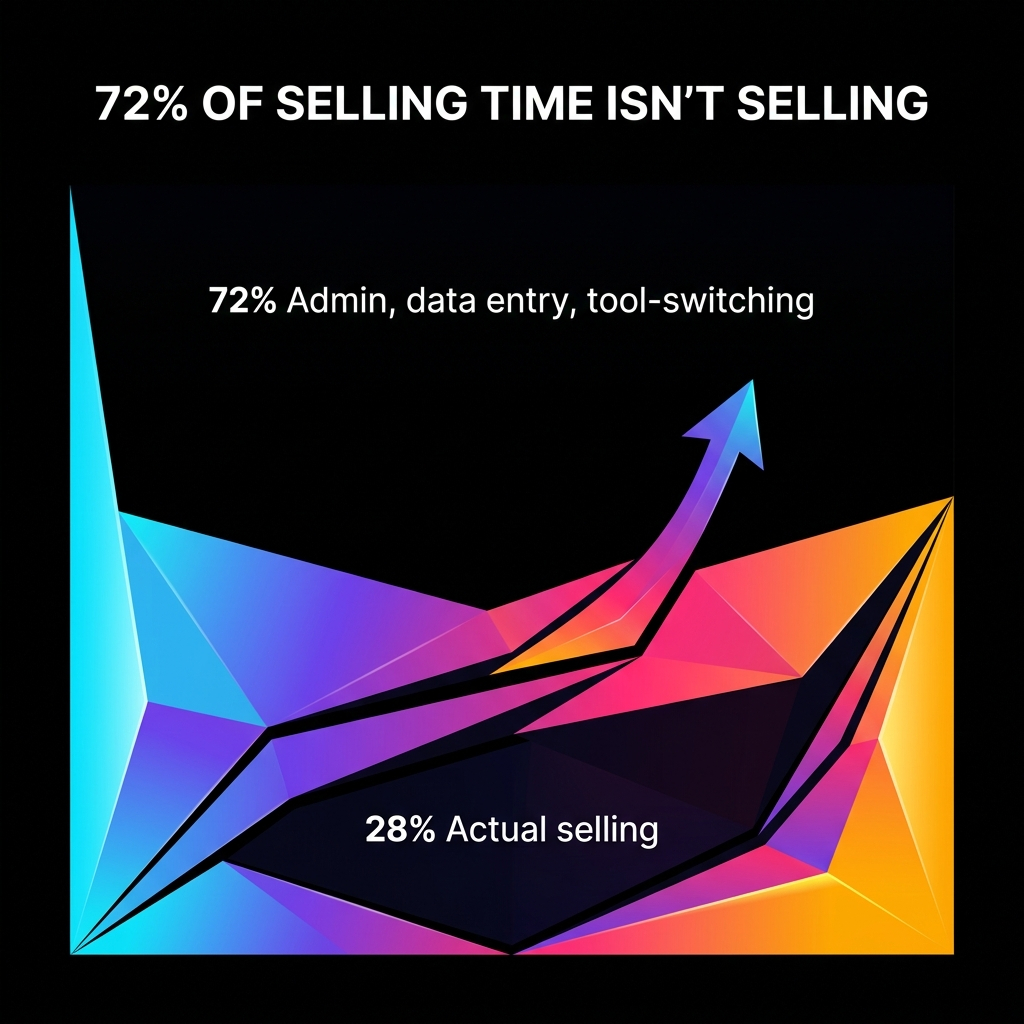
Most articles about sales automation tools start with a list of logos. This one starts with a number.
Sales reps spend only 28% of their time actually selling. The remaining 72% disappears into administrative work, data entry, and switching between tools.
That number explains why the sales automation market keeps growing. It also explains why so many teams buy tools and still watch deals stall.
The tool is rarely the problem. The evaluation is.
You'll find this article structured as an outline of best practices for choosing sales automation tools. It covers what to look for, what to ignore, and where execution breaks even after the software gets installed.
The Gap Sales Automation Tools Exist to Close
Before comparing tools, name the operational gap they need to close.
Revenue teams generate intent every day. Conversations happen. Leads come in. Callbacks get promised. Then a specific failure occurs: the action between intent and outcome goes untracked, and it dies in silence.
The data confirms how common this failure is. Over 30% of leads never get contacted at all, and the average lead response time across industries sits at 42 hours.
Meanwhile, the odds of qualifying a lead drop by 80% after just five minutes, and only 7% of companies hit that five-minute benchmark.
💡 Key insight: a sales automation tool earns its cost when it makes follow-through unavoidable. Every other capability is secondary.
Keep that standard in mind. It shapes every evaluation criterion below.
Best Practice 1: Evaluate Systems, Skip Feature Lists
Feature comparisons produce long spreadsheets and weak decisions. A tool with fifty features and no execution logic still leaks revenue at every handoff.
Evaluate each candidate as a system. Ask three structural questions:
What runs automatically? Which actions execute without a human remembering to trigger them.
What stays visible? Which commitments, callbacks, and bookings appear in a record you can audit.
What remains controlled? Which behaviors operators can govern, configure, and constrain.
A tool that answers all three functions as execution infrastructure. A tool that answers none functions as another inbox.
This framing matters because disconnected systems compound the problem. Revenue leakage hides in forecast variance, in stalled deals marked "on track," and in post-sale handoffs nobody owns.
Every additional unconnected tool adds a handoff. Every handoff adds a place where execution dies.
Best Practice 2: Match the Tool Category to the Gap You Have
Modern sales automation splits into distinct categories. Buying the wrong category for your gap produces expensive shelfware.
Lead Response and Speed-to-Action Tools
These systems capture inbound intent and trigger immediate contact. They matter most when your gap sits at the top of the funnel.
Given that 78% of customers buy from the first company that responds, speed tools carry direct revenue weight. Evaluate them on response time guarantees and on what happens when the first attempt fails.
The second attempt is where most of these tools quietly stop working.
Workflow Orchestration Platforms
These systems route actions between people and stages. They matter when your gap sits in handoffs: sales to onboarding, SDR to AE, call to callback.
Evaluate them on one question. When a step gets skipped, the system flags it, logs it, and routes it forward.
Anything less produces subjective pipeline data, and without clear governance, leadership loses the ability to distinguish a healthy deal from a dead one.
AI Conversation and Calling Systems
AI now handles qualification calls, booking, and follow-up conversations at scale. 88% of companies use AI in at least one business function, up from 78% the previous year.
The evaluation standard here is strict.
Visibility shortens the distance between "something feels off" and "here's the root cause," because logs, prompts, and usage patterns are already captured, making accountability operational rather than a policy statement.
An AI system without complete call artifacts, logged outcomes, and auditable behavior creates risk you carry personally. Demand the records before you demand the demos.
Post-Call Intelligence and Record Systems
These tools capture what happened after the conversation ends. Summaries, commitments, next actions.
They matter because untracked commitments vanish. If it's captured, structured, and logged, it exists. If it lives in a rep's memory, it already started decaying.
Best Practice 3: Test for Governance Before You Test for Output
This is commonly overlooked, and it produces the most expensive failures.
Teams test automation tools on volume. Emails sent. Calls placed. Meetings booked. Volume metrics look impressive in a pilot and hide structural problems in production.
Test governance first:
Trace one action end to end. A lead comes in. Follow the record from capture to contact to booking to completion. Every step needs a log.
Break a workflow on purpose. Skip a step. Miss a callback. Watch whether the system surfaces the failure or absorbs it silently.
Audit the AI behavior. Pull the transcripts and outcomes from a week of automated activity. Confirm you can explain every action the system took.
⚠️ Warning: a tool that scales activity without governance scales your existing chaos. Growth after governance holds. Growth before governance multiplies leakage.
Only 11% of technology leaders feel ready for the scale of AI agent deployment coming in the next 12 months. The gap between deployment and control keeps widening. Your evaluation process determines which side of that gap you land on.
Best Practice 4: Measure Outcomes Tracked to Completion
The ROI case for sales automation holds up. Companies see roughly an $8 return for every dollar invested in automation, and organizations that reinvest AI time savings into high-impact sales activity are 3.1x more likely to exceed lead-to-opportunity conversion goals.
Those numbers depend on measurement discipline.
Define your metrics before the pilot starts:
Response time from lead capture to first contact, measured in minutes.
Follow-up completion rate as the percentage of promised callbacks that actually happened.
Handoff integrity as the percentage of stage transitions with complete records attached.
Selling time recovered against that 28% baseline.
Each metric shares one property. It counts completed actions, and completed actions form the only honest unit of measurement in revenue execution.
Activity metrics tell you the system is busy. Completion metrics tell you the system works.
Best Practice 5: Plan for the Human Layer
Automation done well changes how your team relates to their work. 76% of sales reps say automation reduces work stress by eliminating tedious administrative tasks, and companies that automate repetitive sales tasks see a 15% reduction in turnover.
That outcome requires two conditions during rollout.
First, keep humans in the review loop. Operators need to see what the system executed, correct what drifted, and approve what matters. Trust in automation comes from visibility into automation.
Second, redirect the recovered time explicitly. Time savings without redirection evaporate into more administrative work. Assign the recovered hours to live selling and watch whether the conversion numbers move.
The Standard Modern Sales Teams Should Hold
The sales automation market doubled from $7.8 billion in 2019 to $16 billion in 2025. The tooling improved. The core failure pattern stayed the same: intent enters the system, and the action that should follow goes dark.
The best sales automation tools for modern sales teams share one architecture. Actions run automatically. Records stay visible. Behavior remains governed. Outcomes get tracked to completion.
Hold every candidate to that standard.
Start with one workflow this week. Pick your highest-leakage handoff, trace it end to end, and evaluate tools against that specific gap. You'll make a sharper decision in days than a feature spreadsheet delivers in months.
The silent gap is where revenue disappears. Your tooling decision determines whether that gap stays silent.