
I keep hearing the same advice in revenue conversations: clean your data, structure your CRM, prepare your pipelines for AI. The advice is fine. It is also incomplete in a way that costs teams real money.
Clean data feeding an undefined workflow produces well-organized chaos.
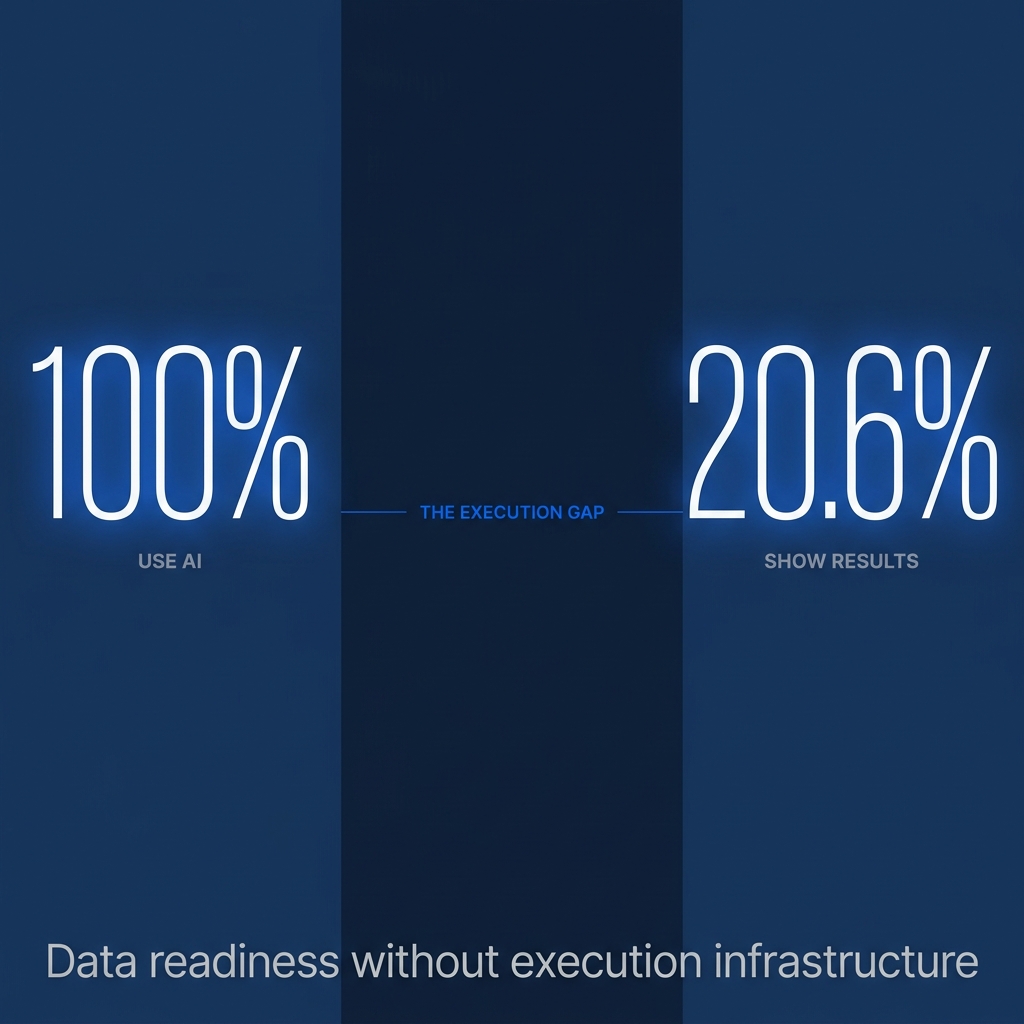
The numbers back this up. Every U.S. revenue organization surveyed now uses AI somewhere in the revenue process, yet only 20.6% describe their AI strategy as production-ready with measurable outcomes. That gap is structural. Integration, workflow control, and measurement are where programs stall.
The Data Readiness Story Stops Too Early
The industry has built an entire vocabulary around data readiness. Warehouses, catalogs, pipelines. Buying that stack creates what researchers call the illusion of readiness, the belief that owning modern data infrastructure automatically means AI readiness.
I watch this play out in revenue teams constantly. The data is clean. The model works. Then a call ends, and the output sits in a queue waiting for someone to route it, update the CRM, and chase the follow-up through email.
The follow-up dies. The booking disappears. Pipeline visibility becomes fiction.
Execution that isn't traceable isn't execution. It's theater.
What "AI-Ready Execution Infrastructure" Actually Means
Since nobody defines this term at the workflow level, I will. For a revenue team, AI-ready execution infrastructure means five things exist before any model touches a prospect:
- Explicit handoff topology. Every AI action has a defined next owner, human or system. No output lands in an unowned queue.
- Governed boundaries. The AI operates inside explicit policies. It knows what it can commit to and what requires escalation.
- Closed-loop writeback. Every conversation produces a structured outcome that lands in the systems of record automatically.
- Hard constraints that fail closed. Caps, quotas, and limits that stop spend and activity before damage happens. Dashboards report problems. Constraints prevent them.
- Auditable outcomes. You can trace every commitment back to the conversation that produced it.
💡 A simple test: pick one AI-touched deal in your pipeline and trace what happened after the last call. If the trail goes cold at any step, your execution infrastructure is undefined at that step.
The Failure Data Points at Workflows, Not Models
Between 70% and 90% of enterprise AI projects fail to deliver their intended value. The same research shows that organizations reporting significant financial returns are twice as likely to have redesigned workflows before selecting AI tools.
That sequencing detail matters more than any feature comparison. The teams that win define the workflow first, then fit AI inside it with explicit policies and handoffs.
Deloitte's findings reinforce the pattern. Only about 26% of organizations have moved 40% or more of their AI initiatives into production, and the missing piece is consistently the execution layer that makes scale possible.
The differentiator isn't AI access. It's whether AI actions are embedded in workflows and audited with measurable outcomes.
Why the Market Avoids This Definition
Selling data readiness is easier than selling execution readiness. Data readiness has a checklist and a procurement category. Execution readiness forces uncomfortable questions about who owns what, where handoffs break, and which parts of your revenue motion nobody can actually see.
This is commonly avoided because it exposes organizational debt, and organizational debt has no line item.
I build in this space, so I hold a position here. I built Vantara around the belief that AI in revenue workflows should behave like infrastructure: deterministic outcomes, governed execution, hard limits, full traceability. That conviction came from watching execution collapse across handoffs too many times to tolerate ambiguity about where intent turns into noise.
What You Can Do This Quarter
You do not need a platform decision to start. You need a definition.
Map one revenue workflow end to end, from first AI touch to closed-loop outcome. Name the owner of every handoff. Write down the policies your AI must operate within, including what happens when it hits a limit. Then measure whether every AI action lands in your system of record without a human retyping it.
⚠️ If your AI vendor cannot show you the audit trail from conversation to commitment to CRM record, you are buying a prototype, and prototypes break under commercial pressure.
Governance precedes scale. Every team I've seen skip that ordering ended up rebuilding under worse conditions.
Define your execution infrastructure before you scale your AI. The data will follow. It always does, once the workflow tells it where to go.