
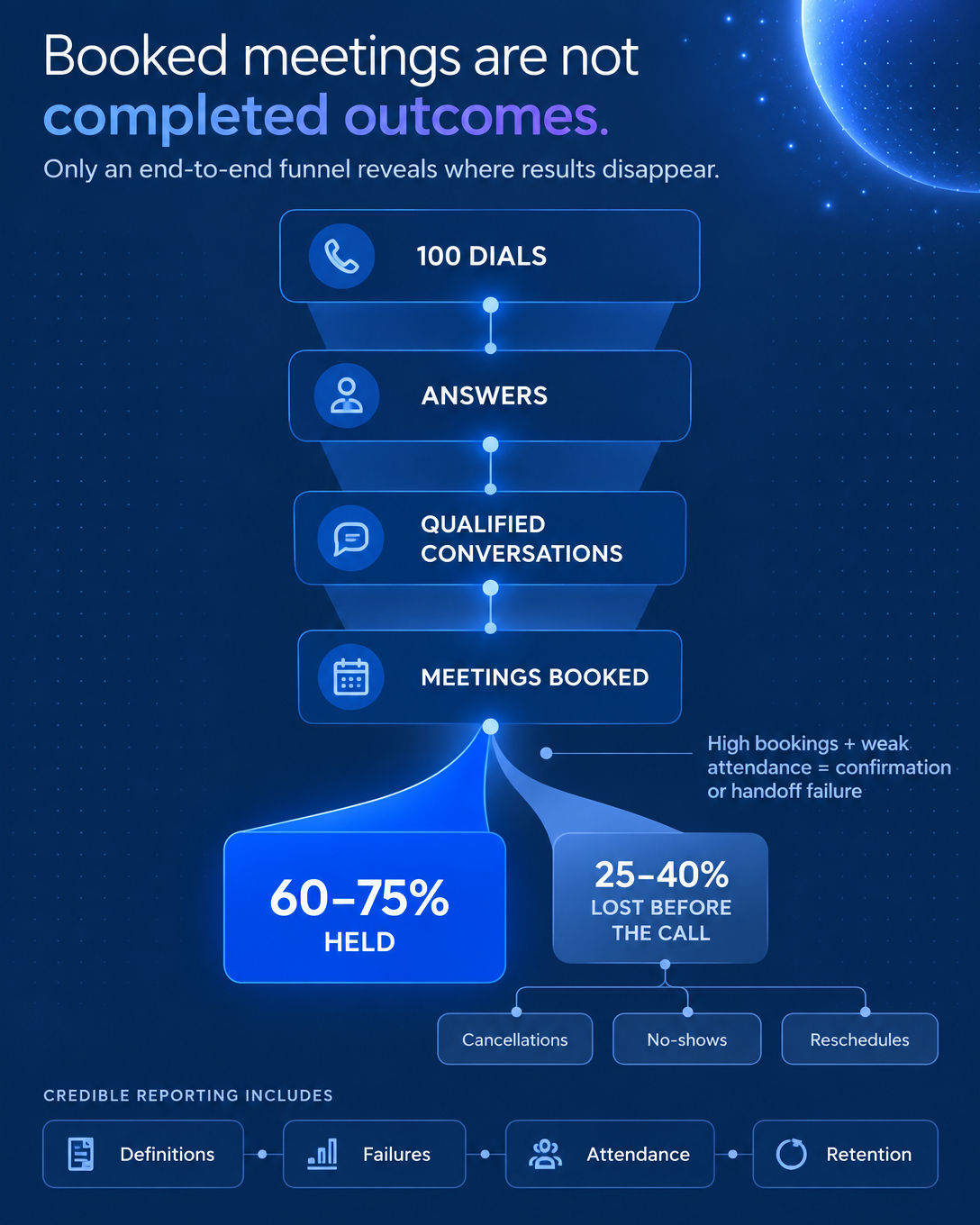
TL;DR: Most AI cold calling vendors report booked meetings and stop there. The metric that actually matters is meetings held. Without the full funnel
— from raw dials to confirmed attendance — vendor claims are incomplete at best and misleading at worst.
Booked meetings
≠ revenue. B2B show rates average 60
–75%, meaning 25
–40% of bookings never become conversations.The real conversion baseline for cold calling is 2.3–2.7% (dials to meetings). Any vendor claiming to dramatically exceed this owes you the full funnel data behind that claim.
Between 40–60% of AI SDR pilots get paused or shut down within 90 days. The demo survives; the deployment fails.
Credible vendors publish every stage: dials, answer rate, conversation rate, meetings booked, meetings held, and failed outcomes.
Human judgment still governs targeting, qualification, and handoff. AI handles volume within those governed boundaries.
Where Booked Meetings Go to Die
Average B2B appointment show rates sit between 60% and 75%. That means teams lose 25% to 40% of their booked meetings before the discovery call even starts.
This is commonly overlooked in vendor reporting. A booking is a promise. Attendance is the proof.
When I see a vendor report
"meetings booked" with no attendance data attached, I read it as a signal. They either did not track it, or they tracked it and decided you should not see it.
Neither answer builds trust.
Key Point: Show rate is the first metric vendors bury. If attendance data is missing from a vendor report, that absence is itself a data point.
What the Baseline Numbers Actually Say
Cold calling converts at roughly 2.3% to 2.7% in 2026. That is two to three meetings per hundred dials. Top performers reach 6% to 10% through better targeting and cleaner data.
Those are the real physics of the channel. Any AI vendor claiming to bend them by an order of magnitude owes you the full funnel behind the claim.
The category has already paid the price for skipping that step. In March 2025, TechCrunch reported that AI SDR vendor 11x.ai claimed customers it did not have, reported $10M in ARR when retained revenue was closer to $3M, and saw 70–80% customer churn according to former employees.
That collapse followed a pattern I see across the space. Between 40% and 60% of AI SDR pilots get paused or shut down within 90 days. The demo survives. The deployment fails.
Key Point: Conversion physics do not change because the caller is an AI. Vendors who imply otherwise without publishing full-funnel data are selling narrative, not results.
What a Credible Result Actually Looks Like
At Vantara, we publish the complete picture. Every stage, defined in writing, with the failures included:
Raw dials. The denominator. No result means anything without it.
Answer rate. How often a human picked up.
Conversation rate. Answers that became qualified dialogue, with "qualified" defined before the campaign, and never after.
Meetings booked. Calendar invites accepted, timestamped.
Meetings held. Attendance verified. Cancellations, no-shows, and reschedules reported as their own line items.
What broke in between. Failed outcomes, categorized. Wrong numbers, compliance blocks, handoff drops, confirmation gaps.
A high booking rate paired with a weak show rate points to a confirmation problem, and the fix lives in your process design. You only see that when the funnel stays connected end to end.
Execution that isn't traceable isn't execution. It's theater.
Key Point: Full-funnel transparency is not a reporting preference — it is the minimum standard for trusting any AI cold calling result.
The Human Work Still in the Loop
Full transparency includes admitting what the machine does not do alone. Phone-first models with verified data see nearly 90% of booked meetings actually go ahead, and that happens when human judgment governs targeting, qualification, and handoff integrity.
Humans still own the target list. Humans still define what "qualified" means. Humans still run the meeting.
The AI handles volume within governed boundaries. It executes deterministic steps, logs every outcome, and hands off cleanly. That division of labor is the honest version of this technology, and it works.
Key Point: AI and human judgment are not competing in this model — they are assigned to different jobs. That separation is what makes outcomes reliable.
The Questions You Should Ask Every Vendor
Before you sign anything, ask for four things:
The full funnel from raw dials to meetings held, with definitions for every stage.
Cancellation, no-show, and reschedule rates on their published results.
A breakdown of failed outcomes and how each category gets handled.
Post-trial retention data and reference customers who renewed.
Vendors with real execution will hand you this data quickly. Vendors selling theater will send you another demo clip.
The difference tells you everything about what happens after you buy.
Key Point: These four questions separate vendors with durable execution from vendors with polished demos. Ask them before any commercial conversation goes further.
Why I Publish the Failures
I build infrastructure for the parts of work that resist visibility. Follow-up drops, missed callbacks, bookings that quietly evaporate between systems. That is the layer where conversation becomes commitment, and commitment becomes truth.
Publishing our failed outcomes alongside our wins costs us some easy marketing moments. It earns us something more durable: operators who trust the numbers enough to build on them.
You deserve the whole funnel. Ask for it every time.
Key Point: Publishing failures is not a liability — it is the credibility signal that separates infrastructure companies from demo vendors.
Frequently Asked Questions
What is the most important AI cold calling metric?
Meetings held. Booked meetings are a leading indicator. Revenue only materializes when the prospect shows up. Track attendance rates alongside every other stage in the funnel.
What is the average cold calling conversion rate in 2026?
Roughly 2.3% to 2.7%, meaning two to three meetings per hundred dials. Top performers with better targeting and verified data reach 6% to 10%.
Why do so many AI SDR pilots fail?
Between 40% and 60% of AI SDR pilots are paused or shut down within 90 days. The most common causes are overstated results in the demo, weak handoff design, and no governance over what "qualified" means before the campaign starts.
What B2B appointment show rate should I expect?
Industry average is 60% to 75%. Phone-first models using verified data and strong human-governed targeting can approach 90% show rates.
What data should I ask an AI cold calling vendor for before signing?
Ask for: raw dials, answer rate, conversation rate, meetings booked, meetings held, cancellation and no-show rates, failed outcome breakdown, and post-trial retention data. Any vendor with real results will provide this quickly.
How do I know if an AI cold calling vendor's results are trustworthy?
Look for published attendance data, not just bookings. Ask for definitions of each metric and whether they were set before or after the campaign. Request reference customers who renewed after the trial period.
Does AI fully replace human judgment in cold calling?
No. In effective deployments, humans own the target list, define qualification criteria, and run the meeting. AI handles volume execution within those governed parameters and logs every outcome for review.
What caused the 11x.ai controversy in 2025?
In March 2025, TechCrunch reported that 11x.ai claimed customers it did not have, reported $10M in ARR when retained revenue was closer to $3M, and experienced 70–80% churn according to former employees. It became a visible example of what happens when vendor reporting is disconnected from actual deployment outcomes.
Key Takeaways
Meetings held is the only metric that connects to revenue. Everything before it is a leading indicator.
B2B show rates average 60–75%. Vendors who omit attendance data from their reporting are hiding the most important number.
Cold calling conversion physics are real. 2.3–2.7% dials to meetings is the baseline. Claims that dramatically exceed it require full-funnel proof.
40–60% of AI SDR pilots fail within 90 days. Demo performance and deployment performance are different things.
Credible reporting includes what broke. Wrong numbers, compliance blocks, handoff drops, and no-shows are data, not embarrassments.
Human judgment is not optional. Targeting, qualification, and meeting execution still require people. AI governs volume within those decisions, not instead of them.
Ask for four things before you sign: full funnel definitions, attendance rates, failed outcome breakdowns, and retention data from renewing customers.