
I have watched dozens of teams evaluate AI calling agents the same way. They open a demo, listen to a synthetic voice sound convincing for ninety seconds, and decide the technology works.
Then they deploy it, and three weeks later nobody can answer a basic question: what happened to the calls.
Which leads got contacted. Which callbacks were scheduled. Which commitments the agent made on behalf of the company. The answers live nowhere, so the answers do not exist.
This article is an evaluation outline. It covers what I look for when someone asks me to name the best AI calling agent, and why the answer starts with governance instead of voice quality.
The Gap Every Buyer Skips Over
Start with the operational reality the market keeps quiet about.
Most deals require five or more follow-up attempts to close, yet 44% of sales reps give up after a single touchpoint. Only 2% of sales close on first contact. The revenue sits between the fifth and twelfth touch, and manual teams rarely get there.
That gap is structural. Reps drop follow-up because manual outreach at scale exhausts them, and no dashboard shows the silence where those leads died.
An AI calling agent exists to close that gap. Evaluating one on voice realism alone measures the wrong layer. The voice handles the conversation. The system underneath either tracks every action to completion or it leaks value invisibly, exactly like the manual process it replaced.
💡 Working rule: if the platform cannot show you every call, every outcome, and every scheduled next action in one auditable record, the demo quality is irrelevant.
Outline Best Practices: The Six-Part Evaluation Structure
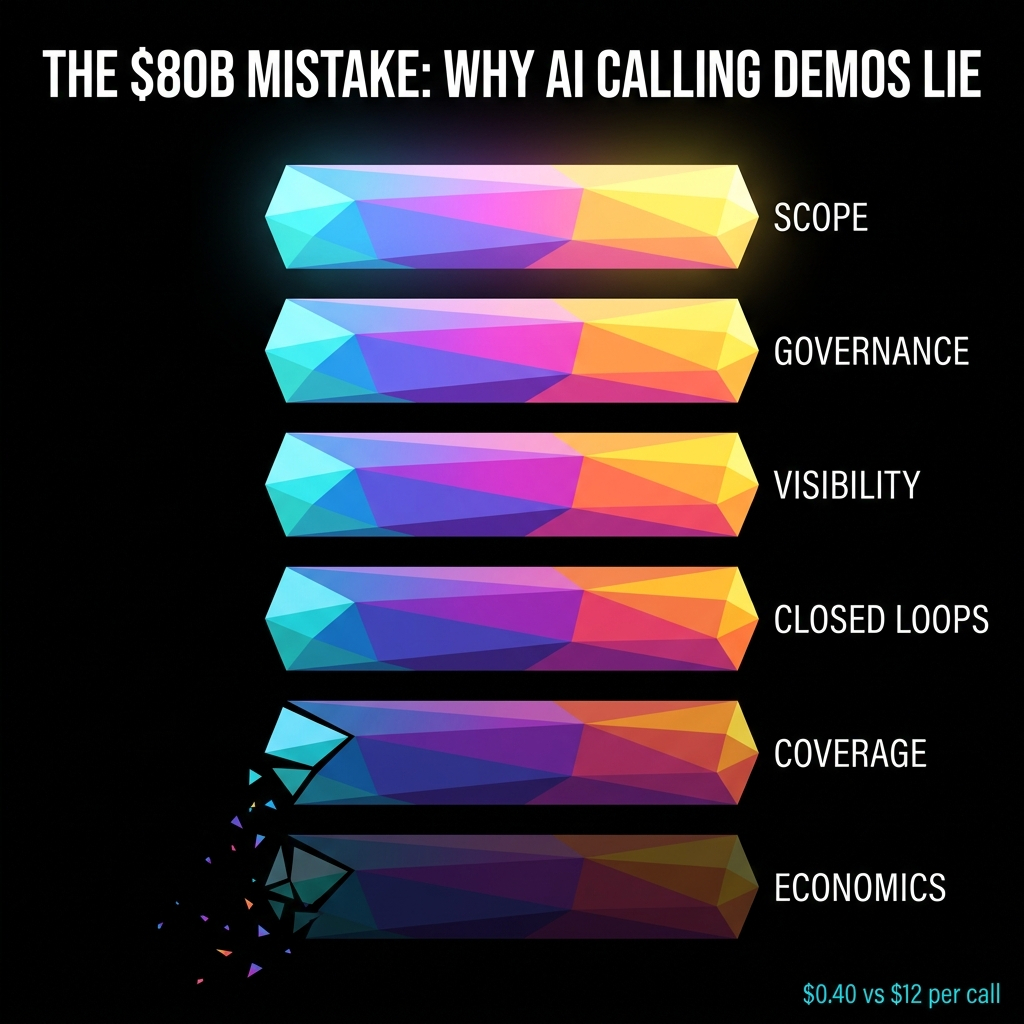
When I outline an evaluation for any AI calling tool, whether the search term is "best AI calling agent," "best AI call assistant," or "best AI calling app," I use the same six-part structure. Each part maps to a failure mode I have seen in production.
01 EXECUTION SCOPE
Define what the agent runs. Outbound dials, inbound answering, callback handling, meeting booking. Write it down before the demo.
Vendors blur categories. An AI call recorder captures conversations. An AI note taker structures them. An AI calling agent executes them. These are different layers of the stack, and buying a recorder when you need execution leaves the follow-up gap fully open.
02 GOVERNED WORKFLOWS
Check who controls what the agent says and does. Deterministic qualification logic beats improvisation. The agent handles the conversation while the operator defines the paths, the escalation rules, and the boundaries.
This matters more every quarter. The EU AI Act entered partial enforcement in 2025, multiple US states now require AI disclosure on phone calls, and HIPAA enforcement explicitly covers AI voice interactions. Ungoverned agents are becoming legal exposure.
03 VISIBILITY LAYER
Every call logged. Every outcome captured. Every commitment routed to a next action. If it is not tracked to completion, it did not happen.
Poor evaluation metrics hide lost opportunities caused by CRM sync failures, delayed follow-ups, and incomplete data capture. The visibility layer is the foundation, and it stays foundational whether you are evaluating a full call center suite or a single call screener.
04 CLOSED LOOPS
Trace what happens after the call ends. A booked meeting lands on a connected calendar. A callback request becomes a scheduled action with an owner. A qualified lead routes into the pipeline with structured post-call artifacts attached.
Open loops are where intent dies. Verify each one closes automatically.
05 COVERAGE WINDOW
Roughly 30% of high-intent business calls happen outside standard business hours. Most companies have normalized letting those calls hit voicemail, which means they have normalized a revenue leak.
Confirm the agent runs continuously and confirm the after-hours calls flow into the same tracked record as everything else. Coverage without logging just moves the leak somewhere darker.
06 AUDITABLE ECONOMICS
Demand production numbers, then verify you can reproduce the measurement yourself. Gartner forecasts $80 billion in contact center labor cost savings by 2026, with per-call costs dropping from $7 to $12 for a human agent down to about $0.40 for voice AI. Real deployments show the pattern at smaller scale: one AI agent contacted 6,531 written-off leads, held 997 conversations, and produced a 17x return on cost.
Those numbers are only trustworthy when the underlying records are visible. Auditable economics require auditable execution.
How This Outline Applies Across the Category
The keyword landscape here is crowded. Best AI caller. Best AI call center. Best AI call screener. Best AI calling agent for global teams. Each search reflects a slightly different operational need.
The six-part outline holds across all of them because the underlying question stays constant. Does the system make follow-through unavoidable, and can you see it.
Outbound sales teams weigh parts 01, 04, and 06 heaviest. Execution scope, closed loops, verified economics.
Support and screening teams weigh 02 and 03. Governed workflows and full visibility on inbound handling.
Global teams add regulatory mapping to part 02, since disclosure and consent rules vary by jurisdiction.
Small teams should refuse to trade governance for price. Chaos multiplies faster at small scale because nobody is watching the gaps.
⚠️ Common trap: evaluating a note taker or recorder as if it were a calling agent. Documentation tools observe execution. They do not perform it. Know which layer you are buying before you compare vendors.
Why the Market Is About to Punish Loose Evaluation
The AI agents market is projected to grow from $10.9 billion in 2026 to $182.9 billion by 2033. Adoption is soaring, and the gap between deployment and results is widening at the same time.
I read that gap as an evaluation failure at scale. Companies bought conversation quality and skipped execution architecture. They deployed agents that talk well and track nothing, then discovered they had automated the same silence that was already costing them.
The technology threshold has been crossed. Customer satisfaction with AI voice agents reached 72%, and 67% of Fortune 500 companies run production voice AI today. Voice quality stopped being the differentiator. Execution governance is the differentiator now, and compliance is becoming a barrier to entry rather than a checkbox.
The buyers who structure their evaluation around visibility and closed loops will select systems that hold up under regulatory scrutiny and revenue scrutiny at the same time. The buyers who select on demo polish will repeat the manual follow-up failure with a better-sounding voice attached.
The Outline, Compressed
Here is the full evaluation structure in one place. Run every vendor through it in order.
✓ Execution scope: written definition of what the agent runs
✓ Governed workflows: operator-defined logic, regulatory alignment
✓ Visibility layer: every call logged, every outcome captured
✓ Closed loops: every commitment routed to a tracked next action
✓ Coverage window: continuous operation inside the same record system
✓ Auditable economics: reproducible measurement, verified in production
My conviction after years in this gap is simple. The best AI calling agent is the one that makes the right action inevitable and keeps every action visible. Everything else is a feature comparison, and features are the least durable part of any platform.
Start your next vendor evaluation with the visibility layer. The rest of the decision gets clearer from there.