
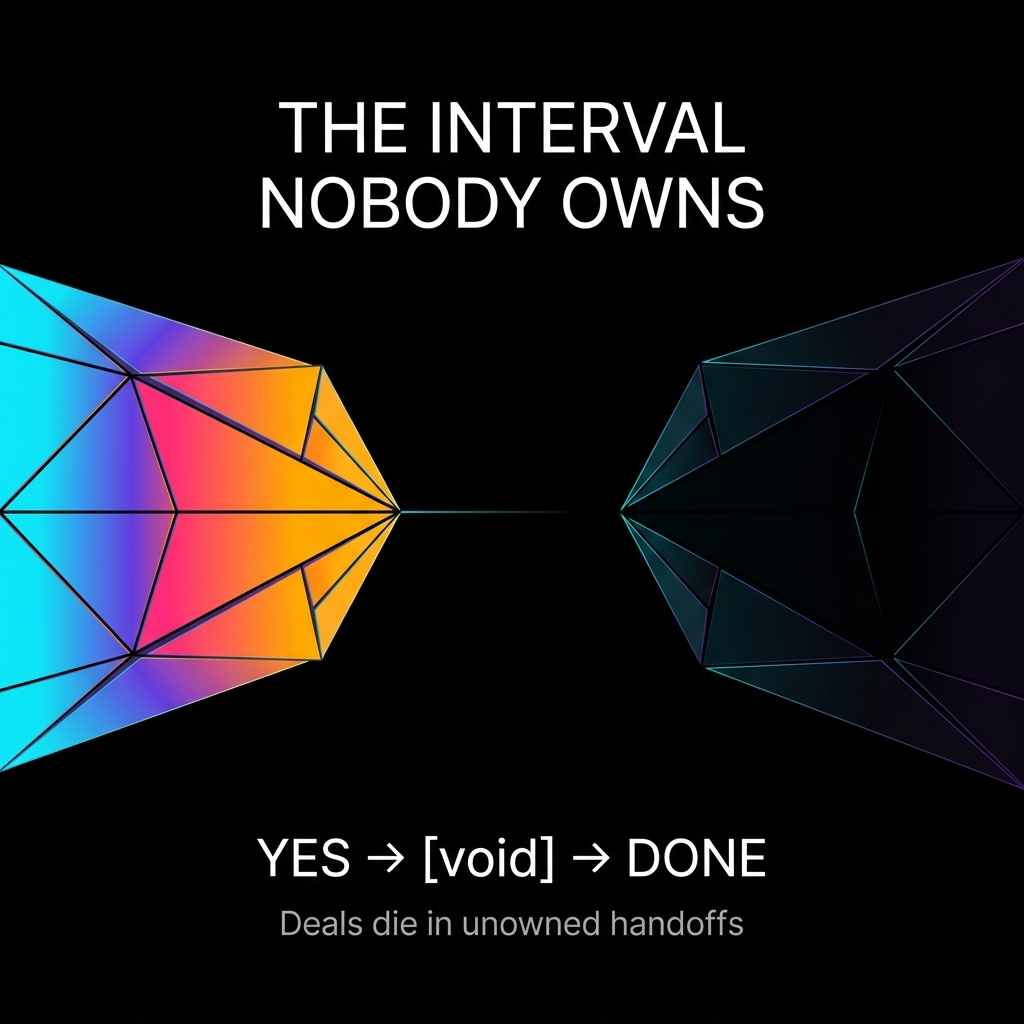
The prospect said yes. The meeting got booked. The rep moved on.
I have watched this sequence play out enough times to stop treating it as bad luck. A deal earns a genuine commitment, everyone feels the win, and then the deal goes silent. No dramatic loss. No competitor swoop. Just an interval where nothing happens, and by the time anyone notices, the momentum is gone.
The common explanation flatters the organization: the rep dropped the ball, or the prospect was never serious. I want to trace a different cause, because the pattern is too consistent to sit inside any one person.
The Interval Nobody Owns
Two jobs live inside every deal. The first job is getting to yes. The second job is getting from yes to done.
Most revenue organizations have staffed, trained, and instrumented the first job with care. Pipeline stages, qualification logic, coaching, dashboards. The machinery around commitment is dense.
The interval after commitment runs on something thinner: individual memory.
The callback that needs to happen. The document that needs to route. The internal handoff to onboarding or legal or finance. These actions sit in the space between two stages, and attention naturally lands on the stages, not the seams between them.
💡 A useful test: ask whether a good outcome depends on someone remembering, or on the structure making that outcome the default. If it depends on memory, you have located the gap.
Why Your Best Rep Hits the Same Wall
Here is the part that surprises most revenue leaders. The gap does not discriminate by talent.
When a problem shows up for your average performers, the instinct is to train and coach. That instinct assumes the cause sits inside the person. A reliable way to test that assumption is simple: watch your best rep.
Your top performer carries more deals, holds more open loops, and fields more inbound. The post-commitment interval demands the same silent follow-through from them as from everyone else, and volume makes that follow-through harder to hold in one head.
When your strongest operator hits the same silence, the cause sits below the operator. A quality gap this consistent points to an unbuilt structure.
Execution dies in handoffs. The fix is to remove the handoff, not to motivate the person carrying it.
Silence Is Data
The reason this problem stays invisible is that it produces no signal. A lost deal generates a record. A stalled contract generates a record. A committed deal that quietly cools generates nothing at all.
The absence of activity reads as neutral waiting. It is not neutral. It is an event with a cause.
Every unlogged callback and every untracked next action is a place where the deal left the system and entered someone's short-term recall. Once an action leaves the system, visibility ends. And where there is no visibility, there is no accountability.
💡 Read the quiet interval as an event. The moment you can see it, you can govern it.
Ownership Should Transfer at Conversion
The design flaw is a missing transfer of ownership.
The moment a deal converts to a commitment, responsibility for the next motion should move from a person to a system. The rep secured the yes. The interval that follows belongs to an architecture that makes the next action automatic and visible.
Concretely, that means the post-commitment moment triggers defined behavior:
- The next action gets captured the instant the commitment lands.
- The callback becomes a calendar-connected action, not a mental note.
- The handoff gets routed to the owning function with a record attached.
- Every step stays logged and observable to the operator watching the account.
None of this depends on discipline. It depends on the interval having an owner, and that owner being a system rather than a memory.
What Redirecting the Diagnosis Actually Changes
When the diagnosis moves from people to structure, the response changes with it.
Training budgets aimed at the interval do not close it, because talent applied to an ungoverned interval produces the same silence. Structure applied to that interval makes the outcome default.
This is why the problem scales by design rather than by headcount. You do not add more reminders. You make the right action inevitable, tracked to completion, and visible to the person accountable for the number.
The organizations that keep misdiagnosing this will keep spending on the wrong layer. They will manage performance around a void that no performance can fill. And they will keep losing deals they already earned.
The One Line to Carry Out of Here
The quiet death of a committed deal comes from an unowned, undesigned interval between yes and done. No amount of rep quality covers it, because the missing piece is architecture.
Look at your own pipeline. Find the deals that went silent after a clear commitment. Ask who owned the interval, and whether that owner was a role, a system, or a hope that someone would remember.
The answer tells you exactly what to build.