
I trusted a green board once. Every task closed. Every field filled. The status display told me the pipeline was healthy, and I believed it because the color was built to make me believe it.
Then I opened the transcripts.
The rep had finished the call. The task was marked complete. The system considered its job done. But inside the recording sat a promise: a callback next Tuesday, a follow-up on pricing, a commitment to send the contract. That promise lived in a transcript no one was required to open. So it died there.
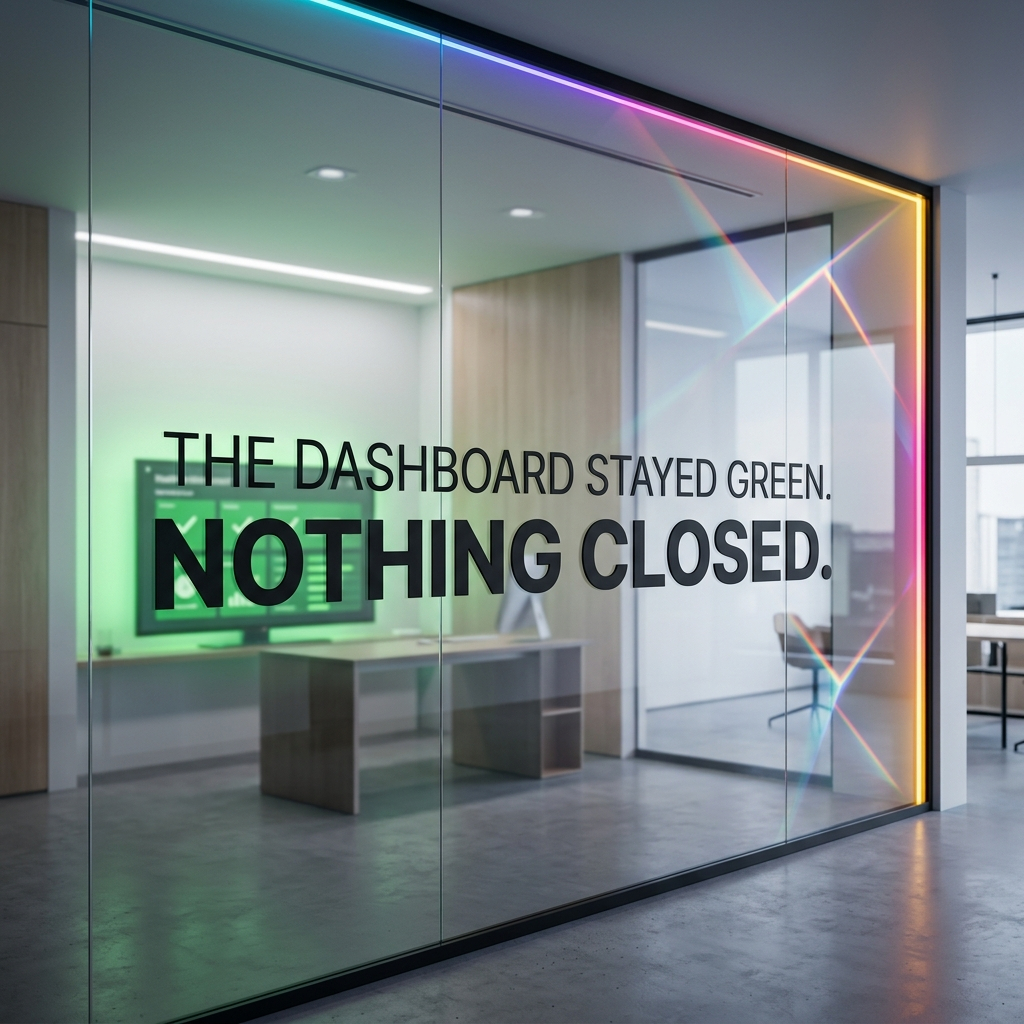
The dashboard stayed green. Nothing closed.
The Record Is Not the Event
Here is the distinction most teams skip. A CRM entry is a stand-in for something that happened in the real world. The record and the event it claims to represent can drift apart, and usually do.
Logging a call captures that a call occurred. It does not capture what the call obligated you to do next. The system rewards the act of recording, so recording is what you get. The follow-through gets treated as residue: unstructured, unowned, unread.
This is why the data problem runs deeper than most audits admit. 91% of CRM data decays annually, and reps spend 5.5 hours per week on entry nobody trusts. Every adoption push asks a rep to choose between logging and selling. They choose selling. They should.
The instability is not a discipline failure. It is what happens when a workflow depends on perfect manual entry to stay true.
Where Accountability Quietly Ends
Trace any handoff and you find a seam. One party's job is declared done. The next party's job never formally begins.
The AI voice platform completes the call and hands off a transcript. The rep logs the task and moves on. The promised callback sits in the gap between those two moments, belonging to no process and no owner.
That silent gap is where revenue disappears. Not through incompetence. Through design.
The behavioral evidence is blunt. 44% of sales reps give up after one attempt, yet it takes at least five follow-ups to close most sales. High-growth teams average sixteen touches per prospect. The average rep makes 1.3. That distance is a systems gap. High-growth companies build workflows that ensure follow-up happens whether or not any individual remembers to do it.
Move the wanting a lot, and the doing moves about half as much. Intention is not a mechanism. Ownership of the next action is.
Reclassify the Problem Before You Solve It
Most leaders file CRM integrity under hygiene. Cleaner entry. Better training. More discipline. That category is comfortable because it points the fix at people rather than architecture.
The real category is design. The workflow automates the part of the work that is easy to represent as a record. It leaves the part that creates value living as a transcript no one opens.
Integrity fails at the seam where recording ends and acting was supposed to begin. So the fix belongs in how the workflow assigns ownership of the next action, not in how neatly the last one was logged.
💡 The audit that matters: Stop measuring how complete your records are. Start measuring how many committed next actions your system tracked to completion without a human remembering to do it.
AI Does Not Repair a Structural Gap
Many teams now bolt AI onto the CRM and expect the data problem to resolve. It will not. AI does not create good data from bad data. Technology improves performance inside a process. It does not replace a process that was never built to govern outcomes.
AI that handles the conversation makes the gap worse in one specific way. It generates more transcripts, more captured intent, more residue. The volume of unopened commitments grows while the mechanism for acting on them stays absent.
You end up automating the record faster than ever, and automating the action not at all.
Read the Color of Comfort
A status display trends toward reassurance because reassurance is what it was engineered to produce. The green does not report reality. It reports the completion of administrative tasks.
The cost is measurable. 44% of companies lose over 10% of annual revenue to bad data. A 30 million dollar company wastes 3 million a year chasing the wrong contacts, all while the board shows healthy.
The dashboard is honest about what it was built to measure. It is silent about everything it was never wired to carry.
What Closing the Seam Actually Requires
The work is structural. Visibility comes before accountability. Every commitment made on a call has to become a tracked object, not a line in a transcript. Every next action needs an owner assigned by the system, not by memory.
Three shifts define the change:
- Capture the commitment, not just the contact. The callback promised on the call becomes a logged, owned, auditable action the moment the call ends.
- Assign the next step by design. The workflow routes the follow-through to a defined owner so it never depends on someone reopening a recording.
- Track to completion. If it was not closed, the record reads open. Green means closed, not logged.
Govern the outcome first. Scale after. A system that multiplies activity without tracking action multiplies the exact failure you are trying to see.
The Real Standard
You have felt the relief of a clean board. You have also, later, found the promise that sat unread until the deal went cold. That gap between the reassurance and the reality was structural the whole time.
CRM data integrity is not about tidier entry. It is about whether your system carries a commitment from the moment it is made to the moment it is closed.
The record tells you the call happened. The question worth owning is whether the promise inside it ever got kept. Build the layer that makes that answer visible, and the green finally means something.