
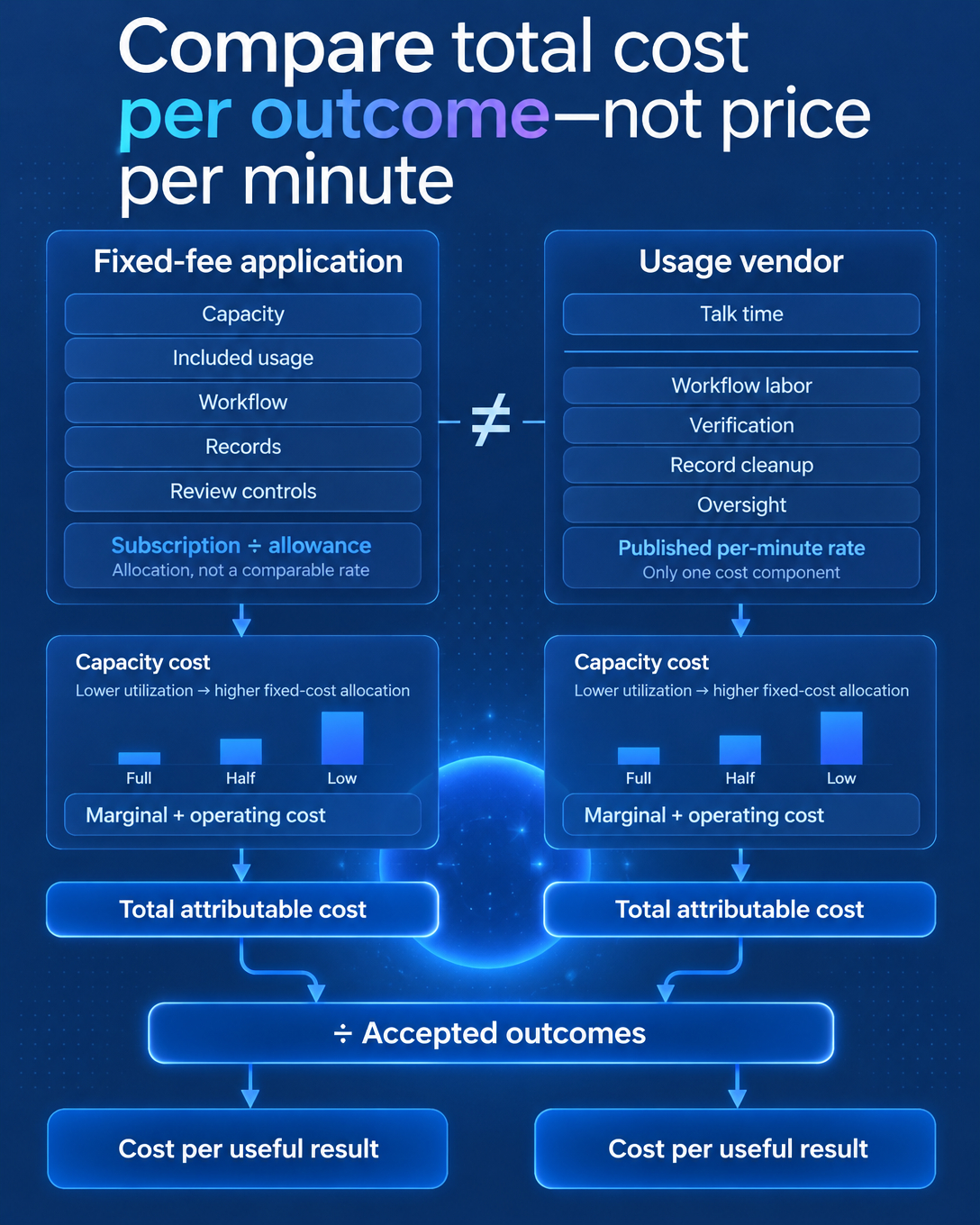
Take a platform priced at $599 per month with 500 included voice minutes. Divide the fee by the minutes and you get $1.198 per included minute, assuming you use every one of them.
That number looks like a price. It is an allocation.
The distinction matters because finance teams put that number next to a $0.07 per-minute quote from another vendor and conclude the fixed-fee platform costs seventeen times more. The comparison feels rigorous. It measures two different things.
What the Allocation Actually Tells You
Dividing a subscription by its included minutes tells you how the fee spreads across capacity if you consume all of it. It says nothing about what the subscription buys beyond minutes: the workflow, the outcome records, the booking logic, the follow-up state, the review artifacts.
A per-minute infrastructure quote prices talk time. A fixed-fee application prices an execution layer that includes talk time.
When you flatten both into a single per-minute figure, you erase everything the application does after the call ends. The spreadsheet looks clean. The decision it supports is wrong.
💡 Tip: Before comparing any two quotes, write down what each one includes. If the scopes differ, the per-minute figures cannot be compared directly.
Keep Two Columns, Always
The fix is structural. Build your budget with the fixed fee in one column and the variable tariff in another.
- Column one: capacity. The subscription fee, what it includes, and the allowance it covers. This is the price of having the system available and governed.
- Column two: marginal cost. The vendor's published rate for usage beyond the allowance, plus any telephony, transfer, or add-on charges.
This separation gives finance two answers instead of one blended number. You learn what the platform costs to hold. You learn what each additional unit of work costs to run.
Blending them hides both answers. It also assumes the subscription gets consumed evenly across the month, which rarely matches how calling campaigns actually run.
Model Low Utilization Before You Sign
The allocation changes dramatically with usage. At full consumption, the $599 plan allocates to $1.198 per minute. At 200 minutes used, the same fee allocates to nearly $3 per minute.
This is where budget conversations go sideways. A team models the expected case, signs the contract, then underuses the allowance in month one because the lead list was smaller than planned or the calling window got compressed.
Model two cases before committing:
- Expected case: your forecast workload based on approved contacts, retry policy, and realistic connection rates.
- Low-utilization case: what the allocation looks like if you run at half of forecast, or less.
If the low-utilization case still produces an acceptable cost per accepted outcome, the contract holds under pressure. If it collapses the economics, you know your real risk is utilization, and you can address it before signing rather than after.
⚠️ Warning: Do not allocate the fixed fee over included minutes in a low-utilization scenario. Allocate it over the minutes you actually used and the outcomes you actually accepted. That is the number finance needs.
The Denominator That Matters
Per-minute allocation uses the wrong denominator for a buying decision. Minutes measure consumption. Your business accepts outcomes: qualified meetings held, follow-ups completed, records updated correctly.
Divide total attributable campaign cost by qualified meetings held. Run that calculation for every platform on your shortlist, using each one's full scope of fees, usage, setup, and ongoing review work.
Now the comparison is honest. A per-minute quote that requires your team to build the workflow, verify every booking manually, and clean up records carries labor costs that never appear in its tariff. A fixed-fee application carries those functions inside its price.
Both deserve the same denominator. Cost per useful result settles the question that cost per minute cannot.
What This Looks Like in Practice
Bring the two-column budget to every vendor conversation. Ask each vendor to place their charges into your structure rather than accepting their framing of the comparison.
Record the quote date and the exact configuration quoted. Published rates change, and a quote for one deployment tells you little about another.
Then run a defined pilot and let recorded inputs replace assumptions. Actual minutes, actual outcomes, actual review time. The allocation math becomes trustworthy once the numbers underneath it are yours.
The buyers who get this right make one commitment early: no single blended number decides the purchase. Capacity cost, marginal cost, and cost per accepted outcome each get their own line. The decision gets made on all three.