
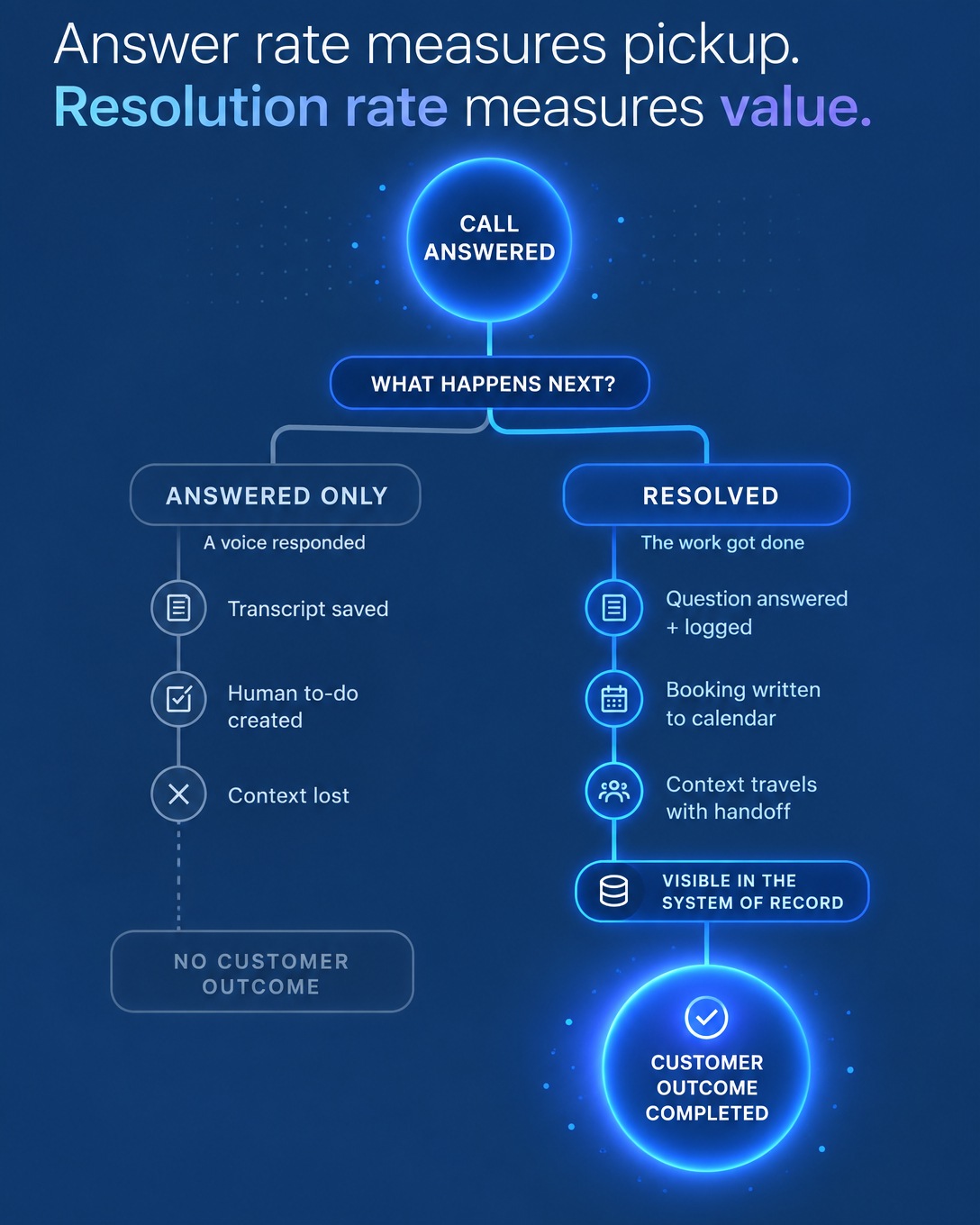
TL;DR: Most AI receptionist comparisons measure whether the phone got answered. The metric that actually matters is resolution
— whether the caller\'s problem was solved, the booking landed in the calendar, and the handoff carried context. One in four AI-handled calls currently ends without resolution. That is where revenue disappears.
AI receptionists achieve 96.4% scheduling accuracy in conversation
— but accuracy in conversation is not the same as a confirmed booking in your calendar.The current first-call resolution rate for AI receptionists is 73%, meaning roughly one in four answered calls resolves nothing.
28.5% of calls arrive outside business hours; 34.8% of those callers carry buying intent. Failing to complete after-hours bookings erases real revenue.
78% of consumers value seamless AI-to-human handoffs, yet only 15% report experiencing one.
The right evaluation framework asks three questions: What record does each call produce? Does the booking write back to the calendar? Does context travel with the handoff?
Why the Distinction Between Answered and Resolved Matters
Small business owners keep asking me the same question about AI receptionists: can it do more than take a message?
I ran the comparison myself. Four real call types, one standard for judging each: what record the system produces, how the handoff works, and whether the caller\'s problem actually got resolved.
\'Answered\' and \'resolved\' are different metrics. Most comparisons only measure the first one. That gap is where revenue disappears.
The stakes are already documented. 62% of small business calls go unanswered, and missed calls cost small businesses an average of $126,000 per year.
Those numbers only count calls nobody picked up. They ignore the calls that got answered, where the caller explained everything, and nothing happened afterward.
I call that answered theater. The phone rings, a voice responds, and the outcome dissolves in the handoff.
The industry baseline confirms the gap. The current first-call resolution rate for AI receptionists sits at 73%. That leaves roughly one in four calls where answering produced no resolution.
Bottom line: An answered call and a resolved call are not the same commercial event. Conflating them inflates your metrics and drains your pipeline.
Four Calls, Four Verdicts
I tested four common call types against one consistent standard. Here is what each scenario reveals about any AI receptionist you are evaluating.
Call 1: A Simple Question
— What Does a Basic AI Actually Deliver?
Someone asks about your hours or pricing. A basic answering service takes a message. A capable AI answers directly and logs the interaction.
Record: a transcript with the question and the answer given.
Handoff: none needed.
Resolved: yes, if the system knew the answer.
This is the easiest case, and it flatters every vendor\'s demo. Do not let it be the only scenario you test.
Key Point: Simple Q&A is a solved problem for most AI receptionists. It is not a differentiator
— it is the floor.
Call 2: A Booking Request
— Does Accuracy Mean Completion?
This is where systems separate. AI achieves 96.4% accuracy for appointment scheduling. Accuracy describes the conversation. It does not describe the calendar.
Task completion for general voice-agent workflows ranges from 87.80% to 97.56% across platforms, and booking flows add slot confirmation and write-back on top of that. The write-back is the hard part. A system can discuss availability fluently and still fail to place the appointment in your scheduling system.
Record (resolved): a confirmed slot written into your calendar.
Record (theater): a note that says \'wants an appointment.\'
Resolved: only when the booking exists in the system your team actually uses.
Key Point: Scheduling accuracy is a conversation metric. Calendar write-back is the execution metric. Only the second one closes the loop.
Call 3: The Slot Is Unavailable
— Can the System Recover?
The caller wants Tuesday at 2 PM. Tuesday is full. A weak system apologizes and ends the call. A governed system offers the nearest open slots, books one, and confirms it.
This scenario matters more than it looks. 28.5% of calls arrive outside business hours, and 34.8% of those callers express buying intent. An AI that picks up at 9 PM and fails to complete the booking delivered zero commercial value. The call counts as answered. The opportunity is gone.
Key Point: Recovery behavior separates capable systems from capable-sounding ones. A polite apology is not a resolved call.
Call 4: \'Can I Speak With Sarah?\'
— Does Context Survive the Handoff?
The caller wants a specific person. The right behavior is a warm transfer with full context, or a structured message routed to Sarah with the caller\'s name, number, reason, and urgency.
The data here is sobering. 78% of consumers value seamless AI-to-human handoffs, yet only 15% report experiencing one. When the handoff drops context, the caller restarts from zero. The first interaction resolved nothing, even though it shows up as \'handled\' in the report.
Key Point: A handoff without context is a failure that looks like success in your dashboard. Measure what the receiving human actually gets.
The Record Is the Product
After running these four scenarios, I judge every system by one artifact: the record it leaves behind.
A resolved call produces a booked appointment, an answered question with a log, or a handoff with full context attached.
An answered call produces a transcript and a to-do item for a human who is already behind.
Execution that leaves no trace is theater. If you cannot see what happened after the call, nothing happened after the call.
Key Point: The record is not a byproduct of the call
— it is the deliverable. No record means no resolution, regardless of how well the conversation went.
What You Should Measure Instead
Answer rate is a vanity metric. It tells you the phone got picked up. It tells you nothing about outcomes.
When you evaluate an AI receptionist, ask three questions:
What record does each call type produce, and where does it live?
Does a booking write back into my actual calendar, confirmed and visible?
When the system hands off to a human, does the context travel with the call?
Resolution rate is the number that pays your bills. Everything upstream of it is noise.
Run the four calls yourself before you sign anything. The systems built for execution will welcome the test. The systems built for demos will show you their answer rate.
Key Point: Swap answer rate for resolution rate as your primary evaluation metric. It is the only number that reflects what the system actually delivered.
Frequently Asked Questions
What is the difference between an answered call and a resolved call?
An answered call means the phone was picked up and a voice responded. A resolved call means the caller\'s goal was achieved
— a question was answered, a booking was confirmed in the system, or a handoff delivered full context to the right person.
What is a good first-call resolution rate for AI receptionists?
The current industry baseline sits at 73%. That means roughly one in four AI-handled calls ends without the caller\'s issue being resolved. Strong systems consistently outperform this benchmark by closing the loop through write-backs and structured handoffs.
Can AI receptionists actually book appointments, or just discuss availability?
Both capabilities exist, but they are not the same. AI achieves 96.4% accuracy in scheduling conversations. The critical differentiator is calendar write-back
— whether the confirmed slot is actually placed in your scheduling system. Many systems fail at this step.
What happens when an AI receptionist cannot fulfill a booking request?
A capable system offers alternative slots, books one of them, and confirms it. A weaker system apologizes and ends the call. Because 34.8% of after-hours callers carry buying intent, the recovery behavior directly affects revenue.
Why do AI-to-human handoffs so often fail?
78% of consumers value seamless handoffs, but only 15% report experiencing one. The failure point is context
— most systems transfer the call without passing the caller\'s name, reason, or urgency. The receiving human starts from zero, and the first interaction adds no value.
What records should a properly resolved call produce?
Depending on call type: a transcript with the answer given (simple questions), a confirmed booking visible in the calendar (appointments), or a structured message with caller name, number, reason, and urgency (person-specific requests).
How do I test an AI receptionist before committing to a contract?
Run all four call types yourself: a simple question, a booking request, an unavailable-slot scenario, and a request to speak with a specific person. Judge each by the record produced, not the fluency of the conversation. Systems built for execution will welcome this test.
Is answer rate a useful metric at all?
As a baseline check, yes
— it confirms the system is picking up. As a primary evaluation metric, no. Answer rate tells you the phone got picked up. It says nothing about what happened to the caller\'s intent after that.
Key Takeaways
\'Answered\' and \'resolved\' are not interchangeable metrics. Only resolution reflects commercial value.
The current first-call resolution rate for AI receptionists is 73%. One in four calls ends without resolution.
Scheduling accuracy (96.4%) measures conversation quality. Calendar write-back measures execution. Evaluate both.
After-hours call recovery matters: 34.8% of after-hours callers have buying intent. Failing to complete those bookings is a direct revenue loss.
Seamless handoffs are rare: 78% of consumers want them, but only 15% get them. Measure what context the receiving human actually receives.
The record a call produces is the product. No trace means no resolution.
Before signing a contract, run all four call types yourself. Systems built for execution will welcome the test.