
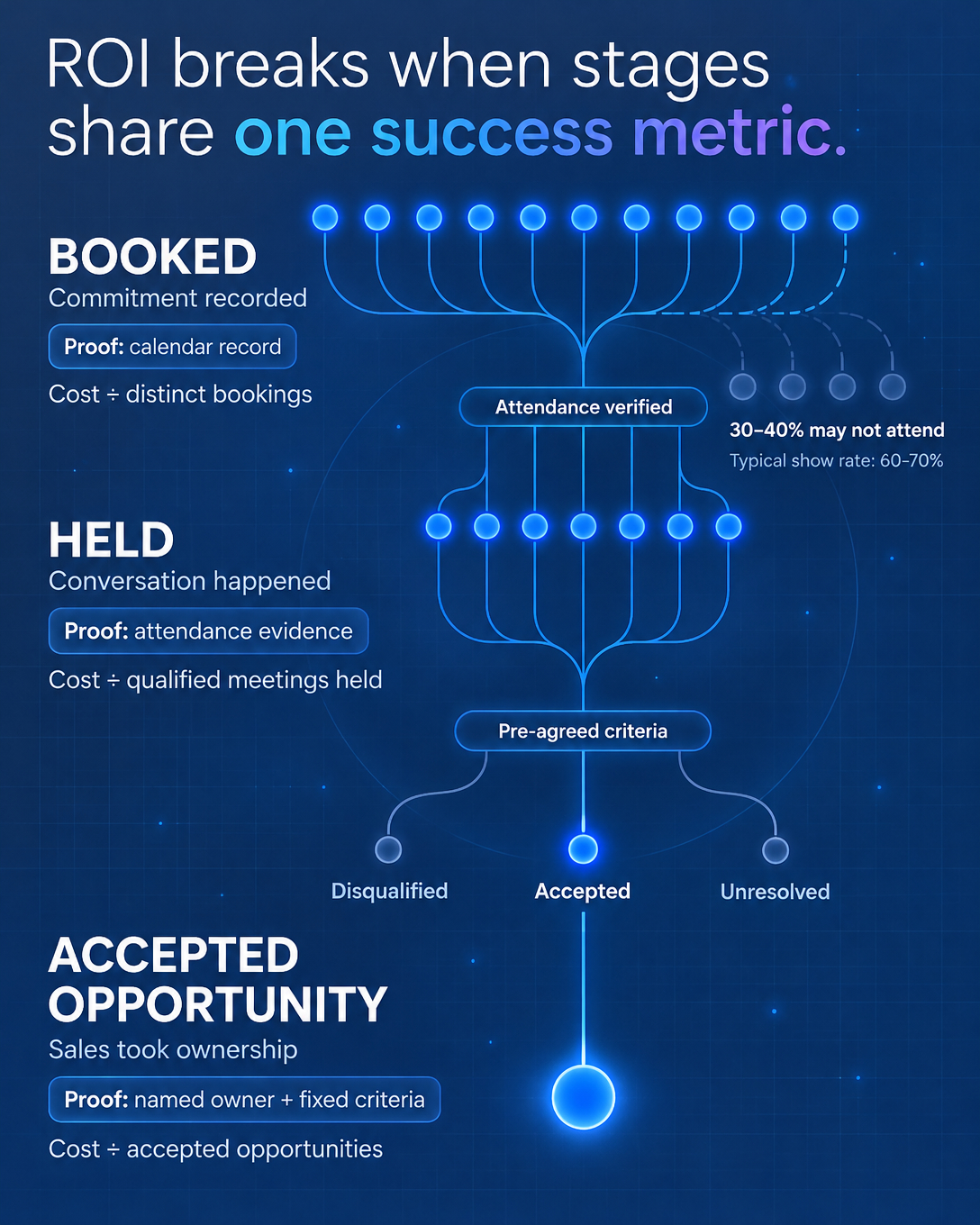
Revenue teams report bookings. Finance wants held meetings. Sales accepts opportunities. These are three different events, and each one requires its own status and its own evidence.
When an AI outbound pilot treats them as one number, the ROI calculation stops describing reality. We build infrastructure for exactly this problem, so we want to define the stages precisely and give you an acceptance framework to write before your pilot starts.
Why collapsing the stages produces false ROI
MIT's NANDA study found that only 5% of enterprise GenAI pilots achieve measurable revenue acceleration, while the other 95% stall with no P&L impact. The teams running those pilots typically layer new AI on top of broken measurement frameworks. The technology executes. The measurement collapses.
The collapse starts with a single conflation: counting a calendar invite as a commercial result.
Industry data shows cold-sourced meetings carry a 60 to 70 percent show rate, which means 30 to 40 percent of booked meetings never happen. A pilot report that divides cost by bookings inflates performance by exactly that margin. Pipeline looks healthy. Pipeline fails to convert. Finance rejects the number, and the pilot dies in review.
Define each stage before the first call
Each stage answers a different question and demands different evidence.
Booking: a commitment was recorded
A booking proves someone accepted a calendar invite. Nothing more. The evidence is the connected calendar record: attendee, time, campaign context. Count distinct bookings against distinct contacts, never against dialing attempts.
Held meeting: the conversation happened
A held meeting proves attendance. This stage is where reporting quietly breaks, because standard CRMs make bookings easy to count and held meetings hard to count. Someone has to disposition the calendar event afterward. When nobody owns that step, booked becomes the headline number and the execution shortfall goes unmanaged for quarters.
Assign an owner for disposition before the pilot launches. A held meeting without attendance evidence stays unresolved. It never defaults to held.
Accepted opportunity: sales took ownership
An accepted opportunity proves the meeting met your pre-agreed qualification criteria and a named person in sales accepted it. Record disqualification reasons. Record unresolved cases. An opportunity accepted under criteria written after the results arrived is a result that cannot be audited.
Write the acceptance definition first
Before go-live, document one page that your sales, operations, and finance leads all sign:
- Qualified means: the buyer fit, purpose, and authority requirements, written in advance.
- Held means: the attendance evidence you will accept, and who checks it.
- Accepted means: the named person who decides, and the criteria they apply.
- The cohort: which contacts, which window, which attribution method.
- The denominators: unique contacts stay separate from attempts.
This document is the pilot's constitution. Research on measuring AI voice ROI identifies three practices that inflate results: per-attempt connect rates instead of lead-level rates, reporting only the best time window, and shifting the success metric after seeing results. A signed acceptance definition makes all three impossible.
Execution that is traceable can be trusted. Execution that only appears in a dashboard summary is theater, and theater fails financial review.
Report three ratios, keep them separate
With clean stage definitions, the pilot report becomes three honest ratios:
- Cost per booking tells you what commitment costs.
- Cost per qualified meeting held tells you what a real conversation costs.
- Cost per accepted opportunity tells you what sales actually received.
The spread between the first and third ratio shows you precisely where execution breaks: in show rate, in qualification, or in sales acceptance. Each failure mode has a different fix, and each fix has a different owner.
If a denominator is zero, report the count as zero and the ratio as undefined. A pilot that tells you the truth early is worth more than a pilot that flatters you for a quarter.
The standard to hold your vendor to
Ask any AI calling vendor one structural question: which evidence does the system persist for each stage, and can your team inspect it. Recordings, booking records, attendance states, and acceptance decisions should survive the call and connect to the record your team already trusts.
We built Vantara on the premise that outcomes should be deterministic and inspectable, because governed execution is the entire value proposition. Write your acceptance definition this week, before the pilot, and every result that follows becomes a number your finance team can defend.