
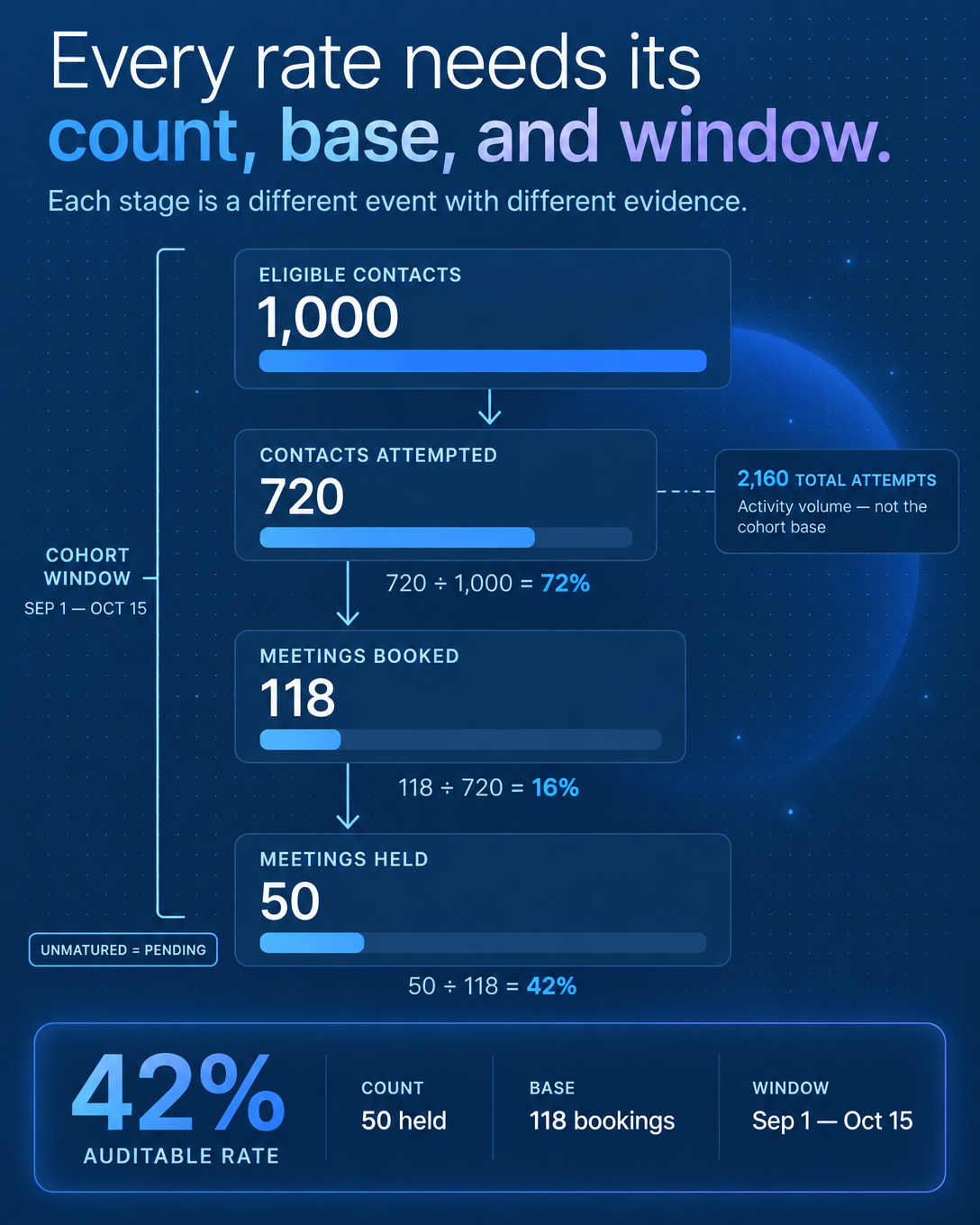
A funnel report with one shared denominator produces numbers that look clean and mean very little. We learned this building execution infrastructure for revenue teams, where every count has to survive a finance review.
Our position is simple. Each stage needs a distinct count, a distinct denominator, and a distinct observation window. When any of the three is missing, the rate stops being evidence and becomes decoration.
The Eight Stages, Defined Separately
Here is the template we recommend, from first contact to recognized money.
- Eligible contacts. Distinct people approved for this workflow and reporting window.
- Contacts attempted. Distinct eligible contacts with an actual attempted call. Show total attempts as a separate number.
- Live human contacts. Distinct contacts where a relevant live connection is supported by evidence.
- Qualified contacts. Distinct contacts meeting the pre-agreed qualification definition.
- Meetings booked. Distinct bookings confirmed in the connected record.
- Qualified meetings held. Booked meetings with attendance and acceptance evidence.
- Accepted opportunities. Opportunities your sales team accepted under declared criteria.
- Realized contribution. Recognized attributable revenue minus agreed fulfillment costs.
Each row is a different event with different evidence. A booked time, a completed conversation, and an accepted opportunity each keep their own status. Blending them hides the exact stage where execution breaks.
A Retry Adds an Attempt, Never a Person
This is the most common denominator error we encounter. A campaign dials 2,000 contacts three times each and reports 6,000 in the base. Every downstream rate shrinks by a factor of three, and the team concludes the channel underperforms.
Keep unique contacts and total attempts in separate columns. The cohort stays the same size no matter how many retries the policy allows.
The base itself also erodes over time. B2B contact data decays by roughly 30% a year, so a list of 50,000 loses about 15,000 valid records inside twelve months. An eligible-contacts count that ignores decay reports attempt rates against a fiction.
Small Rate Errors Compound Across Stages
Precision at each stage matters because the stages multiply. With 10,000 entrants, the difference between 30% and 35% conversion per stage turns 24 customers into 53 by stage five. A measurement error that looks tolerable in one row doubles or halves the final output.
Data quality amplifies this. Research shows 76% of CRM entries are less than half complete. A qualified-meetings-held rate calculated from records with blank qualification fields is arithmetic performed on absence.
If the denominator is undefined, the rate is undefined. Report the count and label the ratio as unavailable rather than inventing a base.
State the Denominator Next to Every Rate
A booking-to-held rate uses held meetings divided by bookings from the same tracked cohort. A contact-to-held rate uses unique eligible or attempted contacts, and the report must say which one.
The same label applies to time. Outcomes that have not matured get reported as pending, with the cutoff date written beside them. A meeting booked on the last day of the window belongs to a different maturity cohort than one booked in week one.
💡 Tip: Add a denominator column to the report itself. When finance reads "held rate: 42%, base: 118 bookings, window: Sept 1 to Oct 15," the number becomes auditable in one glance.
Why We Hold This Line
Execution that cannot be traced functions as theater. We build systems around that belief, and the funnel report is where the belief gets tested first.
The stakes are concrete. 79% of sales organizations miss their forecast by more than 10%, and the frequent root cause sits in undefined observation windows and inconsistent denominators across pipeline stages. Ambiguous stage definitions force your team to reconcile numbers by hand instead of selling.
Where to Start
Write the eight definitions before the next campaign launches. Name the person who decides whether a meeting counts as qualified and held. Record disqualification reasons and unresolved cases instead of deleting them.
Early-stage teams can begin with the four stages that matter most for their motion, usually eligible contacts, attempts, meetings booked, and qualified meetings held, then extend toward accepted opportunities and realized contribution as volume grows.
A number earns trust when you can show its count, its base, and its window. Build your report so every rate carries all three, and your expansion decisions start resting on evidence instead of averages.