
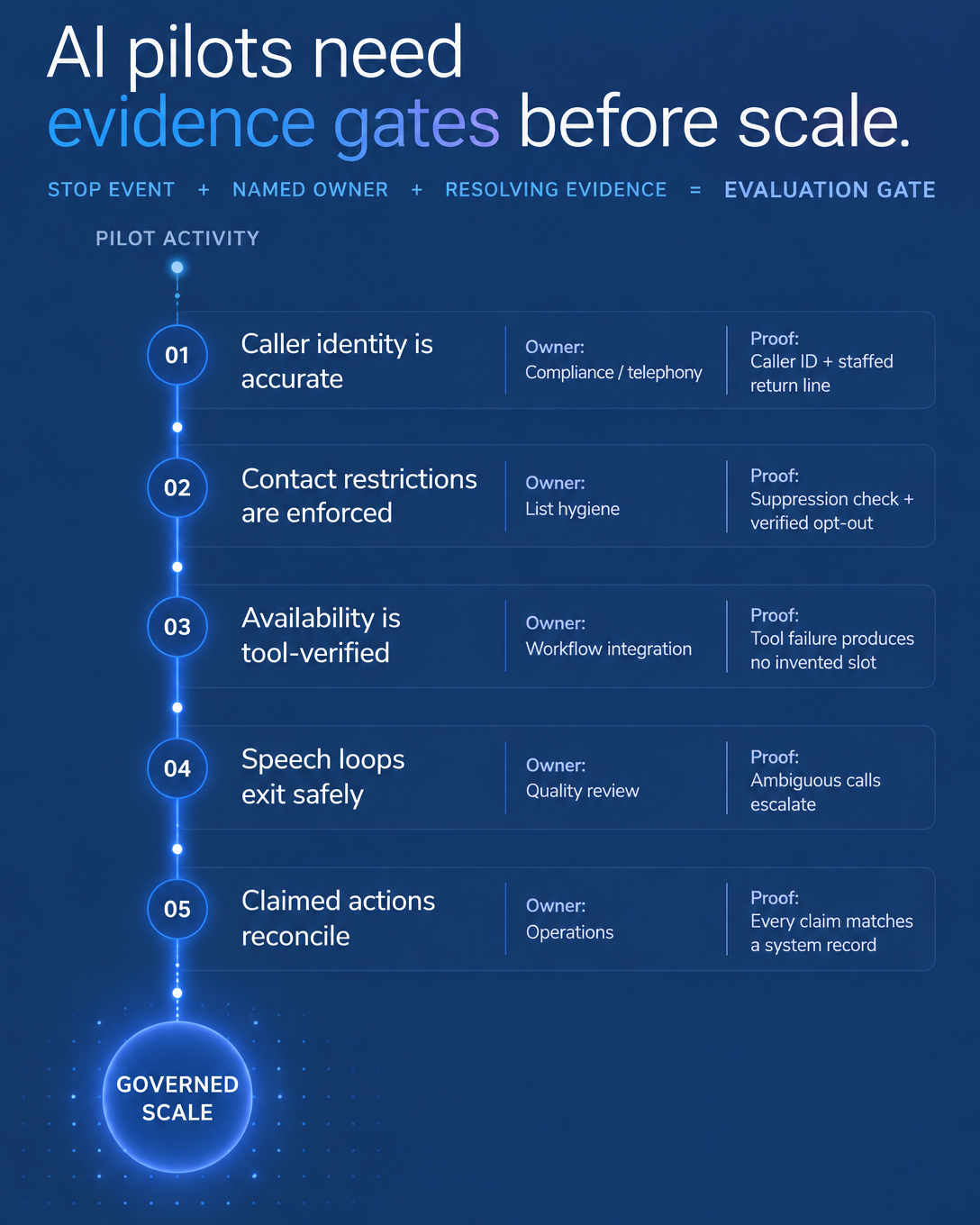
An AI voice pilot that produces meetings can still fail the review that matters. The calls sound fine, the dashboard shows activity, and then someone asks who verified the caller identity, who checked the suppression list, and who confirmed the bookings actually exist.
Answer those questions before the pilot starts. Agree on a short list of events that stop the program immediately, assign an owner to each one, and define the evidence that resolves it. This article covers the five blockers that belong on that list.
Why the blocker list comes before the pilot
A blocker discovered mid-pilot forces a decision under pressure, with incomplete evidence and a vendor relationship already in motion. A blocker agreed in advance is a simple gate. The behavior either occurred or it did not, and the named owner acts on the record.
These five items are evaluation gates, requirements you test against any platform. Listing them makes no claim that a specific vendor has failed them. It makes a claim about what your deployment must prove.
The five blockers and who owns each one
1. Wrong caller identity presented to the recipient
Every outbound call must transmit an accurate caller ID that routes to a working line your business staffs. Misleading caller ID on automated calls violates both the TCPA and the Truth in Caller ID Act, and TCPA violations carry statutory damages of $500 to $1,500 per call.
Owner: your compliance or telephony lead. Resolving evidence: a test call log showing the transmitted number, plus confirmation that the number connects back to a staffed line.
2. Contact restrictions ignored
AI-generated voices count as prerecorded under TCPA rules, which triggers the same consent requirements as traditional robocalls. The FTC receives roughly 250,000 TCPA complaints per month, and each unauthorized call counts as a separate violation.
Owner: whoever controls list hygiene. Resolving evidence: a documented suppression check on the pilot cohort and a verified record that a tester's opt-out request stopped further contact.
3. Availability invented when the calendar action fails
This blocker produces the most damage per incident because the agent sounds certain while being wrong. Confident false availability, such as offering 3 PM when the calendar is full, is the most dangerous failure mode in voice AI. The fix is architectural. The agent never states a time without a successful calendar check, and when the tool fails, it says so and takes a message.
Owner: your integration or workflow owner. Resolving evidence: a forced tool failure during testing, with the recording showing the agent declined to invent a slot.
4. Repeated speech loops the agent cannot exit
Loops typically start with ambiguous input. The agent latches onto its most probable response and repeats it when uncertain. Set explicit exit rules: after the same question appears twice, the agent acknowledges what it already knows, and after three exchanges without progress, it escalates to a human.
Owner: your quality reviewer. Resolving evidence: recordings of noisy, interrupted, and vague-answer scenarios where the agent exited the loop or transferred the call.
5. Critical actions reported complete without evidence
This failure hides inside clean dashboards. Tool misuse and incorrect tool arguments account for roughly 31% of production failures in recent agent deployments, and the output looks locally coherent while the action is wrong. A booking claim without a matching calendar record counts as unresolved, never as success.
Owner: your operations lead. Resolving evidence: a reconciliation of every claimed action against the connected system record for the full test batch.
Make the gates part of procurement, then part of the pilot
Execution you cannot trace is unverified. Governance comes before scale, and the blocker list is the first governance document your pilot needs.
Write the five gates into your evaluation plan. Give each owner the authority to stop calling activity, and require written evidence before any gate closes.
Bring the list to every vendor demonstration and ask to see the evidence path for each blocker in your specific workflow. A platform built for governed execution will show you the records. That walkthrough tells you more about scaling readiness than any demo call.
Settle the gates first. Your pilot then answers the only question worth asking: whether this workflow earns the right to expand.