
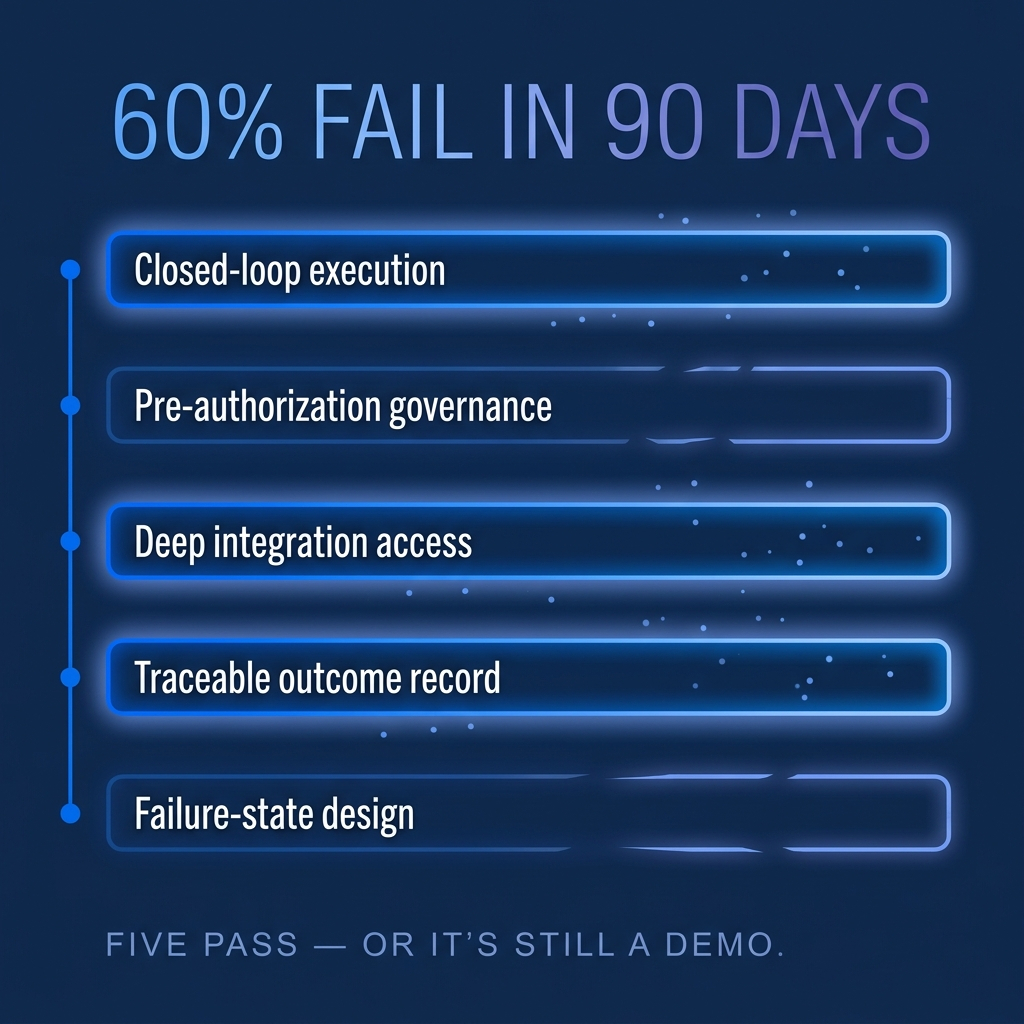
TL;DR: Most voice AI deployments don't fail because the AI is broken. They fail because the right evaluation criteria were never applied during the buying process. These are the five questions I ask before any system earns the right to run.
Closed-loop execution means the agent completes post-call actions without human intervention.
Governance must happen before execution, not after it.
Production requires deep write access to systems of record — not surface-level integrations.
Every agent decision must be traceable and auditable.
Failure-state design must be built in, not bolted on after something goes wrong.
I have watched enough voice AI deployments collapse to see the pattern. Roughly 60% of deployments that pass demo evaluation fail within 90 days of production. The failure was visible at week zero. The buying conversation skipped the criteria that would have caught it.
Here is what I ask before any system earns the right to run.
1. Does It Close the Loop After the Call?
The agent must tell you what happened after the call without a human logging anything.
If your team still updates the CRM, books follow-ups, and reconciles outcomes by hand, you bought a call tool — not an intelligent agent.
Key Point: Closed-loop execution is the baseline. Without it, you're adding AI to a manual process, not replacing one.
2. Does Governance Live Before the Action — Not After?
Controls must assess intent and authorization scope before execution completes.
An agent that acts first and gets reviewed later is running unsupervised. Pre-authorization is not optional — it is the architecture.
Key Point: Post-review governance is not governance. Authorization must happen before the action, every time.
3. How Deep Does the Integration Go?
Surface reads look fine in a demo. Production requires deep write access to your systems of record.
Over 80% of failures occur at the integration layer — because the solution could read data but not act on it reliably at scale.
Key Point: Integration depth is where demos lie. If the vendor can't demonstrate write access to your systems of record, the demo isn't showing you production.
4. Can You Reconstruct What the Agent Did and Why?
You need to reconstruct what the agent decided, why it decided it, and what it committed to.
If that record fails an audit, it fails your customer too. Traceability is not a reporting feature — it is accountability infrastructure.
Key Point: No traceable outcome record means no accountability — to your team or to your customers.
5. What Happens When It Fails?
Escalation paths, human handoff protocols, recovery modes — these must be designed in, not discovered under pressure.
Designed failure stays contained. Discovered failure reaches your customer.
Key Point: Every production system fails eventually. The only question is whether the failure was planned for.
The Standard I Hold
Vendors who answer all five are selling infrastructure. Everyone else is selling a demo.
Frequently Asked Questions
What is closed-loop execution in voice AI?
Closed-loop execution means the AI agent completes all post-call actions — CRM updates, follow-up scheduling, outcome reconciliation — without requiring human intervention. If manual steps remain, it is a call tool, not an agent.
Why does pre-authorization matter in AI governance?
Pre-authorization ensures controls assess intent and scope before an action executes. An agent reviewed only after the fact is effectively unsupervised — and unsupervised AI causes damage before anyone notices.
Why do most voice AI deployments fail in production?
Roughly 60% of deployments that pass demo evaluation fail within 90 days of going live. The failure is almost always traceable to evaluation criteria that were skipped during the buying process — not to the AI itself.
What does integration depth mean for voice AI?
Integration depth refers to whether the system has true write access to systems of record. Surface-level integrations can read data and look functional in demos, but they break under real production loads because they cannot reliably act on that data.
What is failure-state design?
Failure-state design means the system has pre-defined escalation paths, human handoff protocols, and recovery modes. It is the architecture that keeps a failure contained rather than letting it surface directly to a customer.
How do I know if a vendor is selling infrastructure vs. a demo?
Ask all five questions — closed-loop execution, pre-authorization, integration depth, traceable outcomes, and failure-state design. Vendors with real infrastructure can answer all five specifically. Vendors selling demos cannot.
What is a traceable outcome record?
A traceable outcome record is a complete, auditable log of what an AI agent decided, the reasoning behind each decision, and the commitments it made. Without it, internal accountability and customer accountability both break down.
Is voice AI ready for production use?
Some solutions are. The ones that are production-ready treat governance, integration depth, and failure-state design as architectural requirements — not afterthoughts. The evaluation criteria above are how you tell the difference.
Key Takeaways
60% of voice AI deployments that pass demos fail within 90 days — almost always because the buying conversation skipped the right criteria.
Closed-loop execution is the baseline: the agent must complete post-call actions without human involvement.
Governance must be pre-authorization, not post-review. If the agent acts before authorization is confirmed, it is unsupervised.
Integration depth is where most failures hide. Surface reads work in demos; production requires write access to systems of record.
Every agent decision must be traceable and auditable — for internal accountability and for customers.
Failure-state design is not optional. Designed failure stays contained. Discovered failure reaches your customer.
Vendors who can answer all five questions are selling infrastructure. Everyone else is selling a demo.