
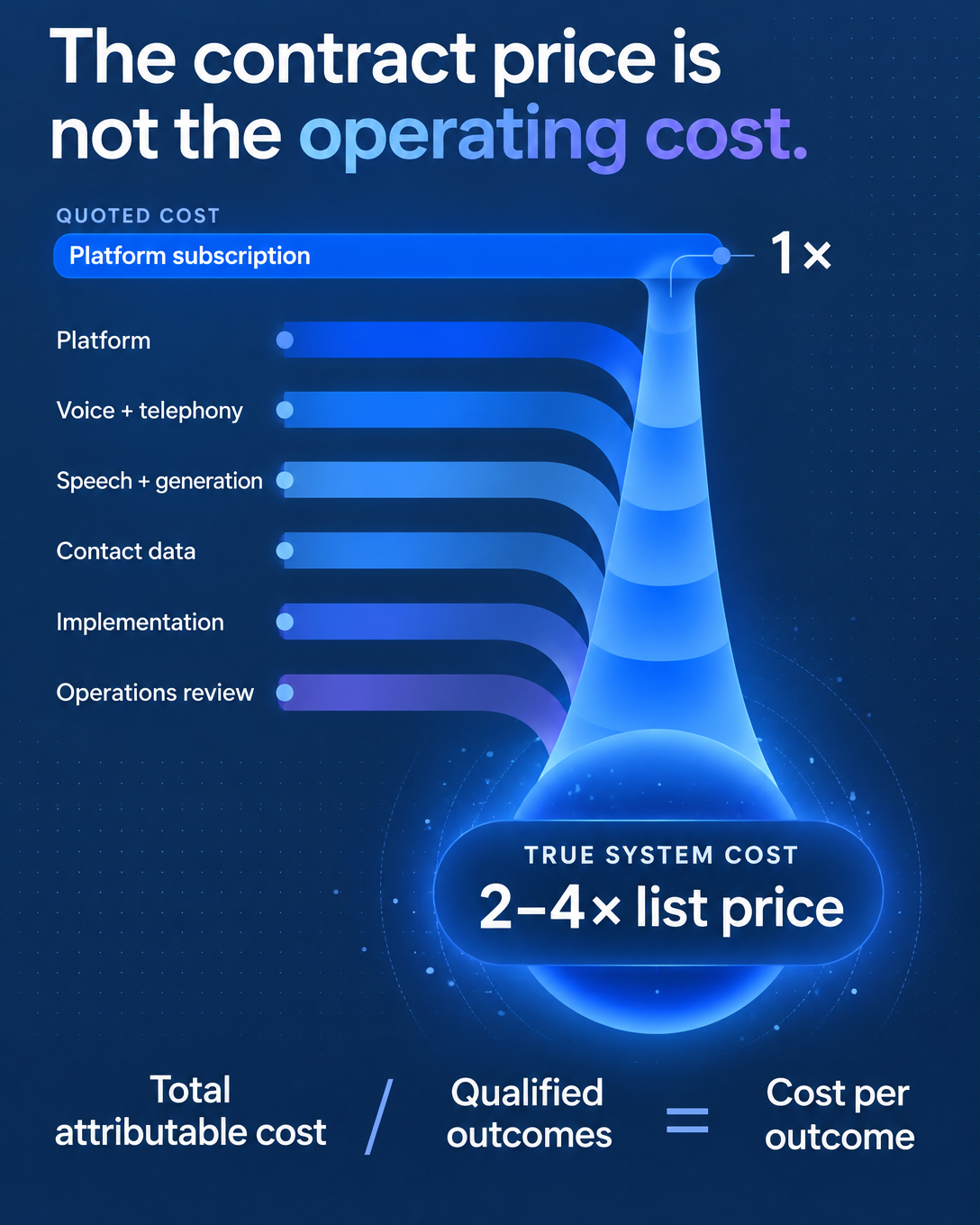
When your revenue team buys AI outbound calling, one number usually reaches finance: the platform subscription. Finance approves it. Then the telephony bill arrives. Then the data enrichment invoice. Then someone calculates how much time your ops team spent reviewing calls.
That first number was never wrong. It was incomplete.
An incomplete budget creates a specific failure mode. Spend becomes visible only after consumption. Nearly half of organizations report AI spending surprises have escalated to the board, and one in three companies deployed emergency spending freezes as bills mounted. The fix sits upstream of the contract, in how you build the budget itself.
Why the Subscription Line Hides the Real Total
Usage-based pricing runs several meters at once. The subscription covers the platform. Telephony, speech-to-text, language model inference, and text-to-speech all meter separately on every connected minute.
In practice, true total cost of ownership runs 2 to 4 times the list price. A platform advertising $0.05 per minute lands between $0.11 and $0.24 per minute once the full stack is counted. At 2,000 minutes a month, that turns an expected $100 into $220 to $480.
Your finance team approved the $100. The invoice reflects the system.
The Six Cost Categories That Belong in Every AI Voice Budget
Build the budget as a complete instrument before signing. Each category gets an owner, a confirmed amount, and a status.
1. Platform or Subscription
Plan, billing period, minimum commitment, and support scope. Confirm what the allowance includes and what happens when it runs out. Request caps instead of automatic overages.
2. Voice and Telephony
Billable events, rounding rules, number costs, and carrier arrangement. Ask whether voicemail and failed attempts consume minutes. These meters run on infrastructure outside the subscription.
3. Usage Layers and Optional Actions
Speech-to-text and text-to-speech are often metered independently. One meter runs on what the caller says, another on every character the agent speaks back. Transfers, premium voices, and connected tools add their own lines.
4. Lead and Contact Data
Feed an AI agent a list of bad phone numbers and it dials them relentlessly, burning money on voicemail drops and disconnected lines. Data enrichment is a maintenance expense that determines whether your minutes convert into conversations.
5. Implementation
Workflow setup, CRM connection work, acceptance testing, and documentation. Budget this as upfront labor with a named owner, then disclose any amortization period to finance.
6. Ongoing Operations Review
Someone reviews call quality, corrects records, adjusts scripts, and handles exceptions. This labor belongs in the budget before the contract is signed. Discovering it after deployment turns a working pilot into a line item nobody approved.
A budget line counts as confirmed only when the quote or current tariff states it. Everything else stays marked unresolved.
How to Put This in Front of Finance
Bring one document with all six categories. Mark each line included, separately billed, not required, or unresolved. Sales, operations, and finance then work from the same instrument instead of three partial views of the same spend.
Then divide total attributable cost by qualified meetings held. That ratio is the number your finance team actually needs. It survives contact with the invoice because every input in it was confirmed before signing.
💡 Tip: forecast from your own pilot's measured call durations, and model a low-utilization case alongside the expected one. Fixed fees allocated across fewer minutes change the economics quickly.
Governance Before Scale
Companies have exhausted annual AI budgets in a matter of months, forcing emergency renegotiations and unexpected funding requests. The procurement model assumed predictable spend. Usage-based AI behaves differently.
Execution that cannot be traced to a cost and an outcome cannot be governed. A six-category budget gives you that traceability from day one. Every dollar maps to a line, every line maps to an owner, and every outcome maps back to what it cost to produce.
Before your next AI voice contract, build the complete budget first. Take it into the vendor conversation and ask for written amounts on every unresolved line. The contract you sign after that exercise is one your finance team can actually defend.