
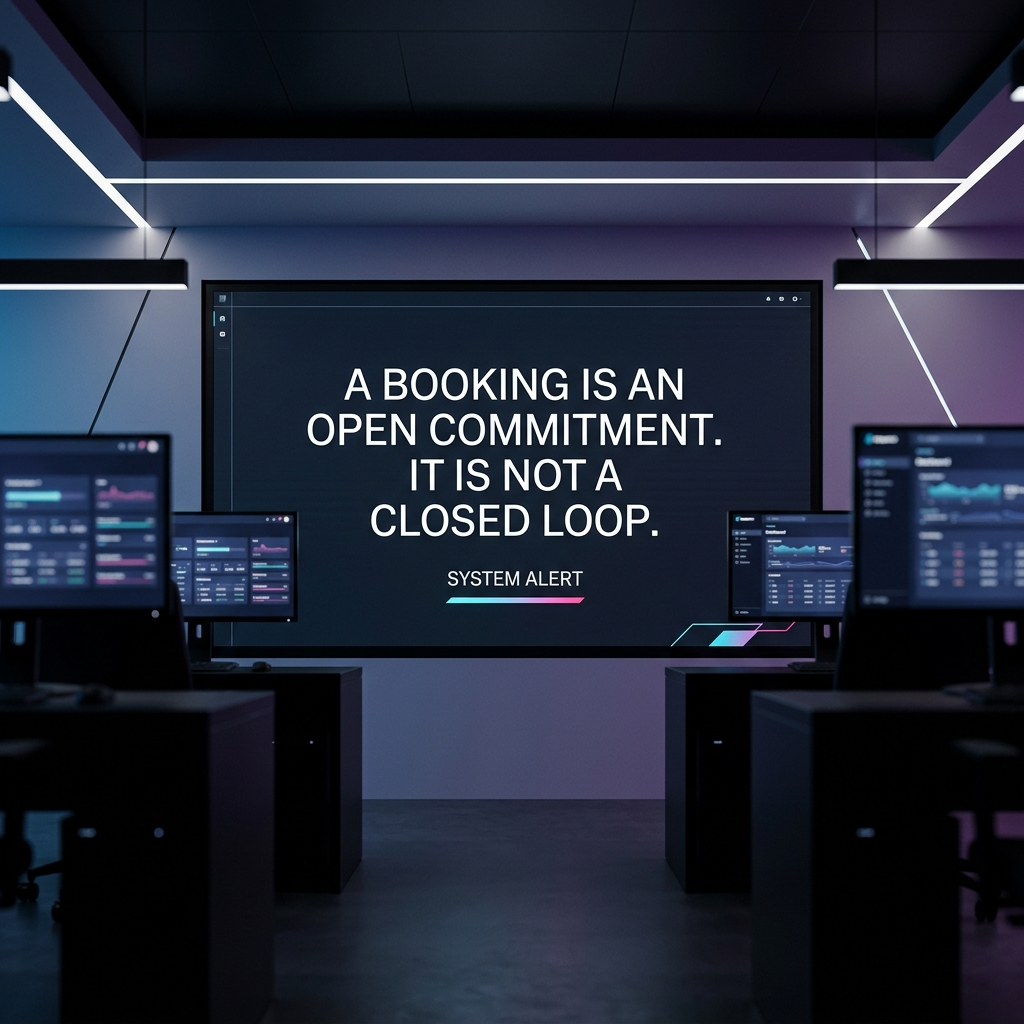
A voice agent picks up the call. It qualifies the lead, checks the calendar, and books the meeting. The dashboard updates. Green check mark. Outcome recorded.
That moment feels like completion. It is the moment most platforms stop watching.
A booking is an open commitment. It is not a closed loop. The gap between those two states is where revenue quietly disappears, and most measurement frameworks are built to look away from it.
Where the System Declares Victory
Every automated process has a point where it decides it has succeeded. The question worth asking is whether that point connects to actual value or just to the edge of what the system can see.
In revenue automation, the edge of visibility usually sits at the booking. The AI captures intent, creates a calendar event, and logs the result. From the platform's perspective, the job is finished.
The obligation, though, has not ended. It has moved. The system transferred it to a downstream person or process, and then it stopped watching.
Follow the process past that handoff point and you find a gap nobody owns. The prospect might show. The rep might prepare. The callback might happen on time. Each of those depends on chance follow-through that the platform no longer tracks.
The Numbers Behind the Illusion
The data on what happens after a booking is unforgiving. Across B2B sales and appointment-based businesses, no-show rates commonly run between 20 and 40 percent. One company struggled with a 7 percent show rate for its sales calls.
Read that again. A booking marked as done had a fractional chance of becoming a conversation.
Show rates for sales meetings typically range from 40 to 80 percent depending on lead source and follow-up consistency. Anything above 70 percent counts as strong. The strongest teams reach 85 to 90 percent, and they get there through qualification and follow-up automation, not through the act of booking itself.
So the booking rate on your dashboard describes something real. It just does not describe an outcome. It describes an obligation that someone still has to see through.
The Convenient Metric Problem
Treat any convenient metric with suspicion. Ask what it lets people stop paying attention to.
The booking count is convenient because it is easy to produce and easy to celebrate. It also lets a team stop watching at the exact moment the risk begins. That is the definition of a vanity metric.
Vanity metrics cloak AI projects in positive affirmations while failing to measure real business outcomes. They look impressive in a slide deck. The booking rate becomes one of them the moment a system optimizes for the number instead of the revenue the number was supposed to represent.
A booked meeting that never happens is functionally identical to a lost opportunity, except it consumed more resources getting there.
Speed makes this worse when it runs without governance. Faster response times and higher booking rates generate more activity. Activity only converts to revenue when follow-through infrastructure ensures those meetings actually occur.
Execution Failures Do Not Announce Themselves
The failure here is rarely a single catastrophic event. It shows up as a thousand small losses. A confirmation that arrived late. A callback that slipped a day. A detail entered wrong. A follow-up that never happened.
Traditional dashboards track sales and fulfillment outcomes. They do not track the micro-latency between intent and action. That silent space is where commitments corrode before anyone notices.
Executives feel the effect without seeing the cause. They monitor backward-looking metrics like win rates and revenue. They do not see the process and alignment factors that actually determine those numbers.
💡 The load-bearing insight: you cannot govern, correct, or improve a process whose outcomes you stop observing at the point of handoff.
Visibility Is the Foundation, Not the Report
Visibility gets treated as a reporting feature, a panel you check after the fact. That framing has it backward.
Visibility is the structure that makes accountability possible. Without it, a booking is a bet placed on someone downstream doing the right thing at the right time, unobserved and uncorrected.
When every callback, every booking, and every next action stays tracked to completion, the definition of done changes. Done stops meaning produced. It starts meaning resolved.
That shift matters because the risk of an early handoff lands on someone. Ask who absorbs that risk when a step gets called finished too soon, and whether they agreed to hold it. Usually no one made that decision on purpose. The architecture made it silently.
Redefining Done
The standard definition of done in revenue automation is architecturally wrong. It measures success at the point of production rather than the point of completion. That single choice turns automation into a machine for generating unresolved commitments.
The correction is not more enthusiasm from the sales team or tighter discipline from operators. Structural failures do not yield to willpower. They yield to systems that make follow-through observable and, from there, unavoidable.
Measure success where value lands, not where the system loses sight of it.
A platform earns the word done when it can see an obligation through to a real result. Until then, every green check mark on the dashboard is an open question wearing the costume of an answer.
What This Means for Teams Deploying AI Voice Systems
Before you trust a booking number, trace it forward. Find the point where your system declares success and check what happens after it.
- Identify where visibility ends in your current stack. That endpoint is where your risk concentrates.
- Separate what the system produced from what it promised. Measure against the promise.
- Track the show rate and the completed-outcome rate alongside the booking rate. The distance between them is your real execution gap.
- Assign ownership for the handoff. A step nobody owns is a step that fails quietly.
AI can handle the conversation. Humans still need to see what is happening and trust that nothing falls through. That trust depends on visibility that extends past the booking, all the way to the result.
Until the loop closes, the work is not done. It is waiting.