
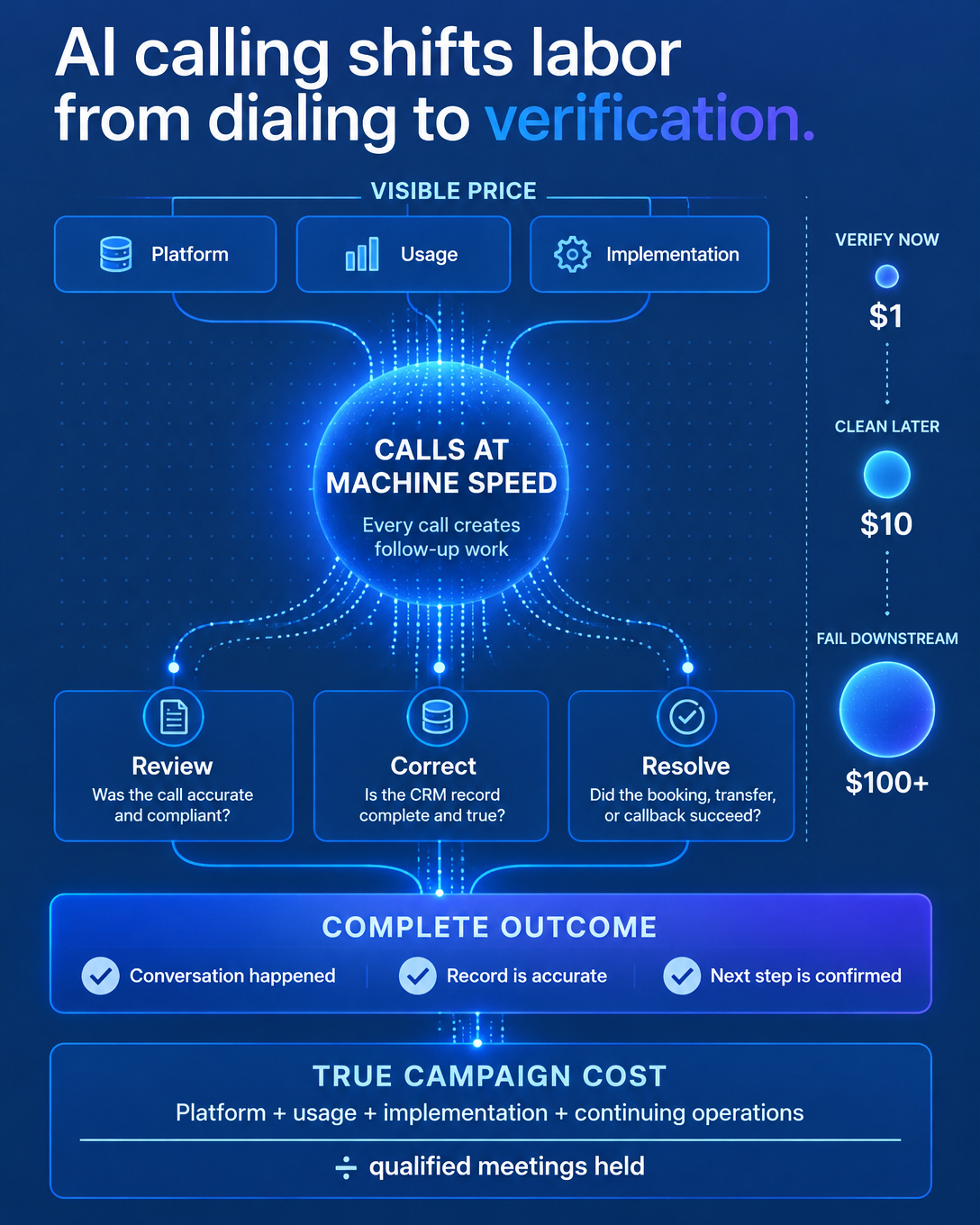
When you price an AI outbound campaign, the platform fee and the per-minute rate are easy to find. Vendors publish them. Finance approves them. The campaign launches.
Then the calls start producing work.
Someone reviews recordings. Someone corrects records the agent wrote into your CRM. Someone handles the exceptions: the booking that never synced, the prospect who asked for a human, the transfer that failed. That labor is real, it recurs with every campaign run, and in many budgets it has no line and no owner.
This is the cost that makes AI outbound look cheaper than it is. Execution that is not traceable, reviewed, and reconciled is unfinished work. The review is part of the execution.
Where the Labor Actually Goes
Teams often justify AI outbound by comparing it to human calling costs, where labor accounts for 60 to 70 percent of total call center spend. The ROI model then assumes those hours disappear.
They move instead. The work shifts from making calls to verifying what the calls produced.
Three categories absorb it:
- Call review. Listening to recordings against transcripts, flagging wrong openings, invented answers, and compliance misses.
- Record correction. Fixing fields, contact statuses, and outcomes the system logged incorrectly or incompletely.
- Exception handling. Resolving failed bookings, unclear outcomes, and callbacks the workflow left open.
Quality assurance alone adds a measurable tax. Dedicated QA work adds 5 to 8 percent to total call center spend, and AI deployments push that higher because every scaled defect multiplies across thousands of calls.
The Cost Compounds If You Defer It
Data quality research puts numbers on deferral. It costs roughly $1 to verify a record at entry, $10 to cleanse it later, and $100 or more when a bad record causes a failed deal or a compliance issue.
AI voice agents create records at machine speed. Apply that multiplier to a campaign producing hundreds of records per day and the arithmetic turns against you quickly.
Governance at the design phase costs almost nothing. Manual cleanup after a campaign costs ten times that. Discovering weeks later that the system burned through qualified leads costs a hundred times that.
The economics reward you for paying the cost early, in structure, instead of late, in cleanup.
Assign an Owner Before the First Call
The fix is a budgeting discipline, applied before launch. Four steps:
1. Name the line
Add "continuing operations" to the campaign budget as its own row: review hours, correction hours, exception hours. Estimate it from your pilot, in hours per hundred calls. A blank estimate is acceptable at the start. A missing row is the problem.
2. Name the person
Assign one person who owns call review, record integrity, and exception resolution for the campaign. Give that person the authority to pause activity when evidence stops matching reported outcomes. An unowned cost gets paid anyway. It just gets paid invisibly, out of your sales team's selling time.
3. Define what "done" means for a call
A call is complete when the conversation happened, the record is accurate, and the next step is confirmed in the connected system. Measure the operational cost against calls that meet that standard. Dialed minutes tell you what you spent on capacity. Completed outcomes tell you what you bought.
4. Demand evidence from the platform
Ask the vendor which artifacts exist for review: recordings, transcripts, outcome records, booking confirmations. A platform that persists outcomes and surfaces exceptions reduces your continuing operations hours directly. A platform that reports success without evidence transfers the verification burden to your team, and that transfer belongs in the price comparison.
Put the Real Number in the Comparison
When you evaluate AI outbound, build the total from four parts: platform fees, usage charges, implementation, and continuing operations. Divide by qualified meetings held. That ratio is the price you are actually paying.
Run the same calculation across vendors and the rankings often change. A cheaper per-minute rate paired with heavy cleanup costs more than a higher rate with clean, verifiable outcomes.
Budget the review work explicitly, give it an owner, and make the evidence requirements part of procurement. The campaigns that scale are the ones where the operational truth was priced in from day one.