
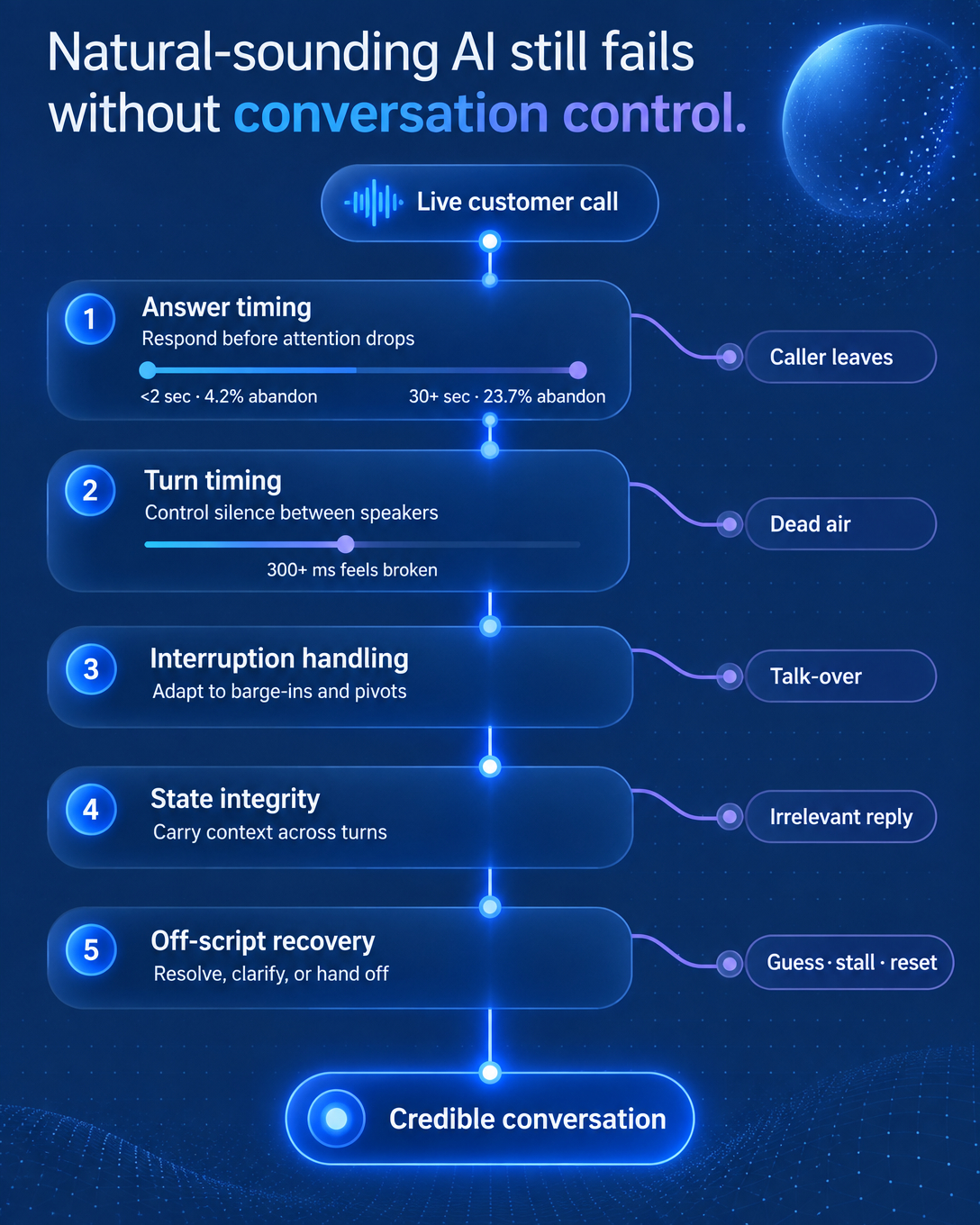
A prospect described the call to me in detail. The voice sounded realistic. Then came a long pause. Then an irrelevant response. Then a failed attempt to explain the offer. He hung up.
I hear versions of this story constantly. The instinct is to blame the voice model. I want to walk through why that instinct points at the wrong layer.
The problem sits in the architecture, and the evidence shows up in seconds, in exact order.
Failure Point One: Answer Timing
Retention gets decided before the first sentence lands. When an AI answers within 2 seconds, abandonment sits at 4.2 percent. When callers wait 30 seconds or more, it spikes to 23.7 percent.
The window is measured in seconds. Most teams measure it in dashboards, weeks later, after the pipeline already leaked.
Failure Point Two: The Pause After the Opening Line
Human conversation runs on hardwired timing. People notice lags as short as 100 to 200 milliseconds. Past 300 milliseconds of response delay, the conversation feels broken. Past 500 to 1,000 milliseconds, callers start repeating themselves and questioning whether the system heard them at all.
Here is the part that gets missed in vendor benchmarks. A pipeline can clock 400 milliseconds on paper while turn detection adds another 700 milliseconds of silence. The spec sheet says fast. The prospect hears dead air.
That silence is an architectural decision someone failed to make. The system needed an explicit policy for when to speak, and nobody wrote one.
Failure Point Three: Interruption Handling
Real prospects interrupt. They talk over the pitch, change their mind mid-sentence, and go quiet when they expect a response.
Most deployments assume clean audio, clear speech, and a caller who waits their turn. Production reality includes background noise, audio drops, and mid-sentence intent changes, and most systems carry no governed fallback logic for any of it.
The demo tested the happy path. The prospect ran the unhappy one.
Failure Point Four: Relevance Collapse
The irrelevant response in that call came from context loss. Voice agents frequently fail to maintain state across turns. They ask for information the caller already gave. They answer the previous question instead of the current one.
The individual responses can be fluent while the connective tissue between them is missing. Fluency per turn tells you nothing about integrity across turns.
Failure Point Five: The Off-Script Moment
The prospect asked something the script never anticipated. This is where most systems reveal what they actually are: a decision tree wearing a realistic voice.
When an unexpected input arrives, an ungoverned system does one of three things. It guesses. It stalls. It retreats to the script. Each option teaches the caller the same lesson: nobody credible is on this line.
Why Voice Quality Was Never the Question
After voice AI rollouts, some contact centers watched abandonment jump from 3 percent to 11 percent, and the causes traced back to latency, turn detection failure, and unresolved intent rather than voice quality.
The failure is structural. So the fix has to be structural. What that call needed:
- Timing policies. Explicit rules for when the system answers and when it speaks. Silence budgets, enforced.
- Interruption governance. Defined behavior for barge-in, mid-sentence pivots, and caller silence. Written before launch.
- State integrity. Context that persists across turns, so the system never asks for what it already knows.
- Off-script recovery. A governed path for inputs the script never predicted, including a clean handoff to a human.
- Traceability. A record of what happened on every call, so failure becomes visible instead of anecdotal.
I hold one principle above the rest here. Execution that isn't traceable isn't execution. It's theater. A realistic voice with no governed response architecture is theater with good production values.
What This Means for You
If you run revenue or operations, audit your voice system against the sequence above. Measure time to answer. Measure the silence after the caller stops talking. Feed it an interruption and an off-script question, then watch what it does.
The prospect who hung up gave you the full diagnostic in ninety seconds. The systems that survive contact with real callers are the ones engineered for the moment the conversation stops following the plan. Everything else gets abandoned, one long pause at a time.