
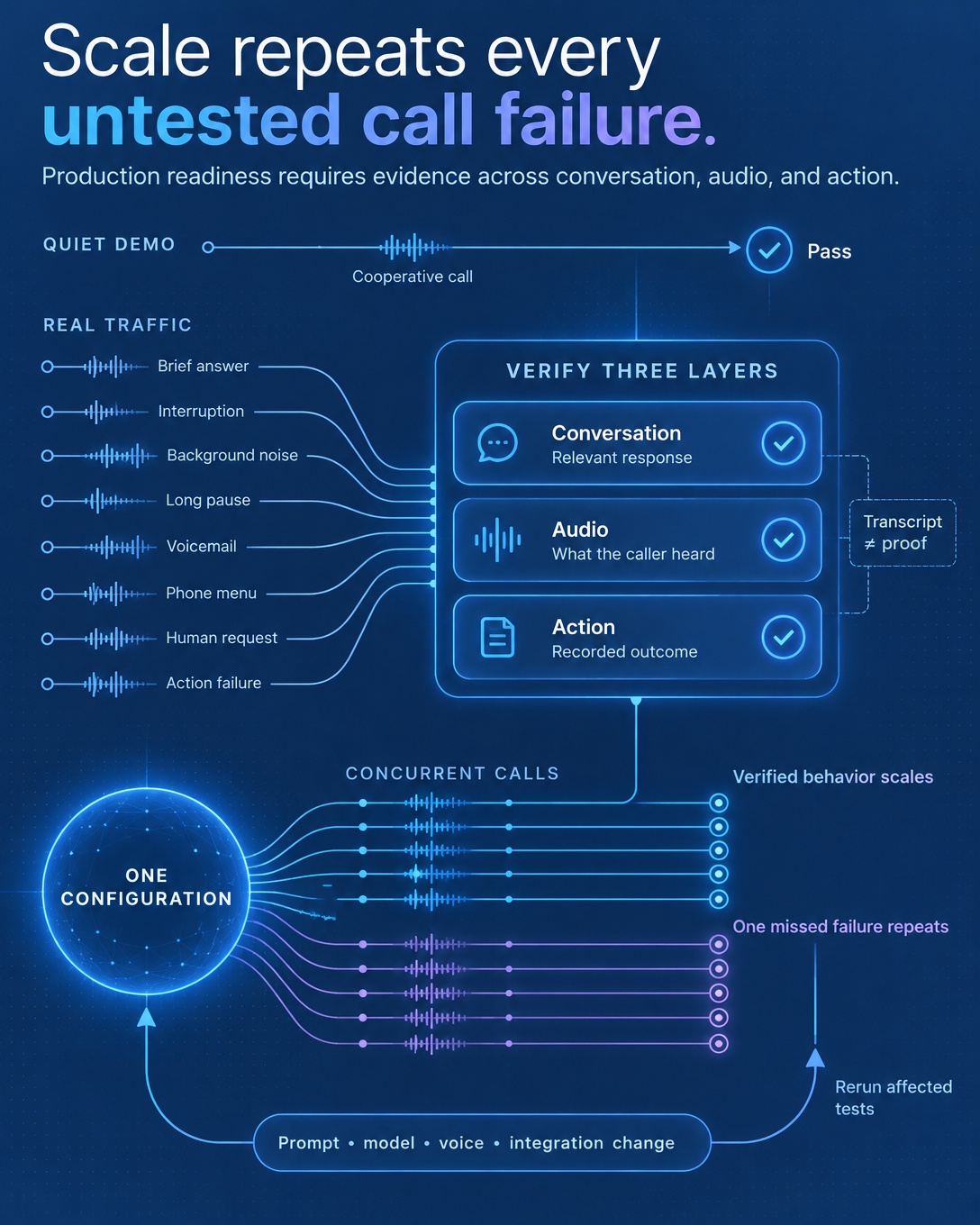
A brief answer. An interruption mid-response. A speakerphone in a noisy kitchen. A pause before answering. Voicemail. A phone menu. A request for a human. A calendar write that fails.
Teams that run outbound pilots label these edge cases. They are the baseline. Real phone traffic produces every one of them daily, and a single untested scenario can turn one bad call into a compliance problem that touches every concurrent line you run.
Independent industry data backs this up. While 38% of tech leaders report piloting agentic AI, only 11% reach production. The missing piece is testing infrastructure, defined acceptance evidence, and the discipline to verify what actually happened after each call.
Below is the test matrix you need, scenario by scenario, with the evidence that proves a pass.
Why Quiet-Room Demos Mislead You
A demo call in a quiet room with a cooperative tester exercises one path out of dozens. Cooperative callers pass. Impatient, confused, and distracted callers expose what the configuration actually does.
Scale makes this worse. At 5% of traffic, a rare scenario looks like a one-off you can wave away. At 50% of traffic, the same scenarios compound into failures that repeat on schedule.
Your acceptance process should assume the hard calls arrive first.
The Eight Scenarios and Their Acceptance Evidence
1. The brief answer
Someone picks up and says "yeah." The recording must show the approved opening and a relevant response, with no repeated introduction and no stall.
2. The interruption mid-response
The agent must stop or yield according to your approved turn-taking behavior. Review what the person actually heard, from the recording, since transcripts hide talk-over. Voice activity detection alone misfires on backchannels like "mm-hmm," coughs, and background sounds, so this scenario needs repeated runs, with both passing and failing examples retained.
3. Speakerphone and background noise
Evidence is the recording plus tester notes confirming the conversation stayed usable and the captured data stayed accurate. Noise that triggers false interruptions belongs in your matrix as a required test, reproduced before anyone draws a conclusion about cause.
4. The pause before answering
The call must handle silence without inventing an answer or abandoning the task. An agent that fills a pause with fabricated availability has failed a rollout blocker, whatever the rest of the call sounds like.
5. Voicemail
Detection is imperfect at every price point. Published accuracy caps near 98.5% on vendor datasets, which means at 50,000 monthly dials roughly 750 calls misroute regardless of provider. Design the failure branch deliberately and verify the configured branch fires in your own call path.
6. The phone menu
Any keypad action must be verified through supported action records. A transcript claiming the agent pressed 2 proves nothing without the event evidence behind it.
7. The request for a human
The agreed transfer, callback, or operator path must appear in the final record. This scenario carries direct compliance weight. Ignoring a request to stop or escalate is a blocker, and the person who can halt activity should be named before the pilot starts.
8. The connected action failure
When the calendar write or CRM update fails, the result must stay unresolved or follow the approved recovery path. A reported booking with no record behind it is a false completion, and false completions are how pipeline reporting becomes fiction.
Compliance Failures Scale at the Speed of Concurrency
One human agent making one mistake affects one call. A misconfigured voice agent repeats the same mistake on every concurrent line until someone stops it.
In 2025, a healthcare provider's voice AI failed its HIPAA audit for retaining call logs 90 days instead of the required 30, resulting in a $2.3 million fine and a three-week shutdown.
Some violations surface once in 100 calls, which means a 20-call happy-path test will never find them. Catching them requires thousands of tested paths and a documented baseline you recheck after every prompt, model, voice, or integration change.
How to Run the Matrix
- Write one acceptance statement per scenario before testing begins. Include input conditions, expected behavior, and configuration version.
- Score three things separately: the conversation, the audio, and the resulting action. A pleasant call that produced a false booking fails.
- Verify the downstream record for every claimed outcome. Attendee, time, booking status, follow-up state.
- Define rollout blockers with a named owner who has authority to stop calling.
- Rerun affected scenarios after every change. A passing baseline from last month proves nothing about today's configuration.
At MediLogix, we apply this same discipline to healthcare technology: a workflow earns trust through verified evidence, documented recovery paths, and governance that holds before the system scales. Voice agents deserve the same standard.
Your next step: take these eight scenarios into your next vendor evaluation and ask to see the evidence path for each one in your specific calling job. A vendor that can show you the recording, the event record, and the recovery branch has built for production. Test all eight before you scale, because the first untested scenario your campaign meets at volume will choose the moment for you.