
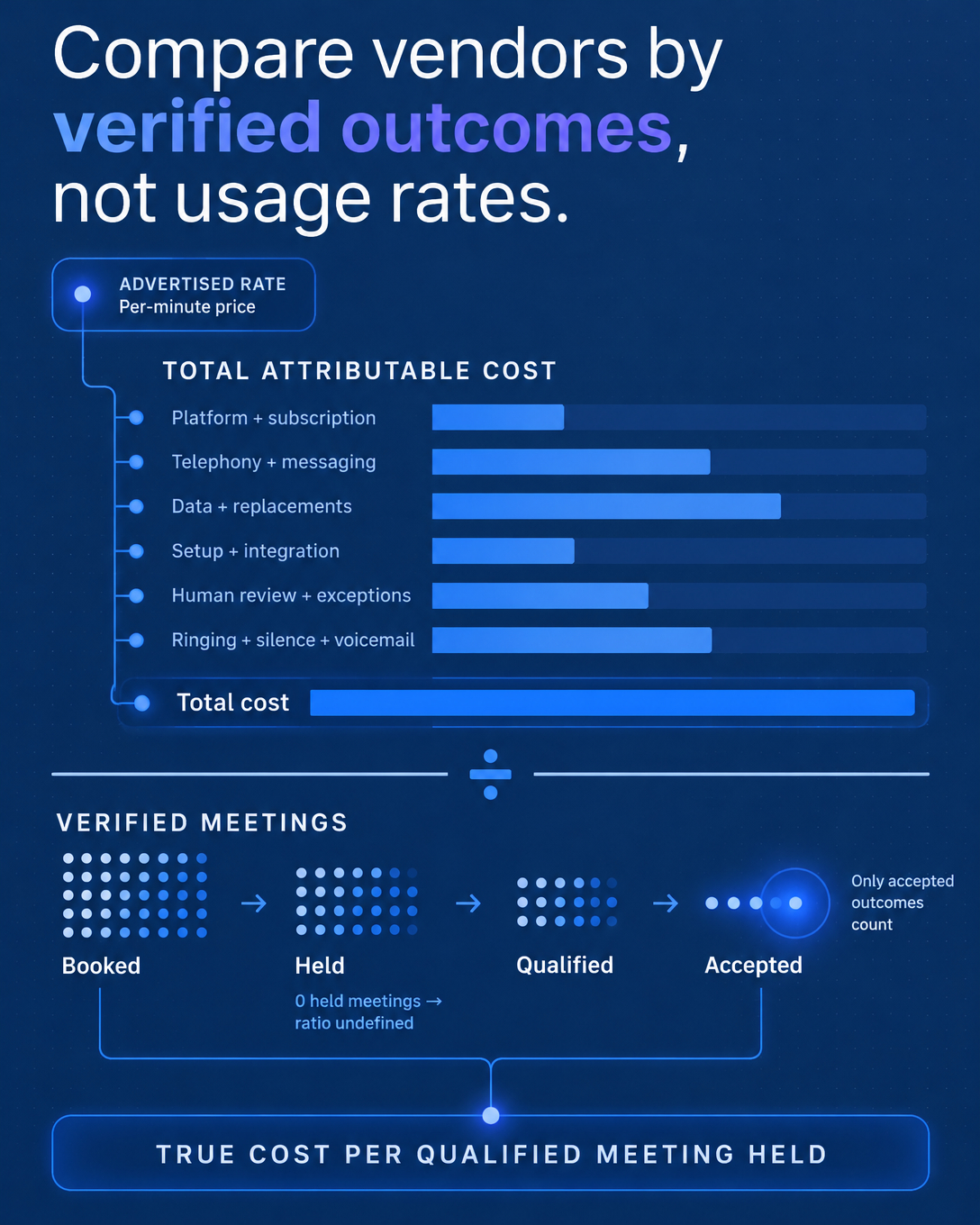
Every AI voice vendor publishes a per-minute rate. None of them publish the number that decides whether your campaign worked: cost per qualified meeting held.
That omission is structural. A per-minute rate is easy to print on a pricing page. A cost per held meeting depends on your list, your workflow, and your follow-through. Vendors cannot publish it honestly, so they publish the minute instead.
The problem starts when you compare platforms by that minute. You end up ranking quotes that describe different scopes, and the cheapest line item wins a comparison it never deserved to enter.
The Minute You Pay For Is Bigger Than the Minute You Think
The advertised rate rarely survives contact with a production deployment. Provider stack fees on bring-your-own-key setups add $0.06 to $0.19 per minute on top of the platform rate. A platform advertised at $0.05 per minute lands at $0.12 to $0.25 per minute once it carries real traffic.
Billing rules compound this. Many platforms meter the full call duration, including ringing, hold time, and silence. A two-minute call with 30 seconds of dead air costs 25 percent more than the conversation itself justified.
Then add the attempts that produce nothing. Outbound dialers burn 30 to 60 percent of attempts on voicemail. Those minutes bill normally. They book zero meetings.
⚠️ If your forecast assumes every billed minute is a conversation minute, your budget is already wrong.
Build the Full Numerator Before You Divide Anything
The calculation that matters is simple to write and demanding to populate:
Cost per qualified meeting held = total attributable campaign cost / qualified meetings held.
Total attributable cost includes every line the per-minute quote leaves out:
- Platform and subscription fees, with minimum commitments stated
- Telephony, transfers, and SMS, each with its own metering rules
- Lead and contact data, including replacement of unusable records
- Setup and integration work, which runs $2,000 to $10,000 for custom API work before a single call is placed
- Human review time, the hours spent checking recordings, correcting records, and handling exceptions after every campaign
That last line is the one procurement teams most commonly skip. A pilot that produced meetings while requiring extensive cleanup owes that cleanup to its own economics. Execution that nobody can trace or verify is theater, and theater still bills by the minute.
The Denominator Has Rules Too
Qualified meetings held. Three words, three separate checks.
A booking in the calendar counts for nothing by itself. The meeting has to happen, the attendee has to fit your qualification definition, and a named person on your team has to accept it. Track bookings, attendance, and acceptance as separate events with separate evidence.
This discipline exists because the alternative produces fiction. A dashboard full of booked slots tells you the agent spoke. The held meeting tells you the system executed.
💡 One hard rule: if your denominator is zero, the ratio is undefined. It is not zero. A campaign with no held meetings has no cost per meeting. It has a cost and a decision to make.
Reporting an undefined ratio as a small number is how pilots get extended past the point where the evidence said stop.
What This Looks Like in Procurement
Run the comparison with your own workload, in this order.
First, define the calling job. Audience, approved purpose, next step, and the evidence you will accept as proof.
Second, request quotes for that exact configuration. Mark each cost line as included, separately billed, or unresolved. Leave unresolved lines visible in the budget instead of guessing.
Third, pilot on one segment and record everything: attempts, connections, billable duration, voicemail hits, review hours.
Fourth, divide actual spend by qualified meetings held and put that number in front of finance.
The benchmark context helps here. Qualified B2B meetings typically run $200 to $350 in mainstream segments, and a human SDR setup can land near $666 per booked meeting. Your pilot number belongs next to figures like these, with your cohort and observation window stated beside it.
The vendors competing on fractions of a cent per minute are answering a question you should stop asking. Ask instead what a held, accepted meeting costs you, fully loaded. That number survives a finance review. The per-minute rate never did.