
Revenue teams comparing AI outbound calling vendors usually anchor on one number: the advertised price per minute. That number is real. It is also the smallest part of the budget.
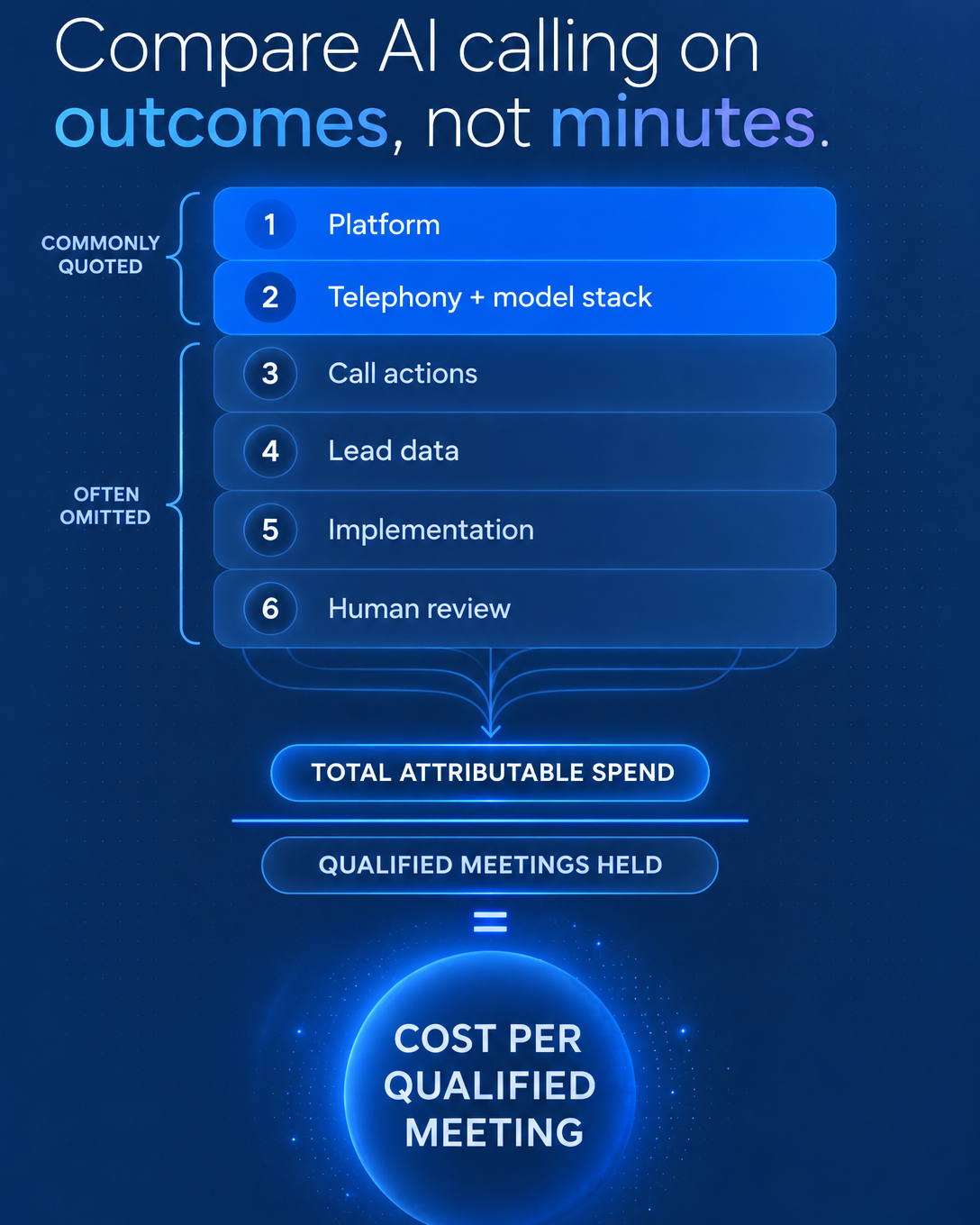
A campaign budget has six distinct cost categories: platform, telephony, optional actions, lead data, implementation, and ongoing review work. Buyers who price only the first two sign contracts with four unresolved lines. The invoice resolves them later.
This article walks through each line, what to confirm before marking it included, and the one metric that tells you what the campaign actually cost.
Line 1: Platform
Confirm the plan, the billing period, the minimum commitment, and what support is included. A subscription with 500 included minutes has a simple allocation math: divide the fee by the minutes you actually use, since unused allowance raises your effective rate.
Keep the fixed fee in a separate column from the variable tariff. Finance needs to distinguish the price of capacity from the marginal cost of additional work.
Line 2: Telephony and the Model Stack
The advertised rate often excludes the components underneath it. Platforms using a bring-your-own-key setup can add $0.06 to $0.19 per minute for transcription, model inference, and premium voices on top of the headline rate. A $0.07 advertised minute can land at $0.13 to $0.26 once the stack is complete.
Confirm billable events, rounding rules, number costs, and the carrier arrangement in writing. Then confirm how failed attempts are billed.
Failed calls, voicemails, and no-answers can represent 20 to 40 percent of outbound attempts at scale. Some vendors charge a minimum per failed attempt, and many bill for ring time, hold time, and silence. Ask how those seconds appear on the invoice before you forecast volume.
Line 3: Optional Actions
Transfers, voicemail drops, knowledge features, and connected tools each carry their own rate on some platforms. Request the rate card for every action your campaign uses. Mark each one as included, separately billed, not required, or unresolved. Unresolved means the budget is incomplete.
Line 4: Lead and Contact Data
The calling job starts with a list, and the list has a price. A qualified B2B lead typically costs $100 to $400 depending on data source and verification depth. Confirm the source, the permitted purpose, enrichment costs, and whether the vendor replaces unusable records.
Underbudgeting this line forces a choice midway through the pilot: buy more data or let the agent dial a degraded list. Both outcomes show up in your cost per result.
Line 5: Implementation
Workflow setup, integration work, acceptance testing, and documentation are real spend. Enterprise AI phone agent deployments carry one-time professional services fees from $2,000 to $25,000 depending on complexity, and 85 percent of organizations underestimate AI project costs by more than 10 percent.
If implementation is amortized, disclose the period and show the upfront amount. Hiding it in a monthly figure makes the pilot look cheaper than it was.
Line 6: Ongoing Review Work
Someone on your team listens to calls, corrects records, and handles exceptions. That time is a campaign cost. Execution you cannot trace back to evidence is not execution you can budget.
Assign an owner to this line before launch. A pilot that produced meetings while requiring heavy cleanup must carry that cleanup in its economics.
The Only Number That Settles the Comparison
Once all six lines are priced, divide total attributable campaign spend by qualified meetings held. In-house SDR teams land at roughly $350 to $600 per qualified meeting once fully loaded costs and realistic output are counted. That is your reference point for the AI campaign, calculated the same way, from the same cohort, over the same period.
Per-minute price answers a procurement question. Cost per qualified meeting held answers the commercial one.
Before You Sign
- Define the calling job: audience, approved purpose, next step, acceptance evidence.
- Request a quote for that exact configuration, with all six lines itemized.
- Ask for the rules on failed attempts, silence, transfers, and allowance overruns.
- Run a pilot, record actual spend and actual held meetings, then decide.
A budget built this way survives contact with the first invoice. That is the standard worth holding every vendor to, including us.