
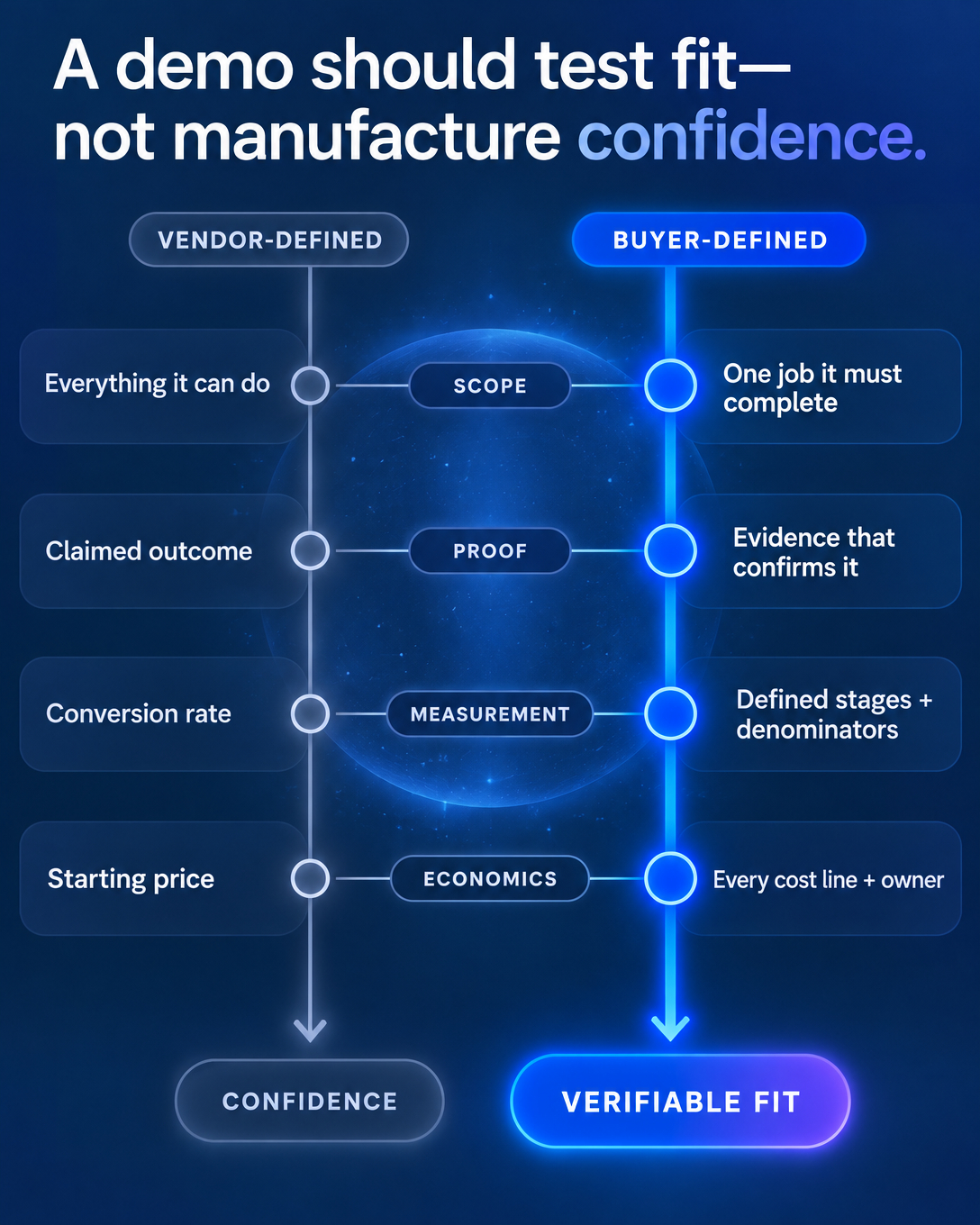
Buyers who make strong AI purchasing decisions prepare differently. They arrive at the demo with an acceptance definition, a funnel template, a budget, and a calling job written in one sentence.
Each document forces the vendor to show you something specific. A demo without those four anchors answers the vendor's presentation plan instead of your purchase question.
The stakes are real. Research shows 40% of software buyers rank the demo as the most critical factor in their decision. That makes the demo the single most expensive hour to spend unprepared.
The Calling Job: One Sentence That Sets the Scope
Write down who is being contacted, why the contact is permitted, what the agent should accomplish, and what a person does next. One sentence.
This sentence forces the vendor to configure the demonstration around your workflow. Generic capability tours stop working once the scope is written down, because every feature shown either serves that sentence or it gets cut.
There is a practical reason to insist on this. In the average SaaS product, 80% of features are rarely or never used. Asking to see everything optimizes for the wrong outcome. The calling job tells you which features actually matter.
The Acceptance Definition: What a Passing Result Looks Like
Before anyone opens a screen, agree on what counts as a qualified meeting, what counts as held, and who accepts the result.
This document forces the vendor to show you evidence paths. Ask where the recording lives, where the transcript lives, and which connected record confirms the booking actually exists. A claimed result and a verified result are different objects, and the acceptance definition makes the vendor demonstrate the second one.
This also protects you from the demo environment itself. AI product demos show 95% satisfaction while early production satisfaction drops to 72%. That 23-point drop is structural. Demos control input quality and hide failure modes. Your acceptance definition tests for that drop before it lands in your pipeline.
The Funnel Template: Honest Denominators, Written in Advance
Bring the stages you will report on: eligible contacts, attempts, live connections, qualified contacts, bookings, held meetings, accepted opportunities. Define each one.
The template forces the vendor to map their reporting to your stages. You learn immediately whether the system tracks distinct contacts separately from dialing attempts, and whether held meetings carry attendance evidence or just a calendar entry.
When a denominator is undefined, the conversion number built on it is fiction. Writing the template before the demo prevents that fiction from entering your business case.
The Budget: Every Cost Line With an Owner
Bring a written budget covering platform fees, billable minutes, telephony, lead data, implementation, and the ongoing review work your team will do after calls complete.
The budget forces the vendor to quote your configuration. Mark each line as included, separately billed, or unresolved. Unresolved lines become the exact questions you ask in the room.
Structure pays here. Organizations applying structured processes to software purchasing report savings of 15 to 30% through right-sized licenses and avoided redundancy. The written budget also gives finance, operations, and sales one shared document instead of three private assumptions.
Why the Four Work Together
The calling job sets the scope. The acceptance definition sets the proof. The funnel template sets the measurement. The budget sets the economics.
Together they convert the demo from a performance into an inspection. The vendor demonstrates the configured workflow, the evidence it retains, and the costs it generates for your specific job. You leave with material a pilot can verify.
Vendors design demos to anchor a reference point in your mind. Preparation is the counterweight. The buyer who arrives with these four documents forces fit to be proven rather than confidence to be manufactured.
Before Your Next Demo
Write the calling job tonight. Draft the acceptance definition with the person who will accept meetings. Build the funnel template with the stages your team already reports. List every budget line and assign each one an owner.
Then schedule the demo and ask one question throughout: show me the evidence path for this workflow.
A vendor with real infrastructure will welcome that question. The walkthrough that answers it is the demo worth your decision.