
An AI outbound dialer places calls automatically, runs conversations with synthetic voice, qualifies prospects against defined logic, and routes outcomes into your systems of record.
That definition covers the machinery. It leaves out the part that determines whether the machinery produces revenue.
The dialer is the visible layer. The governance underneath it decides what actually closes.
This guide explains what an AI outbound dialer is, how it works step by step, and how to deploy one so that every call, callback, and handoff stays tracked to completion.
The Definition, Stated Precisely
An AI outbound dialer combines three components into one execution loop:
Automated dialing infrastructure. The system places calls across parallel lines, manages caller ID health, and detects answering machines before connecting a conversation.
Conversational AI. Speech recognition, language models, and voice synthesis run the live exchange — greeting, qualification, objection handling, booking.
Outcome routing. The system logs call results, updates CRM states, schedules callbacks, and transfers qualified prospects to human reps.
The scale difference is measurable. AI voice agents execute 100 to 500 simultaneous calls, while human SDRs average 15 to 25 dials per hour.
Adoption reflects that math. As of Q1 2026, 41% of enterprise B2B teams run at least one AI SDR in production, up from 3% in early 2024.
The same research shows that 88% of pilots never reach production. The gap sits in execution governance, and the rest of this guide addresses it directly.
How the System Works: The Execution Loop
Every AI outbound dialer runs the same core loop. Understanding each stage shows you where value gets captured and where it leaks.
Stage 1: List Ingestion and Consent Verification
The system pulls contact lists from your CRM or a connected data source. Before any call fires, the dialer checks each record against suppression lists and consent status.
This stage carries legal weight. FCC guidance confirms that AI-generated voice calls require prior written consent under the TCPA, and recent class action settlements — $5.95M against Cider US Holding, $5.9M against Albertsons — both involved gaps between opt-out receipt and suppression list propagation.
⚠️ Warning: Consent checked once at import is consent unverified at dial time. The check runs before every call, and the check gets logged.
Stage 2: Dialing and Connection
The dialer places calls across parallel lines, monitors caller ID reputation, and filters out voicemail systems. Caller ID health matters more than most operators realize — connect rates fall by 40 to 70% when caller ID reputation degrades, because carriers block the calls before the phone rings.
Latency defines conversation quality at connection. The 2026 industry standard sits at sub-800ms response time. Anything above 900ms creates dead air that prospects read as confusion, and G2 review data logs 212 mentions of "call issues" across leading dialer platforms — most tied to connection lag during parallel dialing.
Stage 3: The Live Conversation
The AI agent runs the exchange against a scoped workflow: introduce, qualify, handle objections, book or route. Deterministic qualification logic decides which path each prospect takes.
Performance depends heavily on scope. Task completion rates on well-scoped workflows routinely reach 80 to 90%, with simple lookups completing above 90%. First-call resolution on mixed-complexity work sits at 40 to 55%.
The lesson for deployment: narrow the workflow, then measure completion.
Stage 4: Outcome Capture and Handoff
Every call ends in a state — booked, callback scheduled, transferred, disqualified, unreachable. The system writes that state to the CRM, generates post-call artifacts, and routes next actions.
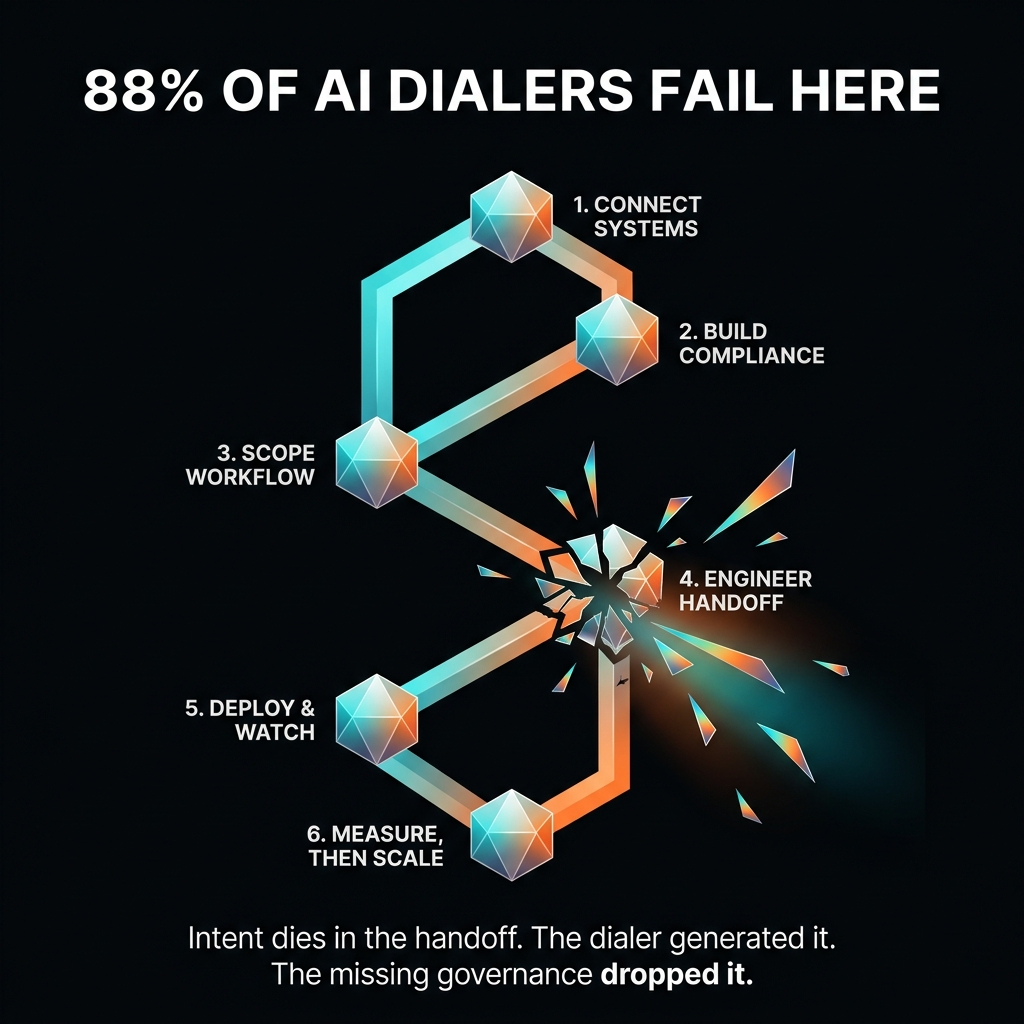
This is the stage where most deployments break.
Analysis of common automation failures shows the same patterns repeating: positive replies that fall into the gap between tools and never reach a human rep, CRM states that quietly fall out of sync, and leads slipping between systems through broken integrations.
Intent dies in the handoff. The dialer generated it. The missing governance layer dropped it.
How to Deploy One: A Governed Setup Sequence
The following sequence treats deployment as an architecture problem. Each step produces something observable before the next step begins.
01 — CONNECT the Systems of Record First
Wire the dialer to your CRM before you configure a single script. Every call outcome needs a destination field, a state definition, and a sync verification.
Test the integration with dummy records. Confirm that a booked meeting, a callback request, and a disqualification each land in the correct field within seconds.
💡 Tip: Define what "complete" means for every outcome type before launch. If it's not tracked to completion, it didn't happen.
02 — BUILD the Compliance Layer
Configure consent verification at dial time. Set opt-out capture to propagate to suppression lists immediately — the settlement cases cited above turned on propagation delay.
Add AI disclosure at call start where proposed FCC rules require it. Monitor caller ID health as a standing metric, since degraded reputation cuts connect rates by 40 to 70% before any conversation happens.
03 — SCOPE the Workflow Narrowly
Start with one call type: a single qualification flow with a defined booking outcome. The 80 to 90% completion rates come from tight scope. The 40 to 55% resolution rates come from mixed complexity.
Write the qualification logic as explicit rules. Every branch in the conversation maps to a defined next action.
04 — ENGINEER the Handoff
Define exactly how a qualified prospect moves from AI conversation to human rep. Specify the trigger, the notification path, the response-time expectation, and the fallback if the rep misses the window.
This step is commonly skipped. It's also the step that separates the 12% of pilots that reach production from the 88% that don't. Teams that scale successfully treat the handoff between AI action and human accountability as an architecture problem.
05 — DEPLOY and Watch the Loop
Launch at limited volume. Review call recordings, transcripts, and outcome logs daily for the first two weeks. Confirm that every callback fires, every transfer lands, and every CRM state matches reality.
A platform running 20 concurrent lines at 3-minute average duration completes 9,600 calls in 24 hours. That throughput only converts when every callback, transfer, and escalation stays tracked to completion.
06 — MEASURE Outcomes, Then Scale
Track qualified opportunities per hundred dials, callback completion rate, handoff-to-contact time, and CRM sync accuracy. Raw dial volume tells you the system is running. These metrics tell you it's working.
Scale volume only after the loop holds at current volume. Govern first, scale second.
What the Data Says About Scaling Without Governance
The 2026 numbers document what happens when teams multiply activity without controlling it.
Outbound volume from AI-assisted teams rose 6.4x, while raw reply rates fell 38% over the same period. More activity produced fewer responses per attempt across the market.
"Your analytics must tell you if AI actually improves speed-to-lead or just makes more noise."
The follow-through data reinforces the point. Research shows 80% of deals require at least five follow-ups to close, while nearly half of salespeople stop after one attempt. Automation removes that human dropout in theory — and amplifies it in practice when no governance layer tracks the sequence to completion.
The economics reward structure over volume. Hybrid AI-plus-human pods cut cost per qualified opportunity by 54% versus human-only teams. AI-only teams report 25 to 35% lower pipeline value per lead. The return comes from controlled handoffs between AI execution and human closure.
The Operating Model That Holds
The deployments that reach production share one structure. AI runs the high-volume, top-of-funnel conversations. Humans close the qualified opportunities. A governance layer between them makes every action visible, auditable, and tracked to completion.
Vantara operates in that layer. The platform tracks every callback, booking, and next action to completion, so operators see exactly what the AI executed, what a human owes, and what remains open. Nothing depends on someone remembering to check.
Not a calling feature. A complete outbound system.
Where to Start
An AI outbound dialer is dialing infrastructure, conversational AI, and outcome routing wired into one loop. The technology handles the conversation reliably when the workflow is scoped tight.
What determines your result is everything around the conversation: consent checked at dial time, CRM states that stay in sync, handoffs that fire on defined triggers, and callbacks logged until they close.
Begin with the systems of record. Build the compliance layer. Scope one workflow. Engineer the handoff before the first live call.
Volume follows once the loop holds. The teams in the 12% built it in that order.