
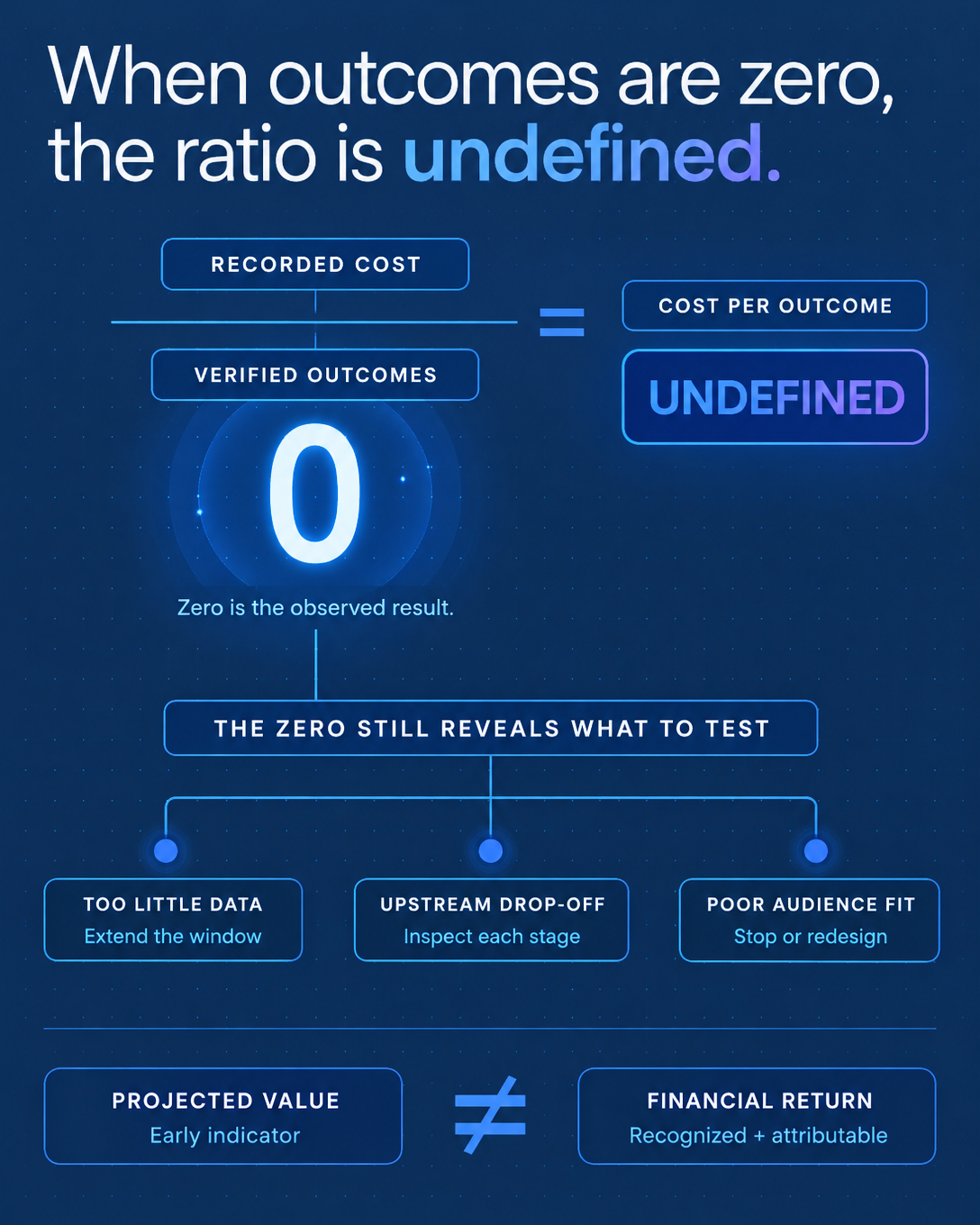
We build systems where conversations become commitments, so we spend a lot of time looking at pilot scorecards. One line keeps causing trouble: cost per qualified meeting held, reported for a pilot that produced no qualified meetings.
The math is settled. When the denominator is zero, division is undefined. The expression has no value and no meaning. A dashboard that prints infinity, or quietly prints zero, is printing fiction.
The honest move is simpler than it looks. Show the outcome count as zero. Show the cost ratio as undefined. Then explain what happens next.
The Substitution That Fails Finance Review
Pilot teams under pressure rarely report an undefined ratio. They substitute. Pipeline value goes on the slide where cost per meeting should be, and the pilot suddenly looks productive.
Pipeline value is a predictive metric, an estimate of potential future sales. It carries no attendance evidence, no acceptance decision, no recognized revenue. It belongs on the scorecard as an early indicator with its own label. It cannot stand in for financial return.
Finance reviewers know the difference. When a sponsor presents pipeline value as ROI, the reviewer asks for the cohort, the observation period, and the attribution method. If those answers point back to zero held meetings, the entire deck loses credibility, including the parts that were accurate.
A number you cannot defend in a finance review is more expensive than a zero you can.
Why Zero Is a Plausible and Useful Result
Zero qualified meetings in a short pilot is a realistic outcome, given how outbound calling converts. Benchmarks place cold call conversion around 2.7 percent of dials to a booked meeting. Small cohorts and tight windows produce zeros regularly.
A reported zero is operationally valuable. It tells you one of three things:
- The cohort was too small or too short to produce the outcome at expected rates. Extend the window and recalculate.
- A stage upstream broke. Connections happened and qualification failed, or bookings happened and attendance failed. The funnel shows where.
- The workflow does not work for this audience. That is a legitimate finding, and the cheapest time to learn it is during the pilot.
Each of those findings requires the zero to be visible. Papering over it with pipeline value removes the signal that would have told you which problem you have.
The Cost of Flattering Denominators
The damage compounds at scale decisions. MIT's NANDA initiative found that 95 percent of pilots fail to deliver measurable ROI, largely because teams never established baselines that made comparison possible. The failure was organizational. The measurement discipline was missing before the tool ever made a call.
Denominator choice drives the same distortion inside a single company. A team quoting cost per booked meeting and a team quoting cost per qualified opportunity can be the identical team with numbers that differ by more than double. Comparisons only hold when the stage is stated next to the figure.
We treat this as an execution integrity problem. Execution that cannot be traced is theater, and a ratio with a hidden denominator is untraceable by design.
What Disciplined Reporting Looks Like
You can set this up before the pilot starts, in one page:
Define the denominator in writing. Qualified meetings held means attendance evidence plus a named person who accepted the meeting. Record who decides.
Report every stage separately. Bookings, attendance, acceptance, and opportunities each keep their own count, cohort, and cutoff date.
When a count is zero, write zero. Mark the dependent ratio as undefined and state the review date when it will be recalculated.
Keep pipeline value on its own line. Label it as an estimate. Calculate financial ROI only from recognized, attributable contribution and recorded costs.
This discipline protects the pilot as much as the budget. A team that reports an honest zero in week four earns the credibility to request week eight. A team that reports fictional economics in week four spends week eight defending the fiction.
Governance precedes scale. That starts with a scorecard willing to say that the number does not exist yet.