
You can run two hundred test calls against your AI voice agent and still fail to answer one question: did that call pass.
The recordings exist. The transcripts exist. The dashboard shows latency numbers. Yet when someone asks whether the deployment is ready, the room goes quiet.
The reason is structural. The team never wrote down what a passing call means. Testing without an acceptance statement produces activity, and activity without a verdict is theater.
One Task, One Acceptance Statement
Every AI voice deployment needs a single task-level acceptance statement written before testing begins. Formal guidance on AI assurance says the same thing: acceptance criteria must be defined in a testable way before deployment, with the explicit goal of confirming the system meets agreed requirements before it touches a live environment.
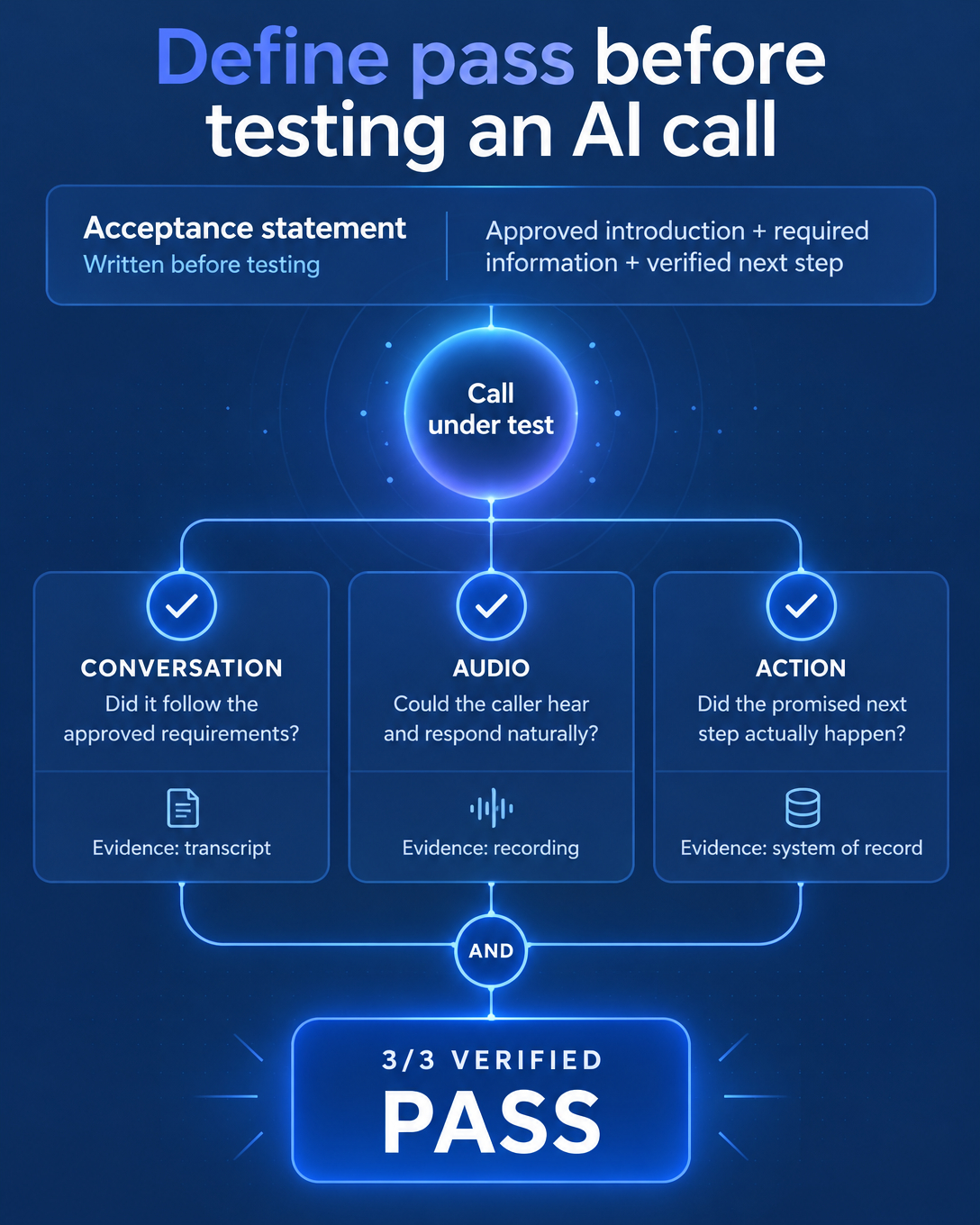
For a qualification campaign, the statement specifies three things:
- The approved introduction. The exact identity and purpose the agent states at the top of the call.
- The information that must be captured. The fields your workflow requires, recorded accurately, in the system of record.
- The agreed next step. The specific action that follows the conversation, with evidence that it happened.
Write it in one sentence if you can. If the sentence runs long, your task definition is unclear, and no amount of testing fixes an unclear task.
Interest and Booking Are Separate Acceptance Events
This is the point teams miss most often. A caller saying "sure, that sounds useful" is one event. A booking appearing in the calendar with the right attendee and the right time is a different event. Each needs its own status and its own evidence.
Benchmark data shows why the distinction matters. In one analysis of 1.4 million calls, 73.8% of AI-handled outcomes were transferred to humans because those agents were configured to triage rather than resolve. Different acceptance criteria produce radically different success numbers on identical call volume.
If your acceptance statement says "booking created," a pile of enthusiastic conversations counts as zero until the calendar record confirms it. That sounds harsh. It is also the only honest way to read a pilot.
Score Conversation, Audio, and Action Separately
A single pass/fail grade on a whole call hides the failure. Three separate scores expose it.
1. The conversation
Did the agent deliver the approved introduction, capture the required information accurately, and respect the caller's answers. Judge this from the transcript against your scripted requirements.
2. The audio
Did the caller experience clipped speech, talk-over, unnatural pauses, or repeated introductions. Judge this by listening to the recording while following the transcript. Transcript text alone proves nothing about audibility. Research on production systems found that 42% of voice AI issues are voice-specific failures invisible to transcript-only evaluation. Speech recognition errors cascade into wrong intent detection and wrong function calls in ways the text layer cannot reveal.
3. The action
Did the promised next step actually occur. Check the connected record: the booking, the follow-up task, the handoff state. An agent reporting completion without evidence in the system of record fails this dimension, regardless of how good the call sounded.
Separate scoring tells you which layer broke. A call can pass on conversation, pass on audio, and fail on action because the calendar connection dropped. Without three scores, that failure gets logged as "the agent performed badly," and your team fixes the wrong thing.
Expect a Sliding Scale, Set Hard Floors
Acceptance for AI systems works differently than acceptance for deterministic software. For LLM-based applications, governance frameworks treat overall quality as a sliding scale rather than demanding a 100% pass rate.
Apply that honestly. Some scenarios tolerate imperfection. A slightly awkward pause costs little. Other failures are absolute blockers: wrong caller identity, ignored contact restrictions, invented availability, or actions reported complete without evidence. Name those blockers before the pilot and assign one person with authority to stop activity when a blocker appears.
What This Buys You
An acceptance statement converts testing from an impression into a verdict. Your sales lead, your engineer, and your finance reviewer all read the same definition of a passing call and reach the same conclusion from the same evidence.
It also makes vendor conversations sharper. Bring the statement to the demonstration and ask to see the evidence path for each of the three dimensions in your specific workflow. A platform that cannot show you the action record behind a claimed booking has already answered your question.
Write the statement first. Define interest and booking as separate events. Score conversation, audio, and action on their own lines. Everything downstream, from the pilot verdict to the expansion decision, inherits its integrity from that one document.