
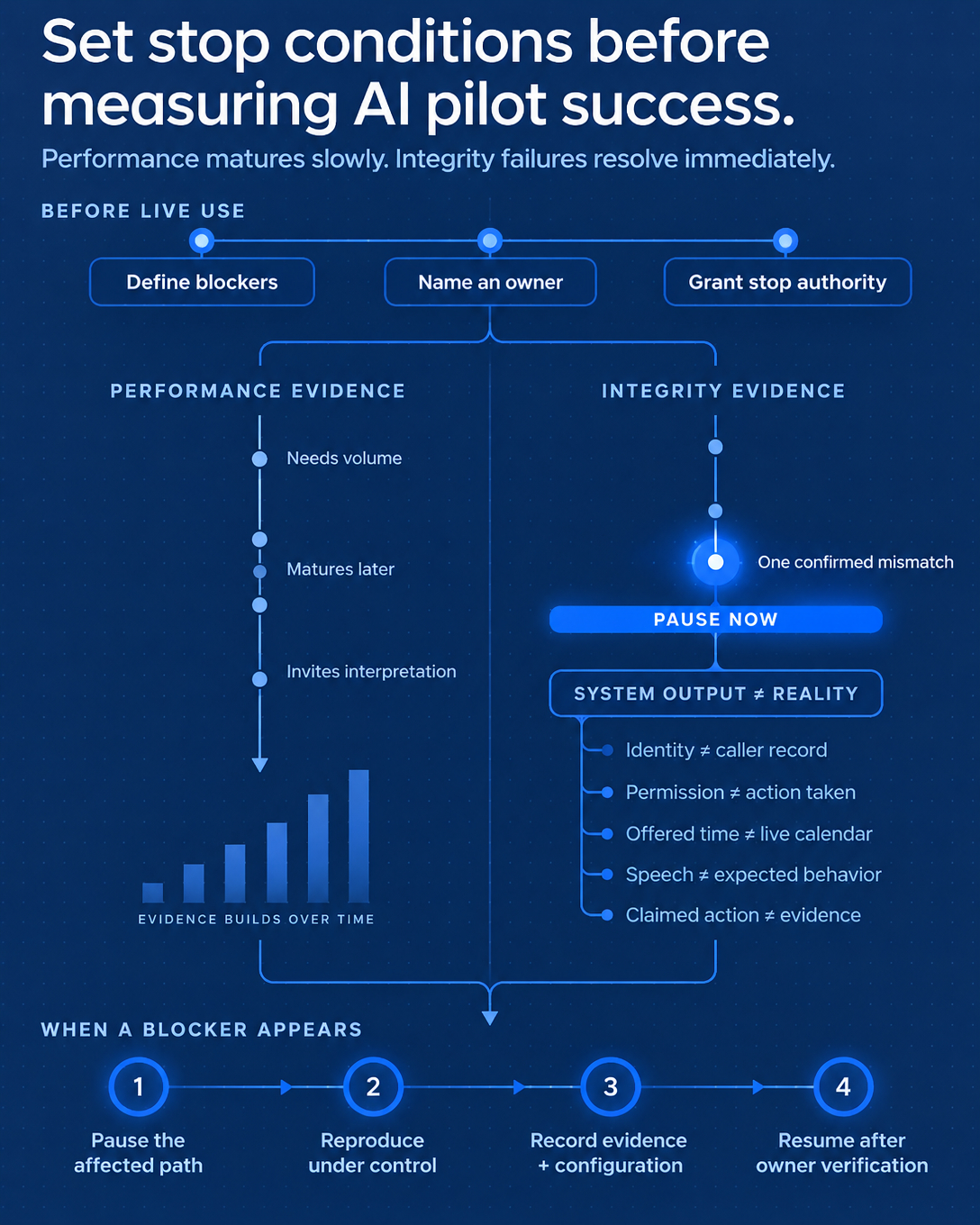
Many teams run an AI calling pilot, collect results, and then decide what counted as success. That sequence puts the hardest decision at the moment when the team is least neutral about the answer.
There is a better order. Before a single live call goes out, write a short list of behaviors that would stop the rollout. Stop means stop. The list exists so nobody has to argue about it mid-pilot.
This article explains why explicit blockers carry more decision weight than success metrics, how to assign an owner to each one, and what to do when a blocker appears while calls are running.
Why Blockers Outperform Success Metrics
Success metrics mature slowly. Meetings need to be booked, held, and accepted before a conversion number means anything. A pilot can run for weeks before the success data is usable.
Blockers resolve immediately. One call with the wrong caller identity tells you something right now. You do not need a sample size to act on it.
Success metrics also invite negotiation. A booking rate of 2 percent instead of 3 percent becomes a discussion about lead quality, timing, and scripts. A blocker invites no negotiation. The system invented a calendar slot that does not exist, and the pilot pauses.
Execution that cannot be traced is theater. Blockers are how you enforce that standard before the volume makes enforcement expensive.
The Blockers Worth Writing Down
Your list should fit on one page. These five belong on almost every outbound calling pilot:
- Wrong caller identity. The agent misrepresents who is calling or on whose behalf. This is a trust failure and often a legal one.
- Ignored contact restrictions. A person who opted out gets called again. One confirmed case stops the campaign.
- Invented availability. The agent offers a meeting time that does not exist in the connected calendar. Every downstream record built on that call is fiction.
- Repeated speech loops. The agent restarts its introduction or repeats a message to a live person. The recipient experiences a broken system wearing your name.
- Actions reported complete without evidence. The system claims a booking, transfer, or follow-up happened and the connected record shows nothing. This is the most dangerous blocker because it corrupts your reporting quietly.
Notice what unites these. Each one is a case where the system produced an output that cannot be reconciled with reality. That is the category you are guarding against.
Every Blocker Needs an Owner With Stop Authority
A blocker list without a named person is a suggestion. Assign one owner per blocker and give that owner the authority to halt calling activity without a meeting.
The assignment should answer three questions in writing:
- Who reviews the evidence when a suspected blocker appears?
- Who can pause the campaign, and through what mechanism?
- Who decides whether the pilot resumes, and against what proof?
Put the compliance-adjacent blockers, caller identity and contact restrictions, with someone outside the team that wants the pilot to succeed. Incentives shape judgment, and the person measured on booked meetings should review booking evidence, and nothing related to consent.
Governance precedes scale. A pilot without stop authority is a rollout that has already started, just without anyone admitting it.
What to Do When a Blocker Appears Mid-Pilot
First, pause the affected calling path. A pause is cheap. A second occurrence of the same blocker is expensive in trust, data quality, and sometimes regulatory exposure.
Second, reproduce the behavior with an authorized tester before diagnosing it. A single recording tells you the failure occurred. It does not tell you why. Change one setting at a time and confirm the result against your baseline configuration.
Third, record the incident beside your pilot scorecard: what happened, the configuration version, the evidence links, and the fix. Keep the failing example. Future reviewers will need it when the configuration changes again.
Resume only when the owner accepts the evidence that the behavior is corrected. Acceptance means a passing test of the same scenario under the same conditions, written into the record.
Blockers Make the Expansion Decision Honest
At the end of the pilot, your decision record should show three things: which success thresholds were met, which blockers were triggered, and how each triggered blocker was resolved.
A pilot with strong booking numbers and an unresolved blocker is a repair project. A pilot with modest numbers and a clean blocker record is a candidate for careful expansion. The blocker list is what lets you tell those two apart without arguing.
Write the list this week, before the pilot starts. Name the owners. Give them stop authority in writing. The teams that do this scale on evidence. The decision becomes an inspection instead of a debate.