
The demo works. The agent sounds natural, books a test meeting, and the team gets excited. Ninety days later, the pilot sits in limbo. Nobody can say whether it passed.
The technology rarely causes this. The missing piece is agreement. Research on enterprise AI shows that 73% of failed projects had no agreed definition of success before they started, while projects with quantified metrics defined upfront succeed at 54% versus 12% without them. That is the most fixable problem in the entire buying process, and it is commonly skipped.
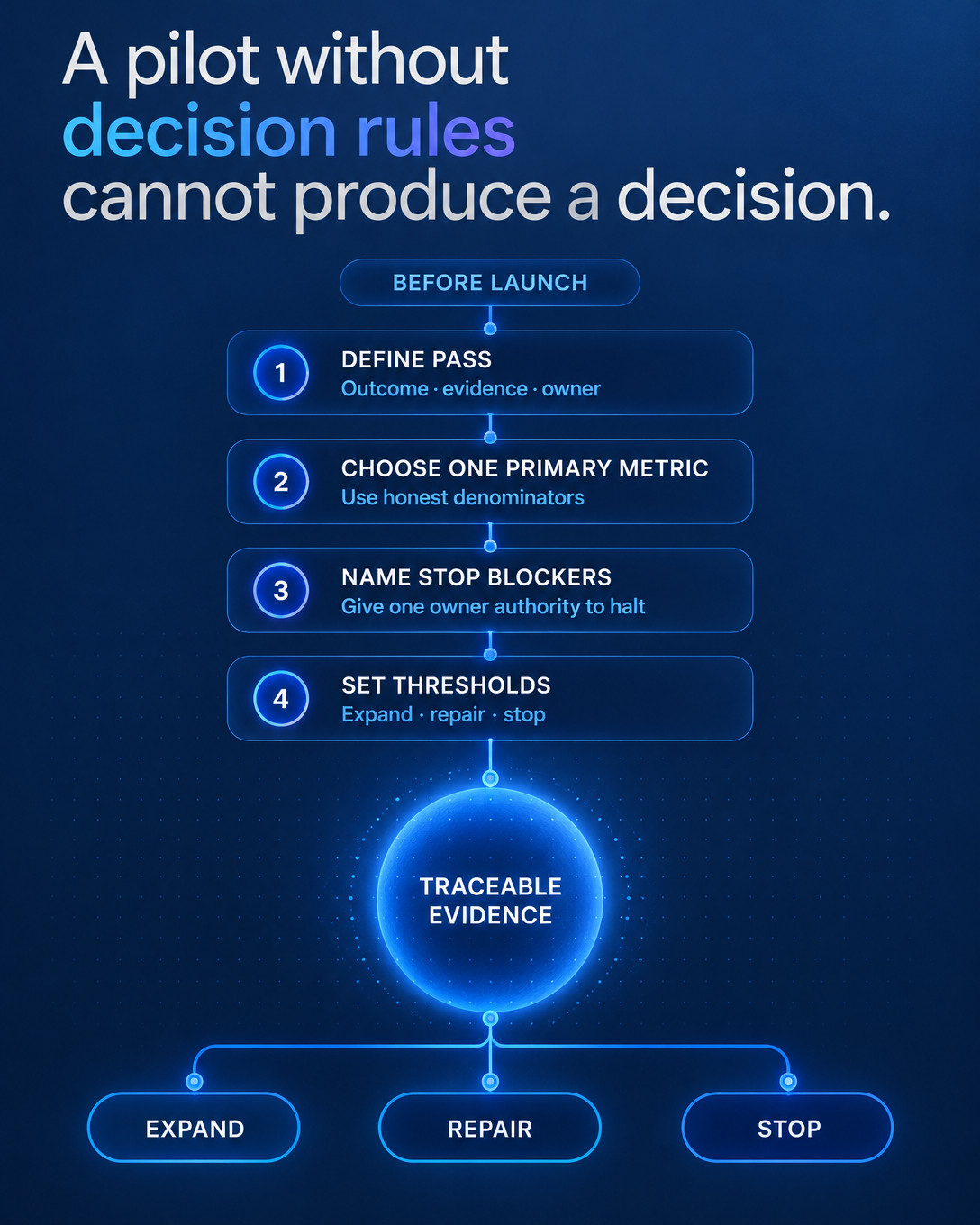
Four decisions, made before launch, keep a pilot from becoming a sunk cost. Skip any one and the pilot drifts.
Decision 1: Write the Acceptance Definition
Define what a passing result looks like in one written statement. For an outbound campaign, that means specifying buyer fit, what counts as a held meeting, what evidence proves attendance, and who accepts the outcome.
A booked time, a completed conversation, and an accepted opportunity are three different events. Each needs its own status and its own evidence. When you collapse them into one number, the pilot report becomes fiction.
Name the person who signs off. If nobody owns acceptance, every meeting gets counted and nothing gets verified.
Decision 2: Pick One Primary Outcome Metric
Choose the metric before you see results. For a meeting-led campaign, cost per qualified meeting held works well: total attributable campaign cost divided by qualified meetings that actually happened.
Resist borrowing an industry conversion rate to make the forecast look complete. The MIT research that found 95% of generative AI pilots showed zero measurable profit impact also revealed the mechanism: success criteria that were never written down, integration budgets that never existed, and teams that were never asked.
Track the full funnel with honest denominators. Keep unique contacts separate from dialing attempts. Label every rate with the cohort and period it covers. If a denominator is zero, report the ratio as undefined rather than inventing a number.
Decision 3: Agree on Rollout Blockers
Quality failures need a stop switch, and someone with authority to pull it. Write the blocker list before the pilot: wrong caller identity, ignored contact restrictions, invented availability, repeated speech loops, and actions reported as complete without evidence.
Blockers protect two things at once. They protect the prospects your agent contacts, and they protect the credibility of the pilot itself. A pilot that produced meetings while violating contact restrictions failed, regardless of what the dashboard says.
Assign one person who can halt activity without a committee. Speed matters when a blocker fires in production.
Decision 4: Set Expansion Thresholds
Decide in advance what result justifies scaling, what triggers repair, and what forces a stop. Set the thresholds from your own margins, capacity, and sales process rather than from vendor benchmarks.
This decision matters more now than it did two years ago. In 2025, 42% of companies abandoned most of their AI initiatives, up from 17% the year before. Pilots without evaluation criteria accumulate positive anecdotes, persist by default, and then get cut in a budget review that nobody can argue against.
Three outcomes, defined before launch, prevent that drift. Expand when the observed workflow and economics meet your rules. Repair when the evidence identifies a correctable issue. Stop when a critical blocker or missing evidence prevents an accepted result.
Why This Discipline Pays
These four decisions share one requirement: traceability. Execution you cannot trace is theater, and a pilot built on theater will never survive contact with your finance team.
The work takes a few hours before launch. An acceptance definition, one primary metric, a blocker list with an owner, and written expansion thresholds. That is the entire investment.
Bring those four documents to every vendor demonstration. Ask the team to walk through the configured workflow and show you exactly which evidence their system retains for each decision. A vendor that welcomes that scrutiny built something real. A vendor that redirects you back to the demo told you everything you need to know.
Run the pilot against your own rules, on your own cohort, with your own baseline. The result will be a decision you can defend, which is the only outcome a pilot owes you.