
I have reviewed dozens of failed AI voice pilots. The pattern is consistent enough to state plainly.
The AI performed. The calls sounded good. Prospects engaged. The transcripts read clean.
And the pipeline never moved.
The failure almost never happened during the conversation. It happened after it, in the space between the call and the next committed action. Nobody instrumented that space. Nobody owned it. So intent dissolved into noise, and the pilot got blamed on the model.
That misdiagnosis is expensive. It sends teams shopping for a better AI when the AI was fine. The handoff was broken.
The Anatomy of a Silent Failure
Here is the sequence I keep finding when I dig into a stalled pilot.
The call ends. The AI captured a booking request, a callback commitment, a qualification signal. Then that outcome had to travel: into a CRM, onto a calendar, into a rep's queue.
That journey was never designed. It was assumed.
- The booking wrote to a system nobody checked
- The callback landed in a queue with no owner
- The qualification data never synced to the record the rep actually opened
- Nobody could answer what happened after the call, for any call
Each gap looks small. Together they turn a successful conversation into a dead lead.
The call looked fine. The pipeline told the truth.
Why This Gets Misdiagnosed
Teams measure what is easy to see. Call analytics are easy to see. Handoff integrity is invisible unless you build for it.
So the reporting deck shows call volume, connection rates, sentiment scores. All green. Meanwhile the metric that matters, the rate at which a call's intent becomes a committed outcome, has no name in most organizations and no dashboard anywhere.
I call it execution fidelity.
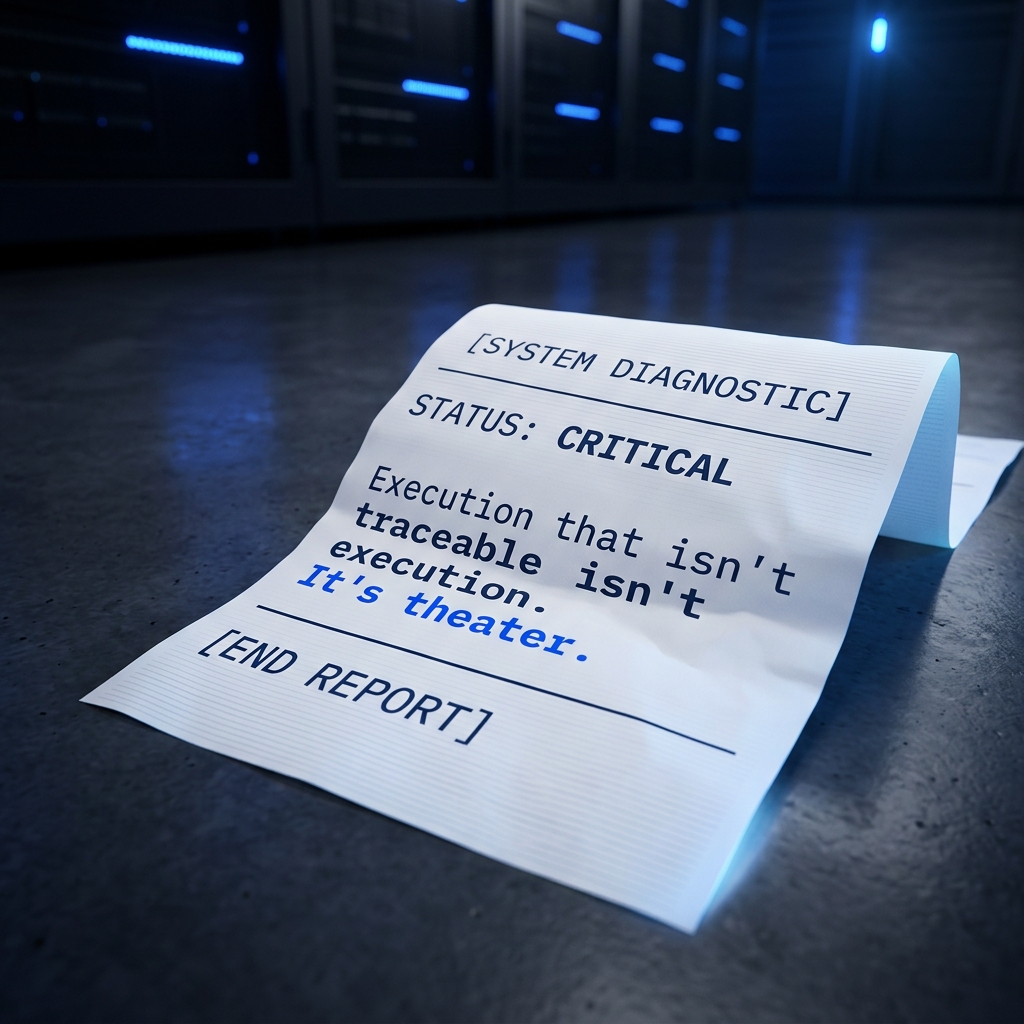
Execution that isn't traceable isn't execution. It's theater.
When execution fidelity goes unmeasured, the postmortem defaults to the visible layer. The model gets blamed. The vendor gets swapped. The next pilot inherits the same uninstrumented handoff and dies the same death, six months later, with better transcripts.
What the Handoff Actually Requires
If you are running or planning a voice pilot, here is what I would instrument before the first call goes out.
1. Define the committed outcome per call type
A booking call succeeds when a meeting exists on a calendar with a confirmed owner. A callback succeeds when the follow-up fires on schedule. Write these definitions down. Vague success criteria produce vague pipelines.
2. Trace every outcome end to end
Every call should produce a record that answers one question: what happened next, and can you prove it. If the answer requires asking three people, you have a visibility problem disguised as a performance problem.
3. Assign ownership to the gap itself
The space between the call and the CRM needs an owner the same way the call script does. This is commonly overlooked because the gap sits between teams, and things between teams belong to nobody by default.
4. Build for failure before scale
Governance precedes scale. A handoff that breaks quietly at 50 calls breaks catastrophically at 5,000. Systems should fail closed, with caps and explicit policies, so a broken sync surfaces as an alert instead of a quarter-end surprise.
💡 Tip: Before your next pilot review, pull ten completed calls and trace each one to its committed outcome by hand. The gaps you find in that hour will explain more than any model benchmark.
The Bigger Signal
The prevalence of this failure tells you something about where the industry sits. Most organizations adopt AI voice as a conversation layer and treat everything downstream as someone else's plumbing.
That framing wastes budget and erodes trust in tools that were never the problem.
The teams that get this right treat voice AI as infrastructure. They design the closed loop first: call, outcome, record, next action, proof. The conversation quality matters, and it matters as one component inside a system that has to hold together under commercial pressure.
Deterministic outcomes beat conversational fluency every time an operator has to defend a number.
So when your next pilot review comes around, look past the transcripts. Ask what percentage of call intent became committed, verifiable action. That number is your real pilot result.
The layer where conversation becomes commitment is the layer worth building. Everything upstream of it is just audio.